- Print This Post Print This Post

By John Helmer, Moscow

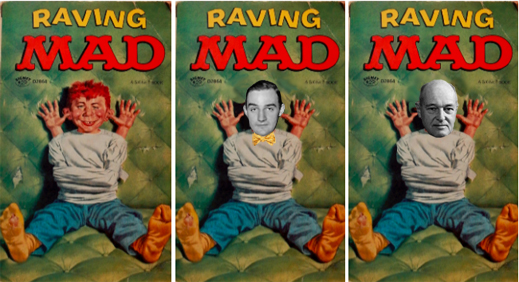
Joseph Alsop (lead image, centre) and George Kennan (right) started the kind of Russia-hating in Washington which,  today, President Vladimir Putin, like the businessmen around him,  think of as a novelty that cannot last for long.

Alsop was a fake news fabricator, and such a narcissist as to give the bow-ties he wore a bad name. Kennan was a psychopath who alternated bouts of aggression to prove himself with bouts of depression over his cowardice. For them, Russia was a suitable target. The Washington Post was the newspaper which gave their lunacy public asylum. This, according to a fresh history by a university professor from California, started in 1947, long before the arrival in Washington of the anti-communist phobia known after the name of Senator Joseph McCarthy.

Russia-hating was an American upper-class phenomenon, cultivated in the offices, cocktail parties, clubs, and mansions of the deep state, as it emerged out of World War II. It needed a new enemy to thrive; it fastened on Russia (aka the Soviet Union) as the enemy.

McCarthyism was an American lower-class phenomenon. It focused on the loyalty or disloyalty of the upper-class deep-staters. That wasn’t the same thing as Russia-hating; Wall Street bankers, Boston lawyers, homosexuals, Jews, communists, were all the enemy. As the Senator from Wisconsin characterized it himself in 1952, “McCarthyism is Americanism with its sleeves rolled.” He implied – without a middle-class tie; certainly not an upper-class bow-tie.

Russia was not an enemy which united the two American lunacies, for they hated each other much more than they hated the Russians. The Soviet Politburo understood this better then than the Kremlin does now. (more…)

- Print This Post Print This Post

By John Helmer, Moscow

When you are a Russian oligarch with a 20-year record of settling out of court with friends, partners and investors accusing you of deceit; when you have a 7-year record of failing to sustain your share value in a genuine stock market, what do you do next? You announce to a neophyte Financial Times reporter that you are selling your shares on the London Stock Exchange with the price underwritten by an anchor investor from China. The newspaper provides free advertising. Noone asks the Chinese anchormen why they are spending money on a business combining Russian electricity and Russian aluminium whose separate parts other Chinese investors have nixed many times before.

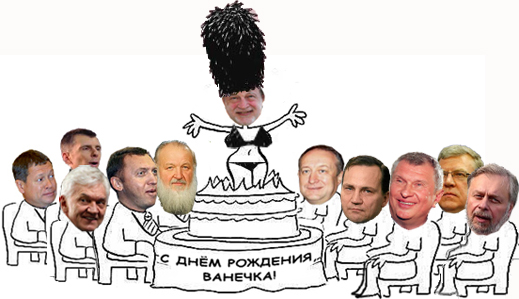
Answer: the deal is guaranteed by the Chinese and Russian states, with an assured premium in a secret buy-back option.  The Russian state aluminium monopoly Rusal, is now the Chinese-Russian state aluminium monopoly, plus the Siberian electricity utilities, Eurosibenergo and Irkutskenergo.   So long Oleg Deripaska (lead image)! Howdy-doo Vladimir Putin and Xi Jinping!  

Hold on, says an insider familiar with the Rusal board deliberations:  “the London IPO which Oleg Vladimirovich is now promoting looks like a test of foreign investor resistance to sanctions, combined with a bet on the rising price of aluminium. Who in his sober mind would now invest into a fully state-controlled company such as Rusal or En+?  Only investors fully backed up or financed by the state. But is Deripaska sharing Kremlin control with Beijng control?  Unlikely — so this is a fake privatization, just like the Rosneft share sale.” (more…)

- Print This Post Print This Post

By John Helmer, Moscow

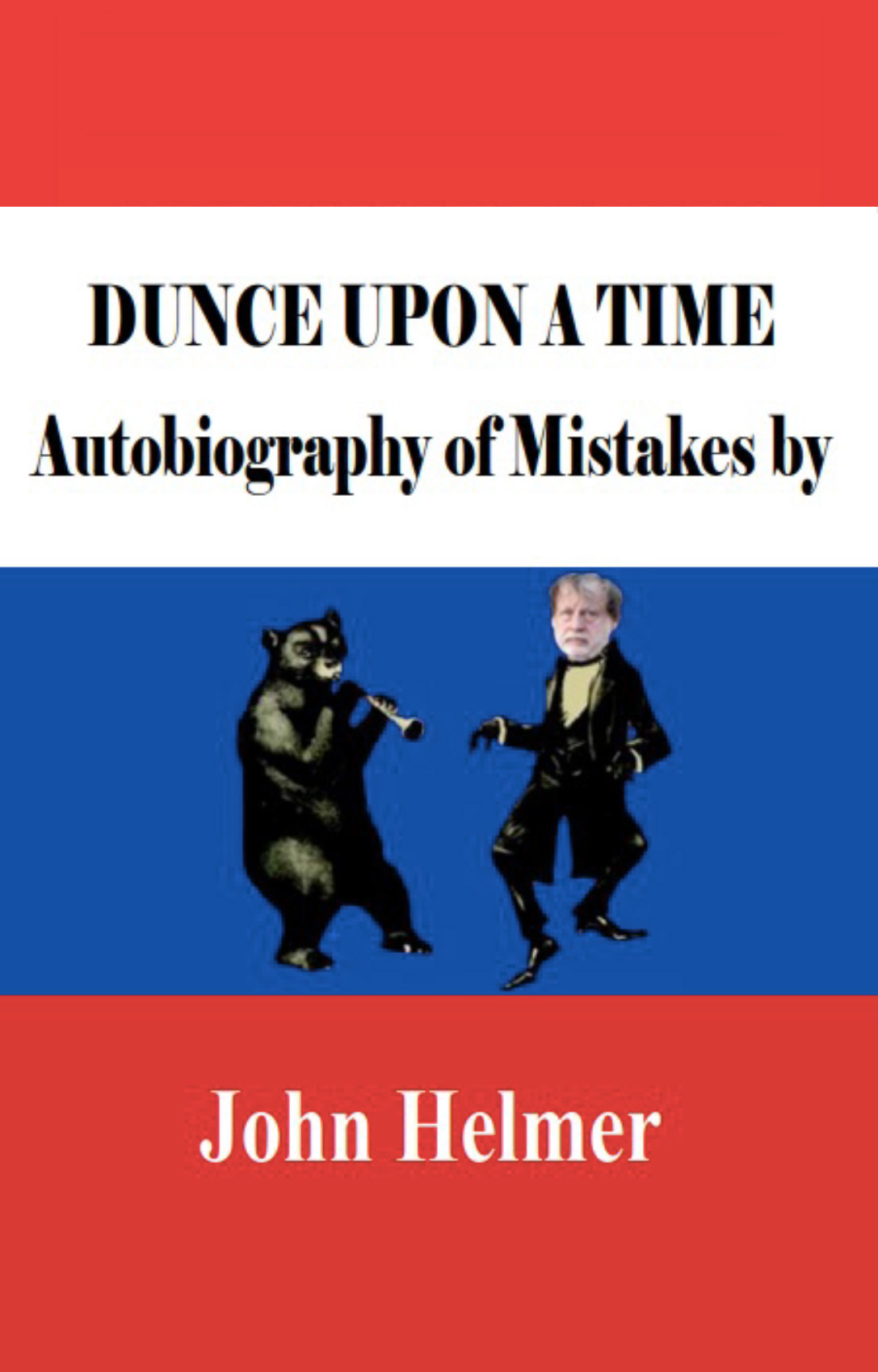
The first Dance with Bears appeared fifteen years ago.  It began as a short commentary appearing once or twice a week. The title came from Astolphe de Custine, the greatest observer of Russia ever to be obliged to conceal what he was writing inside his hat, as the Russians he was writing about chased him across the frontier. That circumstance made for pithy style, sharp focus.

In 1839 de Custine had written: “Such ill-bred and yet well-informed, well-dressed, clever, and self-confident Russians are trained bears, the sight of which inclines me to regret the wild ones: they have not yet become polished men, and they are already spoiled savages.” His book drew denunciations in the Russian press at the time, and was banned in Russia until 1996.

One of the subtlest – make that most duplicitous and cowardly of Russia-fighters among Americans, the State Department official George Kennan wrote that de Custine had produced “the best guide to Russia ever written”, and then proceeded to argue that when de Custine referred to Tsar Nicholas I, Kennan meant the same judgements to apply to Joseph Stalin and his heirs. Like most of what Kennan wrote for his own circle of spoiled savages, he was half-right, half-wrong – make that, mostly wrong. In 1991, twenty years after Kennan had pontificated about de Custine, the collapse of the communist regime in Moscow released forces which had been under control, more or less, for seventy years. This allowed the savages to revert to the type de Custine had observed. Kennan and his successors called that democracy and did more than applaud.  Look where that has got them now. (more…)

- Print This Post Print This Post

By John Helmer, Moscow

Rosgeologia is a small Russian state company which once held the record for drilling the deepest hole in the Earth’s crust. Its biggest discoveries of oil, gas and hard-rock minerals lie in its Soviet past. Even with current contracts from the state oil and gas companies Rosneft and Gazprom, it holds only a small share of the Russian market for seismic and geophysical services; its margin for profit, according to the state auditor, is just above break-even.

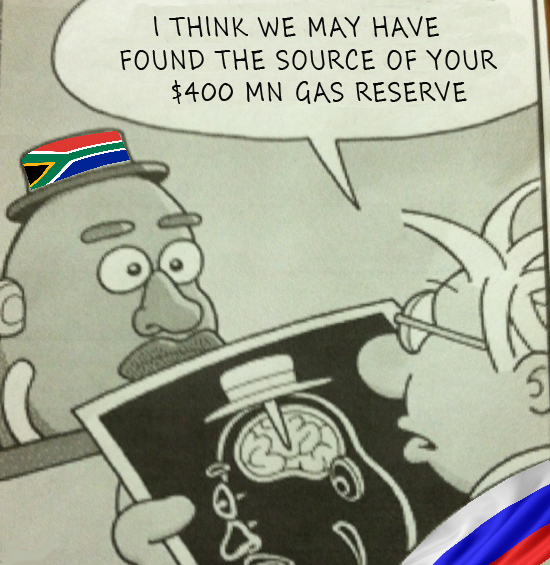
Last month, Rosgeologia (“Russian Geology”, Rosgeo for short) announced what should be a new record for Russian state investment in South Africa, drilling six super-deep wells into the seabed off the South African coast at a cost of almost $400 million, earning the right to sell billions of dollars’ worth of gas. Hours later when they met, President Vladimir Putin and President Jacob Zuma ignored the deal entirely.   Russian experts in Moscow say they haven’t heard of it. The three top officials of Rosgeologia refuse to explain what they have contracted to do.  When one of them, Roman Panov, Rosgeo’s chief executive, advertised his company’s future prospects in a lengthy interview with a Moscow newspaper, the South African offshore oil and gas project wasn’t mentioned at all.

The reason, Moscow sources say, is that they are sceptical Rosgeo has the resources to implement the deal, or that the Russian state banks will accept the risk of South African default.  The reason for that, Russian sources add, is that they believe the Zuma administration is too weak politically, too unstable, and with too little time left in Zuma’s mandate to implement the project. A Russian source is worried that President Zuma aims to  take as much cash from Rosgeo as he can, and run.

South African allegations of involvement in the Rosgeo deal of a Zuma family member, as well as political allies of the president who were at Rosgeo in Moscow recently, threaten to expose the terms of the still secret contract with PetroSA, South Africa’s state oil company, to a High Court challenge for violations of the South African Constitution. That and associated statutes on the management of public money require the Rosgeo-PetroSA deal to be “in accordance with a system which is fair, equitable, transparent, competitive and cost-effective.”   Skepticism about this has already been hinted in a ruling by a South African judge in the High Court in Cape Town on September 22.

The blanket refusal of Rosgeo, the Russian state banks, and PetroSA to answer questions about what they have agreed is a sign of their fear the deal will not survive the transparency test. (more…)

- Print This Post Print This Post

By John Helmer, Moscow

The grand house domestic serial which has been one of the staples of British television is quite impossible in Russia. That’s not because pre-revolutionary Russia lacked the aristo palaces and gilded families, or that nostalgia isn’t popular on television. It’s because the gap between the upstairs family and the downstairs servants was always too wide in Russia – and always too cruel.

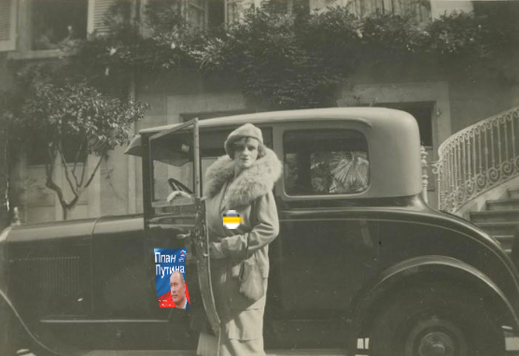
It’s not different today. The recent promotion in London and republication of the stories and memoirs of Teffi (lead image), the short-story fabulist, memoirist, poet and playwright who left Russia for Paris in 1919, illustrates the point – and not much else. (more…)

- Print This Post Print This Post

By John Helmer, Moscow

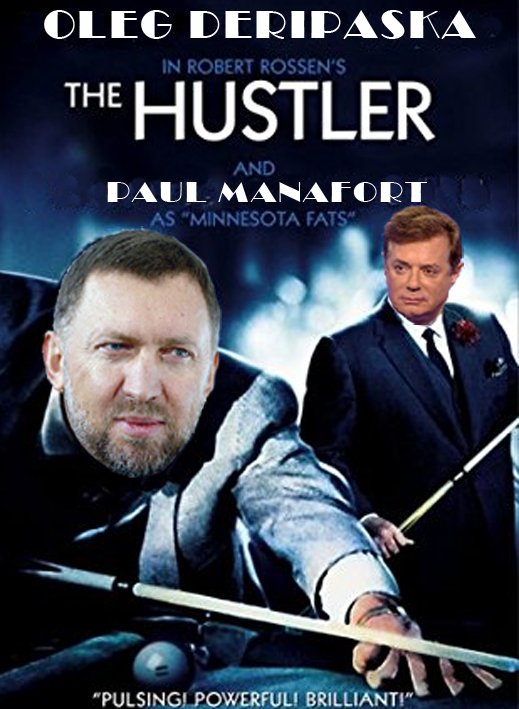
Oleg Deripaska (lead image, left) is famous for snatching other people’s money and legging it.

The records of the High Court in London show what he did to Mikhail Chernoy (Cherney), Boris Berezovsky, and Roman Abramovich. Chernoy recovered $200 million in 2012;  click to open

Only two people have ever taken Deripaska’s money and legged it themselves. One was Anthony Louis, owner and editor of the Moscow Tribune,  the first English-language newspaper published in Moscow. Louis took several thousand dollars in exchange for shares to keep his paper afloat but never handed over the shares to Deripaska. The newspaper sank without trace in 2002.

In April 2008 Paul Manafort (lead image, right) took $18,938,400 from Deripaska in return for which he promised to invest up to $100 million in Ukrainian cable television and telecommunications companies. Manafort trousered the cash, or so Deripaska has alleged in court, as he  has been trying to get his money back. 

But Manafort’s hustle has been reported in US newspapers as an attempt to promote Kremlin influence in US elections, especially the one which put Donald Trump into the White House last November.  The evidence for the subversion claim is now being gathered by the Special Counsel Robert Mueller, and reported publicly by leaks of what his investigation has placed in evidence before a grand jury. These include CIA, NSA and FBI surveillance and wire taps of Manafort during the presidential election campaign – yes, during the presidential campaign — and afterwards. (more…)

- Print This Post Print This Post


By John Helmer, Moscow

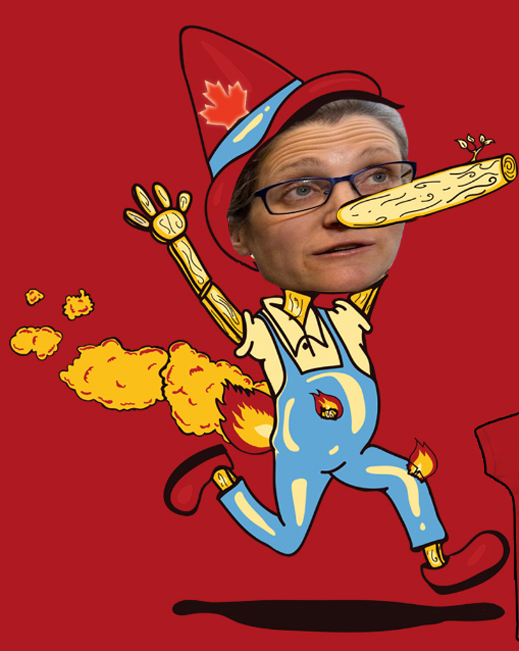
Her Majesty Raina the Queen Consort of the Hashemite Kingdom of Trans-Jordan, and a Palestinian by birth, has announced that Justin Trudeau, Prime Minister of Canada, is “a father, a feminist, a moral leader, a global citizen.” She was speaking at the Atlantic Council’s global citizenship awards  in New York on Tuesday evening.

As she presented the award bottle to Trudeau with a symbol of the world as a stopper, she introduced Trudeau as “the spirit that shines so very brightly in this northern star”. To help them swallow that, the audience was also presented by a commercial Canadian sponsor with glasses of another star spirit, Zirkova vodka.

That turns out to be a Ukrainian brew which its owner,  John Vellinga,  called after the Ukrainian word for star, zirka (зірка). It’s also a brew for which Trudeau’s predecessor as prime minister, Stephen Harper, helped to modernize a distillery in the Ukraine, plus zero import duties on reaching the Canadian border, plus endorsement from the US-financed, Kiev-based investment fund Horizon Capital, created with State Department money by Natalie Jaresko, US diplomat turned Ukrainian finance minister turned US official again, and her protégé, a Ukrainian-Canadian named Lenna Koszarny(more…)

- Print This Post Print This Post

New broadcast by Chris Cook with John Helmer, Victoria, B.C., Canada

Listen to the discussion of Canada’s Foreign Minister Chrystia Freeland’s special relationship with George Soros, Victor Pinchuk,  and the Galician liquidationist lobby which The Real News Network didn’t allow to be broadcast in the US. (more…)

- Print This Post Print This Post

By John Helmer, Moscow

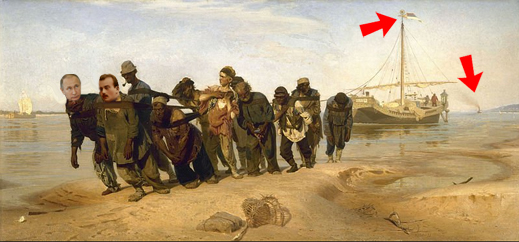
You might say that Russian realism as the style of painting embodying the national spirit, came into its own with “Barge Haulers on the Volga” (lead image), the famous oddity painted by Ilya Repin over three years, 1870-73, following his graduation from the Imperial Academy of Arts in St. Petersburg.  

The canvas depicts a team of burlaki towing a vessel through the Volga sandbars, its sail furled under a headwind strong enough to fill the sail of the barge on the far side of the river.  On the masthead the Russian flag is flying upside down, blowing from left to right. Up river in the distance, there is a motor vessel, its coal-fired smokestack blowing from right to left.   

The painting was commissioned,  paid for,  and hung on his palace wall by Grand Duke Vladimir Alexandrovich Romanov (lead image, front right), son of Tsar Alexander II (ruled 1855-81); brother of Tsar Alexander III (ruled 1881-94), and cousin of the last Romanov tsar, Nicholas II (1894-1917). The duke, the Imperial Academy, and the intelligentsia of St. Petersburg and Moscow considered Repin’s work a portrait of the wretched conditions to which the Russian rural population was subjected, and thus a symbol of the fortitude of Russian people. According to Fyodor Dostovevsky at the time,   what he saw in the painting was “barge haulers, real barge haulers, and nothing more… you can’t help but think you are indebted, truly indebted, to the people.” The master was myopic, insincere, patronising. But note the term, real — we are coming back to it. (more…)

- Print This Post Print This Post

By John Helmer, Moscow

The collapse of Otkritie Bank last month is the largest Russian bank failure since the collapse of National Bank Trust in December 2014.  The Central Bank rescue of Trust made inevitable the much more costly bailout of Otrkitie, announced a fortnight ago on August 29,   charges Ilya Yurov, the former control shareholder and chief executive of Trust, speaking from exile in the UK.  

The reason, according to Yurov, is “the dishonest and deliberately malicious actions of the management and shareholders of Otkritie Bank, and also, unfortunately, a number of officials of the Central Bank of Russia and the Deposit Insurance Agency.”   The state organizations, Yurov alleges,  “continue to adopt dishonest practices when initiating their processes of ‘financial rehabilitation’ or the prevention of bankruptcy of the Russian banks, which inevitably lead to the violation of the rights of customers and bank lenders,  and significantly worsen the situation of the financial industry as a whole.”

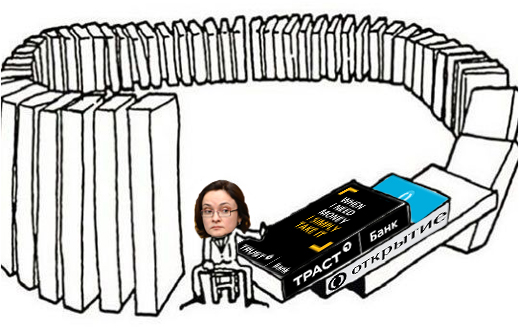
Bank analysts and investors in the Russian banks say the combination of failures reveals grave weaknesses in the Central Bank’s supervision. “The black holes in the Russian banking system are expanding,” believes a London banking source. “The more money the Central Bank lends to stop bankruptcy, the faster the cash disappears. Sooner or later, the falling dominoes will come down on [Central Bank Governor Elvira] Nabiullina [lead image] herself.”

Between December 2014 and May 2015 the Central Bank loaned Rb127 billion ($1.7 billion) to Otkritie for the takeover of Trust in what Russian bankers call a “sanitation” – a state funded bailout, administered by the Deposit Insurance Agency (DIA)  which stops short of bankruptcy, court-ordered administration, or liquidation.

Then late last month,  after Otkritie depositors lost confidence in the bank and withdrew Rb693 billion ($11.6 billion)  from Otkritie accounts in June,  July, and August,   the Central Bank topped the senior management and board, froze transactions, and commenced fresh lending to preserve Otkritie’s solvency. In exchange for the new cash, the Central Bank now owns 75% of the bank’s shares. Over the coming weeks, from Rb250 billion ($4.3 billion) to Rb400 billion ($6.9 billion) will be the Central Bank bailout required, a deputy governor at the bank announced on September 1. 

Yurov has been charged in Russia with defrauding Trust, triggering the bank’s failure after related-party lending to a network of offshore companies, which Yurov controlled, drained the bank of its cash. Up to $1 billion has been reported as unaccounted for, if not exactly lost. Early this year two of Yurov’s subordinates at the bank were tried and convicted of embezzlement from the bank, using fake loan papers.  

In London and New York Yurov is counter-charging the now ousted chief executive and control shareholder of Otkritie, Vadim Belyaev,  and the next most powerful shareholder on the Otkritie board, Ruben Aganbegyan,  with conspiracy to attack Trust, push it into sanitation,  and withdraw Trust’s cash for themselves through Otkritie. Yurov is also accusing three Central Bank officials at the time of being participants in the cash-and-grab conspiracy.

“Yurov is not a credible accuser,” a Central Bank veteran commented in Moscow. “As the old Russian saying has it, Вор у вора дубинку украл – a thief is stealing a bludgeon from another thief.” (more…)