
- Print This Post Print This Post


This image has an empty alt attribute; its file name is twee-3-1024x831.png

By John Helmer, Moscow
  @bears_with

The Trump Administration and its NATO allies are clear:

They will escalate their war against Russia at sea, deploying their navies to enforce trade blockades, ship sabotage and seizures, and the closure of sea lanes, and to launch “pre-emptive” attacks before their targets can defend themselves. This is sea war to achieve regime change on land.

Trump’s current targets are Iran, Venezuela, Cuba, Russia, North Korea, China, and India.

Secretary of State Marco Rubio told a Senate Committee hearing on Wednesday that if these targets attempt to deter the US escalation by raising their guard, the US Navy will shoot first.

“It’s wise and prudent,” Rubio said, “to have a force posture within the region that could respond and potentially, not necessarily what’s going to happen, but if necessary, preemptively prevent the attack against thousands of American servicemen and other facilities in the region. And our allies. I hope it doesn’t come to that, but that’s I think what you’re seeing now is the ability to posture assets in the region to defend against what could be an Iranian threat against our personnel.”  

The Putin Administration is less than clear on what it will do to defend its flag vessels and the oil cargoes it is dispatching to its allies.

On the Anglo-American operation to seize the Russian-flagged tanker Marinera, off the west coast of Scotland on January 7, the Russian Foreign Ministry announced it was an act of piracy, not an act of war against the Russian flag nor an act of war as trade blockades are treated in the United Nations Charter.  

According to a legal source close to Moscow, the US warrants for the seizure of the Marinera  and arrest of the master and crew claim the vessel was operating in violation of US sanctions against Iran, not US sanctions against Russia.   

There has been no explanation for the failure of the Marinera’s Russian naval escort, a submarine and a corvette, to defend against the “pirates”. The Foreign Ministry spokesman, Maria Zakharova, called for release of the two  Russian crew on the vessel, and then thanked the US for their release. When this did not materialize as advertised, the ministry complained of the delay. On January 28, the two Russians were released and were “on their way home”, according to Zakharova.  

The captain and first officer of the vessel appear to have been Georgian; they remain under arrest in the UK on an extradition application by the US for prosecution in a US court. The two Russians and the Indian majority of the 26-man crew are being released and repatriated “in line with standard UK immigration and legal procedures”.   No favour has been shown by either the US or the UK to the Russian Foreign Ministry.

On January 22, the French military attacked and seized the tanker Grinch in international waters of the Mediterranean, off the Spanish coast, and took the vessel and crew to Marseille. The  Comoros-flagged vessel was carrying a cargo of Russian crude oil to a destination in either Turkey or India; the captain is Indian.  There has been no public Russian or Indian response in defence of the Grinch’s cargo, the vessel, or the crew.   

On the tightening of the US blockade against Cuba, including threats against blockade-busting  supplies of oil, Russian and Mexican, to the island,  Zakharova announced yesterday: “Representatives of the US administration have threatened Cuba many times, including by mentioning their readiness to blow up everyone there and trying to force Havana to make a deal…The United States has used every trick to tighten the blockade, including by adding Cuba to the infamous US list of state sponsors of terrorism…we express the hope that allegations contained in these media reports are groundless, and that common sense eventually prevails in Washington…We reaffirm our unwavering solidarity with the people and authorities of fraternal Cuba.”  

Russian sources believe the Kremlin’s will and the Russian Navy’s readiness to defend against these attacks are wavering. According to Oleg Tsarev, the Crimea-based leader of the Ukrainian opposition, this is “the art of great maritime patience.”

 “The EU”, Tsarev wrote on January 27, “intends to close the Baltic Sea for the shadow fleet of Russia…Almost half of the offshore oil export from Russia goes through the Baltic Sea. Now the conditions are being created in which every exit of a Russian tanker from the Baltic can end with its arrest or forced entry to [EU] port for inspection… When the EU moves from words to deeds, the flow of Russian oil through the Baltic will lead to disastrous consequences for the budget and put the state on the brink of survival. Russia may continue to exercise the art of great maritime patience but in case of detention of Russian tankers in the Baltic Sea, you need to have a plan with specific countermeasures.”  

On the escalating US threat against Russian use of the Arctic sea lanes – the Northern Route, as it is known in Russian – President Vladimir Putin announced on January 21: “what is happening around Greenland does not concern us in any way.”   No public elaboration has followed in Moscow.  

On the new declaration of the Baltic and North Sea states, issued on Monday, to  stop and seize Russian oil cargoes and the tankers carrying them, whether Russian flagged or not, has so far drawn no public Russian Government reaction. The declaration explicitly blames the Russian alternative fleet running the gauntlet of US and EU sanctions for creating “new emerging safety situations…particularly in the Baltic Sea region. These disturbances, originating from the Russian Federation, degrade the safety of international shipping. All vessels are at risk.”  

Vessels will be stopped and seized, the document proposes, if they “sail under the flags of two or more states”; if they turn off vessel identification and tracking signals; if they “conduct ship-to-ship transfers without sufficient and timely notification to the coastal state in whose exclusive economic zone the transfer is to take place”; and other coastal state route conditions.  

“These are new challenges,” a well-placed Moscow source responds. “If you act like a pirate, you will be treated as a pirate.” The Russian oil exporters and transporters, the source said,  “can’t continue indulging in this. Russians cannot outrun the blockade unless they stop being pirates. If they act as pirates, it’s not an act of war to stop them.” The source adds: “we must begin by flying the Russian flag, crewing the vessels with Russians, and deploying armed units on each vessel. That was the method for dealing with Somali pirates. We have to take the high road – legitimize vessel registration and the cargoes. Only then can the Russians legimitately use the armed forces to defend, and also deter attacks.”

(more…)
- Print This Post Print This Post


This image has an empty alt attribute; its file name is twee-3-1024x831.png

By John Helmer, Moscow
  @bears_with

For the first time since the negotiations to end the Ukraine war began, President Vladimir Putin has sent as the chief Russian negotiator a General Staff officer and military intelligence chief, Admiral Igor Kostyukov.

The two Russians who have been closest to Putin, Vladimir Medinsky and Kirill Dmitriev, are not at the table. Neither is the Foreign Minister, Sergei Lavrov.

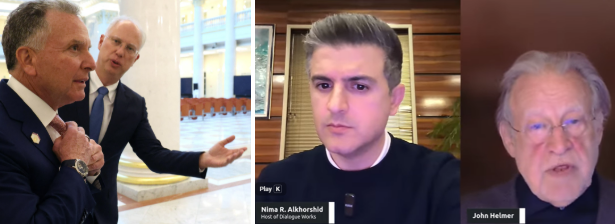
In Abu Dhabi on Friday (January 23), Kostyukov faced the Americans Steven Witkoff, Jared Kushner, Daniel Driscoll, and General Alexus Grynkewich (lead image, left). Driscoll is the Secretary of the Army, in the running to replace Peter Hegseth at the Pentagon, and a protégé of Vice President JD Vance.  Grynkewich has been in charge of the losses on the Ukrainian battlefield since May 2024 when he was head of operations at the Pentagon and then as chief of the European Command (EUCOM) from July 2025.

At Abu Dhabi each of the Americans displayed open-neck, casual clothing. This dress-down Friday costume was a calculated insult to both the Ukrainian delegation – Rustem Umerov in uniform and Kirill Budanov in suit and tie—and to the Russians, Kostyukov and his second at the table, General Alexander Fomin. Kostyukov wore a dark civilian suit and a white collared shirt buttoned at the neck. But Kostyukov’s tie wasn’t tightly drawn. Was he sending the Russian Army’s message that it hasn’t reached the point of strangulation for the other side, yet?

The American signal was that they are dictating terms; that they retain escalation control over the Russians and they must capitulate, along with the NATO allies and the Zelensky regime. This is not the “coordinating” role which, after the two-day meetings concluded, Witkoff  announced. “On Friday and Saturday, the United States coordinated a trilateral meeting alongside Ukraine and Russia, graciously hosted by the United Arab Emirates. Talks were very constructive, and plans were made to continue conversations next week in Abu Dhabi. President Trump and his entire team are dedicated to bringing peace to this war.”  

Russian sources believe Witkoff’s stop to “this war” is no stop to the continuation of the war against Russia which the US, with the NATO allies, continues to escalate on land northward to Finland and Greenland; in the nuclear arms race in space;  and at sea on all of Russia’s trade routes – the Baltic Sea through the Danish Straits, the Northern (Arctic) Route through the Bering Strait, the Black Sea through the Dardanelles, the Mediterranean, Caribbean,  and the Indian Ocean.

This larger peace is what Putin claims Trump agreed in the “understandings of Anchorage, Alaska” – the terms the two presidents discussed last August before Trump cut their meeting short and flew home.

“Naturally, we do not want to publicly go into the details of the provisions that are being discussed. And therefore, I cannot and will not tell you exactly what formula is meant by the Anchorage formula (формулой Анкориджа),” Putin’s spokesman, Dmitry Peskov, announced on Friday.

“There is a high dynamic. The Americans, as intermediaries, are rushing against time. They are in a hurry. They can be understood. This is not a quick process,” Peskov told a reporter on Sunday. “And now, in fact, the essence of the situation is that a certain formula for resolving the territorial issue was developed in Anchorage and on the eve of Anchorage. And now it is very important to implement it.”  

Peskov was not asked, and the Kremlin is not yet acknowledging, that the US side has changed Putin’s “Anchorage formula” by introducing two new conditions for “resolving the territorial issue”. They were tabled at Putin’s meeting with Witkoff, Kushner and Joshua Gruenbaum, the Chabad devotee who has joined the negotiations for Putin’s agreement to the US takeover of Gaza through Trump’s Board of Peace (BOP). The second new Trump demand to add to the “Anchorage formula” is Putin’s acceptance of the US takeover of Greenland, which Yury Ushakov acknowledged in his read-out from the Kremlin meeting.  

“During the meeting in the Kremlin, we also discussed Donald Trump’s idea of a Board of Peace, a host of regional matters and the Greenland issue,” Ushakov admitted.   

Putin’s new concessions in this three-way swap have stimulated dissent in Moscow. The Kremlin has replied with an editorial on Friday in Vzglyad, the semi-official security analysis platform, headlined: “Moscow [Putin] has made an elegant diplomatic move in a subtle game with the United States”.  

“By supporting Washington’s initiatives, the Kremlin is showing how productive an equal Russian-American dialogue can be for the whole world, and especially for its hottest regions. And how useless and counterproductive Europe is in this sense…But why should Russia indiscriminately reject this proposal? Trump is quite sincerely striving for a Ukrainian settlement, so why not assume that he is pursuing the same goals in the case of the Palestinian-Israeli conflict?… Rejecting such initiatives means cutting off opportunities for ourselves in advance, blocking one of the zones for playing on the world chessboard, and even publicly refusing to interact with the leading Western power. Moreover, the Peace Council does not currently touch upon or discuss any of Russia’s interests related, for example, to its own…It is logical that Trump, within the framework of his own dealmaking logic, considers this hint – and will be at least additionally motivated to take a respectful step in return, which is important for Russia’s interests.”  

There is no consensus among the senior policymakers on the Security Council that there is anything “respectful” in Trump’s tactics or anything to be relied upon as he continues to change his “Anchorage formula” by upping the ante.

For the Security Council, Dmitry Medvedev has announced that time is running out for Trump to accept the year-long extension of time for negotiation of new strategic arms limitation terms when the START Treaty expires in a week’s time – on February 5.  There has been “a shift in the right direction but the movement is still very weak,” Medvedev said in a lengthy interview published today. “Donald Trump is initially unstable in political guidelines… We must make sure that Washington is really ready not in words, but in practice to respect our indigenous security interests. And able to work on an equal footing on a common reduction in conflict potential.”  

“Unequal footing” — that was the signal from the dress-down US delegation in Abu Dhabi.

Strategic arms limitations “must be mutual and parallel. And this position remains in force if no clarifications follow in the US approach by February 5,” Sergei Ryabkov, the first deputy foreign minister said over the weekend.  He also conceded that there has been no follow-up on the Anchorage formula from Trump’s agencies. “It is counterproductive to hold high-level events that are later deemed fruitless.”

The Russian Foreign Ministry has also had belatedly to acknowledge that Trump has not released the Russian crew members of the Marinera, as had been announced with thanks by the Ministry spokesman,  Maria Zakharova,  on January 9.  Worse, the British Government is refusing Russian consular access to the jailed crew.  

In the new podcast from India with Lieutenant General P R Shankar and Brigadier Arun Saghal, we discuss each of Trump’s war tactics and Putin’s negotiating responses as their combination is interpreted by Russia’s strategic allies – India, China, and Iran. Click to view or listen to the Sunday morning broadcast.

(more…)

- Print This Post Print This Post

This image has an empty alt attribute; its file name is twee-3-1024x831.png

By John Helmer, Moscow
  @bears_with

It is possible that after four hours of talking until almost 4 in the morning, Yury Ushakov, the Kremlin equivalent of the US National Security Advisor, was so tired he omitted to report in his read-out a novel part of the negotiations.

Ushakov’s read-out runs for 730 words; it was posted on the Kremlin website at 04:15.  The official English translators were still asleep,  and for the time being, as this goes to print,  there is no official English version.

According to Ushakov, the US side comprised Steven Witkoff, Jared Kushner, and Joshua Gruenbaum. Ushakov omitted to list the Russian side, but the published photographs indicate they were President Vladimir Putin, Ushakov, and Kirill Dmitriev, the Russian business representative who had met the Americans in Paris earlier this week.

Ushakov identified Gruenbaum as the new participant. He described him as “a senior adviser to the White House, an expert on the economic dossier.”  Ushakov, a veteran Russian ambassador in Washington, knows this is inaccurate.

Gruenbaum, 39, a law and business school graduate in New York,    used to be a salesman for takeover and restructuring of distressed assets at two New York investment funds, Moelis and  Kohlberg Kravis Roberts (KKR).  His first job in the new Trump Administration a year ago was to take over and restructure the federal government’s contract procurement operations at the General Services Administration (GSA)  along the lines Elon Musk followed in taking over and restructuring the government’s personnel policies.  

The GSA is part-time for Gruenbaum. A GSA spokesman has claimed: “many officials serve in multiple roles. [GSA] Commissioner Gruenbaum is honored that the President has trusted him to support additional critical work that the administration is doing — a trust based on the commissioner’s track record of taking on challenging tasks and getting things done.”  

Gruenbaum’s priority is with Witkoff and Kushner. He has been an active member of the New York Jewish negotiating team with Israel’s Prime Minister Benjamin Netanyahu for the post-military control of Gaza under Trump’s Board of Peace (BOP).  In that role, Trump has just promoted Gruenbaum to become, with Aryeh Lightstone, “senior advisers to the Board of Peace, charged with leading day-to-day strategy and operations, and translating the board’s mandate and diplomatic priorities into disciplined execution.”  The Jerusalem Post reports that Gruenbaum will play “a key role in helping BoP members with day-to-day operations.”  

The connection between Gruenbaum’s role in the Gaza negotiations and his new place at the Ukraine talks is a swap —  Russian sources believe — between the militarized reconstruction of Gaza which Trump is planning and the future of the four regions of Novorossiya which Putin is planning and the General Staff are fighting for. This swap, tabled overnight in the Kremlin, is Putin’s agreement to sit on the BOP board and accept the US-Israeli plan for Gaza in exchange for Trump’s agreement to the Russian territorial terms for a Ukrainian peace settlement.

The third element in the swap was signalled in Ushakov’s read-out, acknowledging “the situation in Greenland” was also “discussed.” But Putin had already signalled his concession the evening before, January 21, in a staged question-and-answer at the Security Council. “As for Greenland. What is happening around Greenland does not concern us in any way.”  

(more…)

- Print This Post Print This Post

This image has an empty alt attribute; its file name is twee-3-1024x831.png

By John Helmer, Moscow
  @bears_with

In all large criminal gangs – racketeer influenced and corrupt organizations (RICO) as they are termed in US law  – there is always the mouth that talks tough; the pocket which collects the money; the gun that’s the enforcer. The mouth is the most expendable so long as the pocket keeps full and the gun stays loaded.

In Lucky Luciano’s enterprise, he was the first; Meyer Lansky the second; Benjamin Siegel,  Albert Anastasia and Vito Genovese the third.      

In President Donald Trump’s enterprise, he is the first; Steven Witkoff is the second; Stephen Miller is the third. Miller is currently publishing his ambition to become Trump’s National Security Advisor, replacing Marco Rubio, sidelining JD Vance, taking control of the pocket for warmaking abroad and for enforcement at home.  

On the eve of Witkoff’s new meeting with President Vladimir Putin today (January 22), the Kremlin theory is, as it was in the talks with Witkoff last year, that Putin is moving Trump the mouth through Witkoff the pocket. It has been the Iranian experience that this is a miscalculation – that the gun moves the mouth more directly, more often than the pocket.  

But in Kremlin theory, this operation is modeled on the Cuba takeover – that was Luciano’s success after Lansky negotiated bribe terms for Fulgencio Batista.  

In the podcast aired from Crimea with Regis Tremblay and Dimitri Lascaris on Tuesday evening, the aim is to predict the future from the Moscow perspective while anticipating the worst from the Montreal viewpoint. Click to view or listen: https://www.youtube.com/watch?v=ZyLgvidwVqc 

It is also explained why, in order to keep the long war going against Russia, Denmark and the NATO allies will come to terms with Trump over the future of Greenland – terms which will also save Trump the cost of bribing the Greenlanders for the deal.  

This is how history is being written with the hammer.

(more…)

- Print This Post Print This Post

This image has an empty alt attribute; its file name is twee-3-1024x831.png

By John Helmer, Moscow
  @bears_with

A quarter of a century ago, President Vladimir Putin explained to President George W. Bush the way the warfighting world really works.

“There is a contradiction between a new, young, aggressive financial Islamic capital and the old one,” Putin said.  “In reality, it is a financial issue. Religion is secondary. The real goal is to have a place in the centre of world finances, a place that is already occupied. They want to push away representatives of Jewish capital or, if not, they will try to destroy the centre and shake it up and, ultimately,  in that way to take its place. The reason for the terrorism isn’t the Middle East or poverty. They use poverty and they use unresolved conflicts. They are using other problems. These problems are not the real reasons for terrorism…I raised this not just to support you, but to say that we all have fight in the same world.”

By Jewish capital, Putin was repeating the line he remembered from his Marxist-Leninist textbooks in which the capital of Russia’s enemies in Europe and the US was inter-connected and in which the ideology of religion always reflected the underlying class struggle between capital and labour.   So far as is known, Putin hasn’t acknowledged as much at his meetings with Steven Witkoff (lead image left, with Kirill Dmitriev) and Jared Kushner. Nor has he said that the US-directed attacks on the Russian hinterland, including his own residence in Novgorod, are anything but terrorism.

Putin has also not described the US-Israeli genocide of Gaza as an enterprise of Jewish capitalism on to whose board of directors, the Board of Peace (BOP), Putin was recently invited to sit by the chairman, President Donald Trump. The Kremlin spokesman, Dmitry Peskov, has advertised the invitation which has been sent to more than fifty countries.  “President Putin has indeed received an offer through diplomatic channels to join this Board of Peace. We are currently studying all the details of this proposal. We hope to contact the US side to clarify all the details.”  

This wasn’t a Russian nyet. It wasn’t the explicit endorsement of Trump’s invitation as a political compliment – the line Belarus President Alexander Lukashenko took when he received his summons and accepted with alacrity, claiming it was US “recognition of Belarus’s international standing and Lukashenko’s personal role.”  

When Peskov was asked again, he said it is still “premature” to say Putin will join the BOP. “We do not yet know all of the details regarding the initiative on this board, whether it concerns only Gaza or includes a broader context,” he said. “There are a lot of questions about this initiative so far, and we hope to receive answers during contacts with the Americans.”  A Moscow supporter of the Kremlin has claimed  Putin’s acceptance could be “for the simple purpose of not wanting to provoke Trump by risking him being offended by Putin’s rejection of his invitation into escalating. A supplementary motive could be that this is a political insurance policy in the scenario, however far-fetched it might seem, that the Board of Peace ultimately de facto replaces some of the UN’s functions.” 

In the new podcast with Nima Alkhorshid in Teheran, the focus is on the evidence of Russian responses to Trump’s moves from Putin, his Kremlin advisors, the General Staff, and the Foreign Ministry. The big question, illustrated with tables, maps and charts, is whether Russia is capable of projecting the military dominance it has won in the Ukraine to the new battlefields and fronts Trump and the European allies are opening from the Caribbean to the Atlantic, from Cuba to Greenland.

The corollary, also discussed, is whether Putin will decide to advance his military power,  temporize, or retreat, according to the interpretation of the allies, China, Iran, and India.

A well-informed Moscow source warns against exaggerating Trump’s exceptionalism. “I think Trump’s aggression is a repeat of George Bush Junior’s aggression, which was followed by Obama’s proxy wars and regime changes. All of that followed the wars of Bush Senior and Clinton, Serbia in particular. We don’t let Trump’s ego blind us to the continuity of American neo-imperialism and neo-colonialism in full force. The chances of a direct military conflict between the US and Europe are exaggerated. In reality, they will realign together in their common war against Russia. Their public rhetoric and propaganda are a matter of timing in the  election cycles.”

Click to watch or listen.  

(more…)

- Print This Post Print This Post


This image has an empty alt attribute; its file name is twee-3-1024x831.png

By John Helmer, Moscow
  @bears_with

Revealed for the first time in public is that President Vladimir Putin believes that international terrorism of the radical Islamic type is not the result of Middle Eastern conflict or of regional poverty or of Great Power proxy warfighting. Rather, he thinks it is a form of competition of the Marxist-Leninist type between Islamic and Jewish capital. At least, that’s what Putin told President George W. Bush when they met in China in October 2001.

Also revealed is the consistency of Putin’s three-step method for dealing with US presidents — first by ingratiating them personally;  then by lecturing them with lessons on history, economics, and strategy; and lastly by offering unilateral concessions in return for promises of US benefits to follow.  

As the releases of declassified records for the George W. Bush presidential archive continue,    the evidence mounts that this method of Putin’s is the one he is repeating today with President Donald Trump.

The new evidence is that Putin’s method is a repeated failure. One reason for this is confirmed in the new documents from the Bush archive — US presidents never do what they say. This is American deception.

The second reason is that the understandings Putin reaches with US presidents are those Putin has in his head – they are never those in the American heads. This is Russian self-deception.

(more…)

- Print This Post Print This Post


This image has an empty alt attribute; its file name is twee-3-1024x831.png

By John Helmer, Moscow
  @bears_with

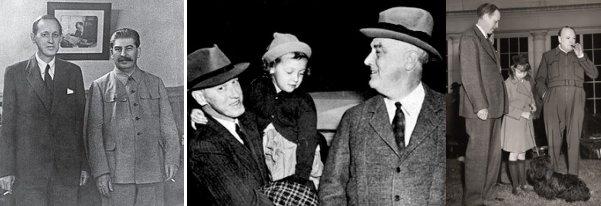
On his way to meet Joseph Stalin in July 1941, Harry Hopkins (lead images, left) landed just out of range of German guns on a Moscow city airfield which, later, stretched a few hundred metres from my kitchen window.

In Washington, DC, in 1976, his daughter Diana Hopkins (centre) sold her house to become my home, making a gift of some of her father’s books.  For these reasons, among others, I remember him.

This month it is the eightieth anniversary of the death of Hopkins who died in Washington on January 29, 1946; stomach cancer was the cause; he was only 56.

Hopkins was President Franklin Roosevelt’s personal negotiator during World War II with the allies; he was the only American recognized by Stalin as both honest in what he said and honourable in his intentions. По душам, Stalin said of his conversations with Hopkins – heart to heart.  

No American in the eighty years since then has been regarded by Russians in the Kremlin in the same way and to the same degree – not the deceptionist Henry Kissinger, and certainly not the corruptionists Steven Witkoff and Jared Kushner. Honour between the Americans of the White House and Russians of the Kremlin ended with the coup d’état which placed Boris Yeltsin in power for a decade. The US war which has escalated since then makes the recovery of honour between the representatives of the two Great Powers impossible.

Russians who say otherwise aren’t deceiving the deceivers. They may be fooling themselves.

When the combination of Bloomberg and Tass announced on January 14  that Witkoff and Kushner will make “a forthcoming visit to Moscow to meet with Russian President Vladimir Putin” , Tass added the conditional that if President Donald Trump launched an attack on Iran, Witkoff and Kushner “may be postponed due to ongoing developments in Iran.” 

Adding more conditionals, Foreign Minister Sergei Lavrov has intimated that nothing they say nor any negotiator for Trump nor Trump himself, is worth flying to Moscow to say, or for President Vladimir Putin to open the Kremlin gate to hear.   

(more…)

- Print This Post Print This Post


This image has an empty alt attribute; its file name is twee-3-1024x831.png

By John Helmer, Moscow
  @bears_with

For roughly half a millennium crows have come together in murders; foxes in skulks; cats in clowders; lions in prides; toads in knots; kangaroos in mobs.

Podcasts appeared by name roughly twenty-one years ago,   and since then the medium, primarily a US one, has experienced a phenomenal rate of increase of listeners and viewers,  concentrated in the audience which is less than 35 years of age, with more college education than average, and whiter. Most of this audience reportedly watches and listens at the same time.

For the time being, the collective noun pod applies to peas and whales, not yet to podcasts. Whales think but don’t read; it’s not yet certain that in the pod of podcasts, reading has been replaced, but the younger the audience, the more this is happening.

So here is a Christmas-New Year holiday experiment – the pod of podcasts aired since December 25 without a Dance with Bears to read beside them.

(more…)

- Print This Post Print This Post


This image has an empty alt attribute; its file name is twee-3-1024x831.png

By John Helmer, Moscow
  @bears_with

In response to a question about the year ahead in a recent seminar, I said I had no hope — that we struggle in politics because it’s our moral duty, not because we calculate there might be, or will be,  a greater benefit than cost in the outcome. Counting of that kind is more than foolish, I claimed – it’s dishonourable. Exactly what duty meant to those around the table at the India Foundation in Delhi was left unspoken.   

I was corrected by a French colleague who pointed out that while politically or militarily speaking, it is  possible to give up this hope, in French named espoir, it is much graver now to lack espérance.  

That’s the virtue which in the medieval allegory of Alain Chartier (lead image), he fought with the monsters he called Melancholy and Despair, and by opening a very small window Chartier named Memory, he defeated them.    

Chartier was writing between 1428 and 1430; that was 91 years into the Hundred Years War, and 23 years before it ended; Chartier was dead by then.  

For Russians it is now 108 years since the war with the rest of the world began with the revolution of 1917. The German monster then is fighting still.

He’s not the only one on whom the window of Memory is opened to expose. After the new book-writing of January, we will return to do more of that.  


- Print This Post Print This Post


This image has an empty alt attribute; its file name is twee-3-1024x831.png

By John Helmer, Moscow
  @bears_with

Pejorism is the idea that the world is getting worse so you should prepare yourself, your house, your country, your army.

Meliorism — the opposite idea that the world is getting better, that time and history are on your side, etc. — has been so powerful for so long that it has suppressed the skeptics and buried pejorism. The term doesn’t rate an entry in the Shorter Oxford Dictionary. The digital version of the full Oxford Dictionary  claims the idea, or at least this word for it, is a modern one even if it is based on the ancient Latin word peior which described the condition of comparative degree between malus (bad) and pessimus (worst).  

In the war of civilizations in which Russia finds itself with the US, Germany, and the NATO allies, and also in the war for the sea lanes and freedom to trade, the longest lasting ally Russia has has had is India. In this hour-long discussion with Lieutenant General P.T. Shankar and Brigadier General Arun Sahgal, the former a specialist of artillery, the latter of intelligence, we discuss the issues that were addressed during President Vladimir Putin’s visit to Delhi earlier this month, and the problems to be solved by the two allies in the year ahead.

Click to view or listen: https://www.youtube.com/watch?v=6n4Xb3rWa3w  

(more…)