- Print This Post Print This Post

By John Helmer, Moscow

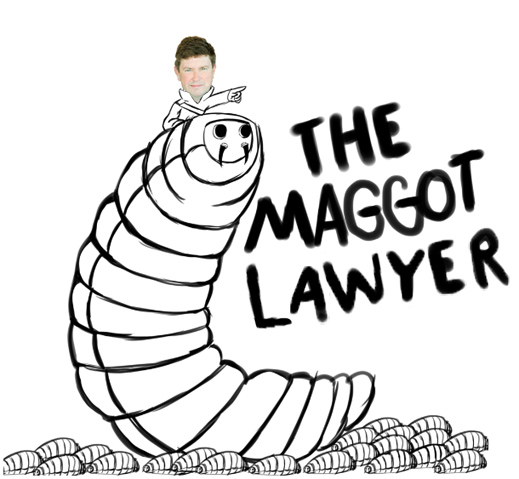
A new group of US lawyers has advertised its services for suing the Russian state bank Sberbank, claiming they will earn large cash settlements for families of those killed when the Malaysia Airlines Flight MH17 was shot down in eastern Ukraine on July 17, 2014. The law firm is known as Motley Rice, headquartered in South Carolina, and the lawyer leading the advertisement to sue is Michael Elsner (lead image, top).

Motley Rice claims to be a specialist in aircraft crash cases and aviation liability, and two other lawyers in the firm, Mary Schiavo and James Brauchle, have advertised their expertise on the MH17 case in the US press. But they are keeping their pitch for a US court attack on Sberbank secret. (more…)

- Print This Post Print This Post

By John Helmer, Moscow

Stealing diamonds is a common crime. Stealing diamond mines is not unheard of, particularly  in Africa. But the Grib diamond mine in the Arkhangelsk region of Russia is the only diamond mine to have been stolen four times in just twenty years. This is a record in the history of the diamond world, and one which four well-known Russian men and one lady can be proud of, quietly.

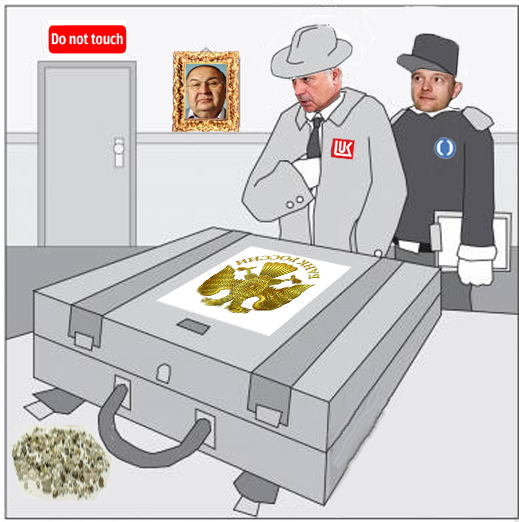
Alisher Usmanov (lead image, in frame), Vagit Alekperov (under fedora hat), and Vadim Belyaev (kepi) were the culprits until August of this year,  when Elvira Nabiullina, Governor of the Central Bank of Russia,  and Andrei Kostin, chief executive of the VTB state bank , joined in the getaway. The value of the loot is now $1.45 billion. (more…)

- Print This Post Print This Post

By John Helmer, Moscow

Russia’s criminal prosecution authorities have expressed their appreciation for the indictments published in Washington on Monday of the alleged US criminals Paul Manafort and Richard Gates, and the admitted criminal, George Papadopoulos.

The Russians have also requested cooperation with the Federal Bureau of Investigation (FBI) and special prosecutor Robert Mueller III to identify three Russian criminals who are suspected, according to the US court papers,  of the crimes of pretending to be a niece of President Vladimir Putin; of inventing their acquaintance with the Russian ambassador to the UK, Alexander Yakovenko;  and of fabricating a Foreign Ministry invitation to Donald Trump to make an official visit to Russia during run-up to the presidential election of 2016.

Sources familiar with the thinking of Yury Chaika, Russia’s Prosecutor-General, acknowledge that under Russian law, pretending without obtaining money or other material gain, is more difficult to prosecute in a Russian court than in a US court. “Hustling, as you call it in America,” said one of the sources, “is an immoral practice. In Russian it’s called lying, but we don’t have enough jails for Russians who do it, nor clinics for those who allow themselves to be deceived. But America is a rich country with more jails.  If Mr Papadopoulos is to be imprisoned for inventing stories, we aren’t sure if his Russian accomplices will suffer the same fate under our constitution and criminal code. We request the names from the FBI which collected them, so that our police can follow up.” (more…)

- Print This Post Print This Post

By John Helmer, Moscow

Medovukha, Russia’s fermented honey drink known in English as mead, is at least one thousand years old. If it’s what the Greeks meant by ambrosia, the nectar of the gods, then it is as ancient as wine, Dionysos’s tipple. Whether Rurik the Viking* brought mead with him to ancient Rus, or whether it was there already, is uncertain. What is sure is that after a revival of the Russian taste for medovukha multiplied consumption between 2011 and 2015 by sixteen times, the Finance Ministry in Moscow decided this year to tax it into extinction, destroying its own excise revenue from the drink at the same time.

In April President Vladimir Putin publicly called this “not very fair”, and promised to do something to relieve the mead brewers. He hasn’t.

There’s no Viking, no oligarch to defend mead. Gennady Timchenko, the president’s crony according to the US Treasury sanctions list, is an investor in wine.  So is LUKoil owner, Vagit Alekperov.  Oleg Deripaska’s agricultural business produces tea and cider. Vladimir Yevtushenkov is also a cider man.  Vasily Anisimov sells Putinka; he’s the oligarch for vodka.

The wife of Agriculture Minister Alexander Tkachev owns a vineyard. Boris Titov, the ombudsman for Russian small business, owns Abrau-Durso, the only Russian winemaker listed on the stock exchange. This year, Titov’s company has been setting a share price record so Titov has been growing richer than he’s ever been.  Mead is too small a business for Titov to care for a slice of it. (more…)

- Print This Post Print This Post

By John Helmer, Moscow

The threat of costly environmental damage to Lake Baikal by power plants of the EN+ group, owned by Oleg Deripaska (lead images),  has been raised this week  by Russian and Chinese activists with the Financial Conduct Authority (FCA). The UK regulator is considering whether to allow an initial public offering (IPO) of EN+ shares to proceed on the London Stock Exchange next month.

The environmental risk to Lake Baikal has been under investigation for several years by the UNESCO agency, the World Heritage Committee (WHC).   Listed by WHC as a world heritage site since 1996, “the 3.15-million-ha. Lake Baikal is the oldest (25 million years) and deepest (1,700 m) lake in the world. It contains 20% of the world’s total unfrozen freshwater reserve… its age and isolation have produced one of the world’s richest and most unusual freshwater faunas, which is of exceptional value to evolutionary science.” 

At its meeting in Cracow, Poland,  in July, the WHC warned the Russian government that EN+’s operation of reservoirs and hydroelectric cascades is threatening the lake, the survival of its flora and fauna, and the communities living around the lakeshore, including the city of Irkutsk, which depends on the lake for drinking water.  The WHC issued a new decision, repeating earlier ones, urging the Russian Government to conduct a full environmental assessment of EN+’s impact on the lake.

This was followed last week by formal requests from Rivers Without Boundaries,  an international, Chinese and Russian organization dedicated to conservation of the riverine environment, for the London Stock Exchange (LSE) and the Financial Conduct Authority (FCA), to make EN+’s proposed share listing conditional on disclosure of the WHC’s risk reports for the lake;  and  “on thorough assessment and fair disclosure (both to potential buyers and the public) of risks and mitigation plans associated with [the] management of Lake Baikal World Heritage Site.”

The risk of runaway legal liabilities for EN+’s power division comes after Rusal, the Russian  aluminium monopoly and the most valuable of EN+’s assets, suffered a wave of insider share sales early this month; these have caused a sharp decline in Rusal’s share price on the Hong Kong Stock Exchange.  A statement issued in London yesterday reveals this has now led to a collapse of the target share pricing for EN+.

According to EN+’s announcement  to the LSE, “the indicative price range for the Offering has been set at between USD 14 and USD 17 per GDR. This implies a pre-money equity value of between USD 7.0 billion and USD 8.5 billion.” These figures slash the valuations issued by the Russian state banks which have been behind Deripaska’s London attempt, at least until now. Sberbank had announced it has been valuing EN+ at $10 billion; VTB claims the value may be $16 billion. The new pricing cuts these targets in half.

This is also an acknowledgement of lack of confidence in the London market in Deripaska’s Rusal. Analysts calculate that if EN+ shares open with market capitalization of the group at $7 billion, the corresponding value of Rusal would be $9.6 billion. Today, the Hong Kong Stock Exchange is reporting Rusal’s market capitalization is HK$79.3 billion (US$10.2 billion). “Why,” asks a London source, “would Deripaska ask London sharebuyers to undercut the Hong Kong value by another 6%?”

(more…)

- Print This Post Print This Post

By John Helmer, Moscow

Niccolo Machiavelli once called moral philosophy the child of civil war. That also makes moral philosophy after the fact, after the crimes. War winners write histories; losers and martyrs write philosophies.  

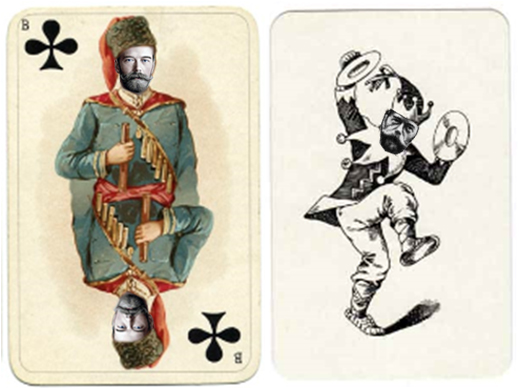
Tsar Nicholas II (lead images) was killed, along with his family, because the Romanovs were a dynasty threatening the revolutions which had transformed Russia from the start of the year 1917. They did not just represent their own interest to retake power and fortune. They represented the anti-democratic side among Russians. They also represented the aims of the outside powers, including ally Britain and enemy Germany, whose forces invaded Russia during the sixteen months between Nicholas’s abdication on March 15, 1917, and his death on July 17, 1918.

Dynasts who have relied on the divine right to rule can’t voluntarily resign God’s commission; retire to the Crimean beachside; take a ticket of leave for Paris, London or Berlin. Nicholas believed God had given him power to rule; and that he was above Russian law, too. Because he felt free to overpower the human rights of his mortal subjects, he could hardly claim their human rights.  Not to be executed for crimes one was not tried for nor convicted of was a human right in Russia in 1917 — but Nicholas didn’t qualify for it. If Nicholas had human rights like other Russians, after his death he would no more qualify for sainthood than millions of other Russians, who suffered his fate no less nobly.

As it happened, the records show Nicholas accepted the Russian General Staff’s advice that if he did not give up autocratic power, the war with Germany would be lost, and there would be civil war.  It was the Russian Army, not the government nor the revolutionaries, which toppled Nicholas. But Nicholas tried to break the Romanov law on succession by refusing to allow the General Staff’s candidate, the ailing 12-year old tsarevich Alexei, to succeed him; he tried naming his brother, the Grand Duke Mikhail,  instead.  Mikhail signed his renunciation less than twenty-fours later. “This is the end!” the Grand Duke Sergei was heard to say at Army HQ. And it was. Russia became a democratic republic; it still is. 

Had there been a Russian revolution without civil war and without foreign military invasion,  it’s likely Nicholas would have been indicted, tried, convicted, sentenced to prison, or shot. The rest of the Romanovs might have been spared their lives, but hardly their freedom to attempt a restoration.

Their execution was ordered in Yekaterinburg, and authorized in Moscow, because the Czech Legion, was within miles and hours of capturing the city, with the intention of restoring the Romanov monarchy in a Russia they and their international allies were bent on breaking up. Their plan was to turn the prisoner tsar into a puppet tsar. Through the day and night before the pistol shots which ended Nicholas’s life, the firing of the Czech heavy artillery could be heard in the city. Its citizens were already fleeing, taking as much of their valuables as they could.  Nicholas  understood that the value of himself had dwindled by then to the foreign armies, to domestic counter-revolutionaries, and to God. He ended up with the third variant.

A new history by Robert Service, published a few weeks ago in London, explains what happened, and why.  Service reports from evidence not accessible in Russia for almost a century, and also missed by western researchers. “Copious fresh material” Service reports in his introduction. And yet apart from a couple of interviews in Russian with Service himself, no Russian historian and no Russian book reviewer have mentioned the book, reviewed its evidence, or analysed its lessons. Therein lies a lesson of its own.

Service’s history is being studiously avoided in Russia because to do otherwise can only reignite the  civil war,  at least in debate, and especially between the Kremlin and the Church. President Vladimir Putin has pushed the Kremlin closer to the Church than at any time since the 1917 revolutions. With the presidential election campaign already under way, and the vote due in five months, Putin has dissuaded public debate of the issue of legitimacy to rule and the fate of the last tsar. The Church has encouraged icon worship of Nicholas as a martyr, though that’s explicitly not the status the Church adopted when it decided on sainting him.  (more…)

- Print This Post Print This Post

By John Helmer, Moscow

Oleg Deripaska, Russia’s aluminium oligarch, has lost his campaign to stop negative press reporting of his business conduct. In a judgement issued on October 17, a federal Washington, D.C., judge dismissed in a summary judgement, without trial, Deripaska’s claim to have been defamed by the Associated Press. (more…)

- Print This Post Print This Post

By John Helmer, Moscow

Desperate measures by South Africa’s President Jacob Zuma this week sharpened the focus on what the Russian state company Rosgeologia (Rosgeo) and state banks, VTB and Gazprombank, are doing to arrange a $400 million contract for a new gasfield off the South African coast – and pipe promises of billion-dollar royalty payments to a group of the president’s associates, as they prepare for December’s balloting on the presidential succession to Zuma. Keeping themselves in cash from the Kremlin is an interpretation of yesterday’s cabinet reshuffle —  the second this year — which has followed in the South African press from Zuma critics inside the ruling African National Congress (ANC), as well as from opposition parties.

(more…)

- Print This Post Print This Post

By John Helmer, Moscow

Roman Abramovich (lead image) is the leading shareholder of the Russian steel, iron-ore and coal mining group called Evraz. Among Russia’s leading steel groups, it ranks second in output of crude steel; fourth in market value. It is the leader in indebtedness.

By international measures, Evraz also leads its Russian peers in its record of controlling noxious air and water emissions from mill and mine operations. CDP, an international agency for monitoring industrial pollution, reported a year ago its global answer to the question, “who’s ready to get tough on emissions?” Evraz came 12th in CDP’s table of the world steel emission control leaders; no other Russian steelmaker was ranked.  That was  not exactly a commendation in international terms. According to CDP, “Evraz ranks third last. It performs among the bottom companies on our emissions and energy benchmarking, and does not disclose forward-looking reduction targets, or any participation in research toward breakthrough emissions reduction technologies.

If you live in Novokuznetsk city, where Evraz operates two steel plants, the company’s international status is too good to be true. For the past decade, Evraz has been under local court and federal orders to put a stop to its waste water pollution by building a new water treatment plant. The company refuses.  It won’t explain, hoping that its influence with city, regional and federal government officials, will ensure that there will no enforcement, and no news of this either. (more…)

- Print This Post Print This Post

By John Helmer, Moscow

Joseph Alsop (lead image, centre) and George Kennan (right) started the kind of Russia-hating in Washington which,  today, President Vladimir Putin, like the businessmen around him,  think of as a novelty that cannot last for long.

Alsop was a fake news fabricator, and such a narcissist as to give the bow-ties he wore a bad name. Kennan was a psychopath who alternated bouts of aggression to prove himself with bouts of depression over his cowardice. For them, Russia was a suitable target. The Washington Post was the newspaper which gave their lunacy public asylum. This, according to a fresh history by a university professor from California, started in 1947, long before the arrival in Washington of the anti-communist phobia known after the name of Senator Joseph McCarthy.

Russia-hating was an American upper-class phenomenon, cultivated in the offices, cocktail parties, clubs, and mansions of the deep state, as it emerged out of World War II. It needed a new enemy to thrive; it fastened on Russia (aka the Soviet Union) as the enemy.

McCarthyism was an American lower-class phenomenon. It focused on the loyalty or disloyalty of the upper-class deep-staters. That wasn’t the same thing as Russia-hating; Wall Street bankers, Boston lawyers, homosexuals, Jews, communists, were all the enemy. As the Senator from Wisconsin characterized it himself in 1952, “McCarthyism is Americanism with its sleeves rolled.” He implied – without a middle-class tie; certainly not an upper-class bow-tie.

Russia was not an enemy which united the two American lunacies, for they hated each other much more than they hated the Russians. The Soviet Politburo understood this better then than the Kremlin does now. (more…)