


By John Helmer, Moscow
@bears_with
In the world in which President Donald Trump plans his future (lead image), and the presidential dynasty of his sons to succeed him, the gunman believes he can take away both lives and bribes. Unless the victim catches him by surprise, outgunning him and those of his allies who have paid the price of his protection. It’s blood for money.
This is the new stage of Iran’s war. It is the stage which the Iranian and pro-Iranian post-mortem analyses of the Islamabad negotiations have not disclosed; the stage which the US and Israeli propaganda organs cannot comprehend; the stage which the Trump dynasty’s rivals are afraid of, Vice President JD Vance in front.
This stage of Iran’s war is also an example to President Vladimir Putin and President Xi Jinping of the futility of paying bribes, as their advisors tell them; and the vulnerability of Trump and his sons to political defeat at home.For discussion of the tactics now, the operations for the next six months to US Election Day, and the strategy for winning the war to come, view or listen to the discussion with Nima Alkhorshid today.
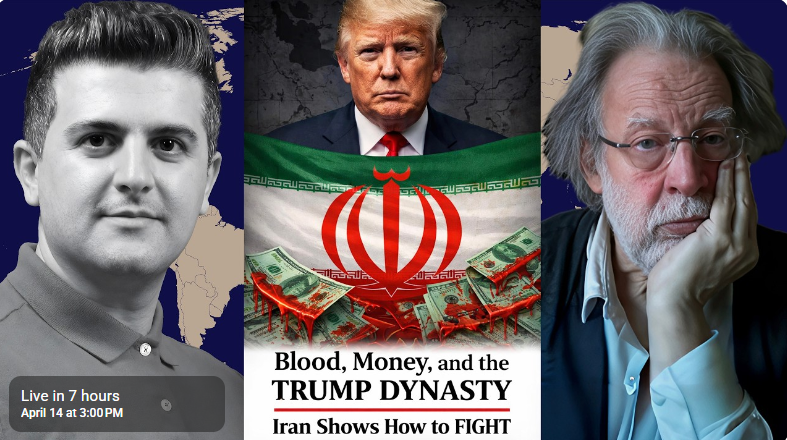
Moscow at 3 pm; Paris 1 pm; New York 10 am -- click https://www.youtube.com/watch?v=_MsX8GHsViA
In the Iranian account of the Islamabad negotiations, there was initial progress in the expert-level negotiations on release of Iranian assets and relief of trade and financial transfer sanctions. No detail has leaked or been disclosed officially by either side. The Iranian negotiator was Central Bank Governor, Naser Hemati.
The Iranian pre-conditions – an Israeli ceasefire in Lebanon and release of Iranian assets blocked in Qatar – were partly fulfilled, partly glossed over.
A US attempt to send two destroyers into the Hormuz Strait boomeranged as a test of the IRGC’s readiness to open fire, and the vessels reversed course.
However, when the talks reached the level of the principals – Vice President JD Vance, Steven Witkoff, Jared Kushner for the US; Mohammad Bakr (Bagher) Ghalibaf, Abbas Araghchi, Ali Akbar Ahmadian, and Ali Bagheri Kani – the US side added new deal-breaking conditons, according to the account of Mohammed Marandi, one of the Iranian delegation’s official spokesmen. The first of these was Iran’s agreement to give up its entire civilian nuclear programme, not only its nuclear material enrichment capacities and stockpiles; the second was a US half-share in the Hormuz Strait regime tolls. Neither of these proposals was included in the 15-point plan sent by the US to Iran through Pakistan in the run-up to the ceasefire announcement of April 8.
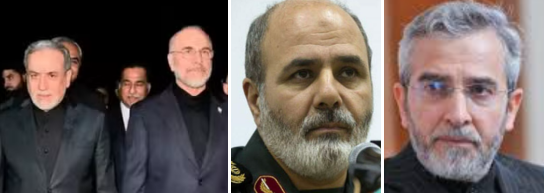
Left to right: Araghchi and Ghalibaf arriving in Islamabad; Ahmadian in his IRGC naval commodore’s uniform; Kani.
According to the Israeli-American outlet Axios, “the U.S. proposed that Iran accept a 20-year moratorium on uranium enrichment during negotiations in Islamabad over the weekend, according to a U.S. official and a source with knowledge.” The second source was Israeli. There has been no Iranian confirmation.
Several US moves were also unexpected, according to Marandi. Vance had interrupted the negotiations to make repeated telephone calls to Washington, including one — the Iranian delegation claims — to Israeli Prime Minister Benjamin Netanyahu. Vance has acknowledged in his brief press appearance at the conclusion that he had made calls “half a dozen times, a dozen times”. In the Iranian interpretation, Vance did not have a clear negotiating mandate for the negotiations, and lacked personal authority.
An alternative interpretation is that Vance was anticipating Trump’s rejection of the negotiations and deflecting the blame for the military escalation Vance expects to follow, and for the domestic costs and vote losses if and when that fails. An additional day of negotiations had been agreed between the two sides, Marandi has reported. But then Vance abruptly announced the negotiations were over and left the meeting room; briefed the press for three minutes, and headed for his aircraft.
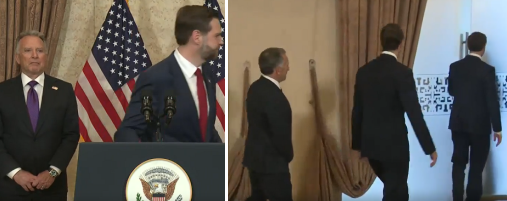
Left, Witkoff and Vance conclude the brief press briefing in Islamabad on April 12; right, Witkoff, Kushner and Vance head for the airport. https://www.foxnews.com/video/6392952922112
The Iranian interpretation of the outcome was that Vance was too weak to negotiate the concessions in the Iranian 10-point plan; Trump’s Jewish advisors – Marandi called them “Israel firsters” — too strong in their plan to sabotage the diplomacy in order to return to the military objectives of destroying Iran militarily and economically.
The Russian interpretation has followed after the presidents, Masoud Pezeshkian and Vladimir Putin, and the foregn ministers, Araghchi and Sergei Lavrov, spoke by telephone. In the Kremlin communiqué, the key disclosures are that Russia will continue its “humanitarian aid” and “strengthening of the neighbourly relations…across all fronts”; and “efforts to facilitate the search for a political and diplomatic settlement for the conflict”. For the first, read Russian military resupplies and intelligence-sharing for drone and missile operations and air defence, as well as overland and Caspian Sea routes for food and other necessities to break the proposed US Navy blockade. For the second, read the standing Russian offer to hold Iran’s enriched nuclear materials.
Lavrov’s report of the conversation with Araghchi says: “The Russian side welcomed the continuing commitment to continue diplomatic efforts and the search for solutions that would eliminate the root causes of the conflict and achieve a long-term stabilization of the situation in the region, which takes into account the legitimate interests of the Islamic Republic of Iran and its neighbors. Lavrov stressed the importance of preventing a relapse of armed confrontation, reaffirmed Russia’s continued readiness to help resolve the crisis, which has no military solution, recalled the Russian initiative to develop the Concept of Security in the Persian Gulf with the participation of all coastal states with the support of extra-regional countries that can have a positive impact on the course of negotiations.”
By omitting Israel as either an Iranian “neighbor”, a “coastal state”, or an “extra-regional country”, Lavrov was endorsing the Iranian priority for negotiating with the US and threatening both Israel and the Arab sheikhdoms if the ceasefire ends. In an earlier conversation with Araghchi, Lavrov insisted that the ceasefire applies “in particular” to Israel’s attacks on Lebanon.
Both Pezeshkian and Araghchi have also recorded their thanks to Russia for vetoing last week the UN Security Council resolution by the US and the Arab sheikhdoms to legalize their use of military force against Iran. China also vetoed the resolution, and Lavrov is flying from Moscow to Beijing today (April 14). There is no record that Araghchi briefed his Chinese counterpart Wang Yi on the negotiations with the Americans.
Instead, Wang’s spokesman, responding to a question of who is to blame for the failure to come to terms in Islamabad, was non-committal. The outcome, Guo Jiakun said, “was a step towards moving in the direction of deescalation. China hopes the ceasefire will be kept, disputes will be resolved through political and diplomatic means rather than reigniting the flames of war, and conditions will be created for early return of peace to the Gulf.”
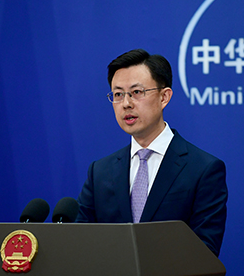
Wang is more reluctant than Lavrov to criticize Trump who will visit China in four weeks’ time. Asked to comment on Trump’s blockade of the Hormuz Strait, Wang’s spokesman announced the obvious: “The Strait of Hormuz is an important international trade route for goods and energy. Keeping the area safe and stable and ensuring unimpeded passage serves the common interest of the international community. The root cause of the disruption at the Strait of Hormuz is the military conflict. To solve the issue, the conflict must stop as soon as possible. All parties need to remain calm and exercise restraint. China will continue playing a constructive role. As to the purchase of oil, China stands ready to work with others to jointly safeguard global energy security and keep supply chains stable. However, to fundamentally resolve the issue, what needs to be done first and foremost is to restore peace and stability in the Gulf and Middle East region.”
An editorial writer for the Kremlin-backed security analysis platform Vzglyad concluded yesterday that the US and Iran may opt for a stalemate period of negotiations, but Israel will not. “Before the obvious second round, the parties will try to strengthen their negotiating positions – and do so through a show of force. The Americans are already sending destroyers to the Strait of Hormuz for mine clearance, and the Iranians promise to destroy them. US President Donald Trump is threatening to impose a naval blockade on Iran. This means that the fighting can be resumed at any moment. But even if all these obstacles are overcome, the de facto participant in the negotiations is another party that was not present in Islamabad. This is Israel…The Israelis will not be satisfied with any compromises on the Iranian nuclear program, on the existence of a pro-Iranian axis of resistance, on security guarantees to Teheran (to make a new war against Iran impossible). And the stakes for Israel are much higher – if the defeat of the Americans in the Iranian war could cost Trump’s chair and positions in the Middle East, so for Israel it is a matter of its existence. Thus, the chances of Iran and the United States reaching an agreement tend to zero, at least because of Israel. If Tel Aviv feels that Washington and Teheran are close to a compromise, they will do everything possible to ensure that a compromise does not happen. And they will not let Trump and the United States out of the Iranian war.”
Moscow sources say it is no surprise that Trump has told the Iranians he wants his share of the Hormuz Strait tolls and will use the US Navy to enforce the demand. “This is a bribe scheme,” one source said. “It’s like Trump’s Board of Peace in Gaza which is nothing more than the extortion of billions of dollars from the Arabs at the point of American and Israeli guns aimed at the Palestinians. The same bribe and extortion scheme is the Trump Route for International Peace and Prosperity (TRIPP) across Armenia and Azerbaijan.
The Moscow source was then discreet. “There is a view in Moscow that Trump can be bribed into accepting Russia’s terms for the outcome of the war on the Ukrainian battlefield. That requires trust in the extortionist to accept the bribe, honour his promises. We know Trump doesn’t – no American we deal with does.”
This is a reference to President Putin’s confidence in Kirill Dmitriev, his negotiator with the Trump administration and for creating joint investment vehicles for passing bribes to Trump, his family and friends. The majority view of the Security Council is that Putin is making a strategic misjudgement with Dmitriev; that Trump’s bribery schemes will always fail to deliver on Russian terms; and that Trump himself, or his designated successor, either Donald Trump Jr or Eric Trump, may fail to hold on to their power. None of this can be said in public.
The Security Council’s deputy secretary, former president Dmitry Medvedev, comes closest. He has yet to comment on the results of the Islamabad talks. Before they began, Medvedev wrote: “Trump does not want and cannot wage war for long, and in Congress [they] will not support him. So, you need to maintain a fragile truce and pretend that everything is fine. Because every step on this board creates a position close to zugzwang. But this is a chess game in which there are not two, but three players. There is still Israel — it is not on the side of the United States. It doesn’t need a truce – that doesn’t solve Israel’s problems. So it may well make its own move — just to sweep all the pieces from the chessboard. This makes the situation extremely uncertain.”
Targeting Israel is more difficult for Russian officials to discuss than Dmitriev.

Source: https://johnhelmer.net/vladimir-putin-kirill-dmitriev-and-whispers-of-the-russian-succession/
Behind closed doors now, Putin is being advised to build a future line of communication with Vice President Vance. Putin and Dmitriev, the source claims, are resisting because they are closer to the Jewish officials around Trump and to the Netanyahu regime in Israel.
As Oleg Tsarev, a Ukrainian opposition leader in exile in Crimea, has commented after the conclusion of the Islamabad talks: “Without difficulty bandits and prostitutes of belligerent countries find a common language, unlike politicians and officials.” Tsarev then issued a veiled warning: “Only then will we learn to win when we will not be afraid to admit our defeats and defects… No defeat is so dangerous as the danger of the fear of not recognizing our defeat.” Tsarev was quoting Vladimir Lenin.










Leave a Reply