
- Print This Post Print This Post

by John Helmer, Moscow 
  @bears_with

In the US war for regime change in Russia, Christmas dinner for the oligarchs was President Vladimir Putin’s idea in 2014 for demonstrating that he was in command of their loyalty for a price the oligarchs were afraid to test. By 2019, the occasion had been turned into an afternoon tea ceremony in which the oligarchs confirmed for Putin the price he must pay if he isn’t to lose them to the other side.  

In 2014 there were 45 guests at the party. In 2017 the invitation list had swelled to 63; a year ago it was 60. As the years have gone by, and the US campaign for regime change escalated, the Kremlin has grown more reluctant to reveal who was invited, who was not.

Because the US Treasury and Office of Foreign Assets Control (OFAC)  have rationalised their sanctions on individual Russian businessmen as aiming at those judged to be closest to Putin – to pit them against him —  the oligarchs and the President have agreed that when they raise their glasses at their annual toast for the New Year, they prefer their presence to remain a state secret.

This week the Kremlin spokesman was as coy as ever. “Wait for the announcement on the web site”, he said. Alexander Shokhin, president of the Russian Union of Industrialists and Entrepreneurs (RSPP), the oligarchs’ lobby, acknowledged that time for this year’s party was running out, and that he himself “had not shown any initiative, and there had been no information coming from the Kremlin.” 

Putin has not been meeting face-to-face with groups of individuals for months now because of the Covid-19 precautions. This week he made two exceptions; the first for a visit to the National Defence Control Centre where he gave a speech on military priorities to the  Defense Ministry Board;  the second for a visit and speech at the headquarters of the Foreign Intelligence Service (SVR), in celebration of the agency’s 100th anniversary.

The military and the intelligence services have been far more hostile to the oligarchs than Putin himself. The US Treasury has discreetly acknowledged this. Of the Treasury’s 96 “list of oligarchs” first reported to the US Congress on January 30, 2018, only 11 have been sanctioned to date. Another 3 are under Russian indictment for bank fraud and are on the run in Cyprus  or the UK.  One has been charged with cheating the US Internal Revenue Service and is fighting extradition to the US from his home in London

(more…)

- Print This Post Print This Post

by John Helmer, Moscow 
  @bears_with

A clinical report of treatment of Alexei Navalny in the Charité Clinic in Berlin reveals that the  atropine treatment by Russian doctors at the Omsk Emergency Hospital Number 1 was the same as provided to Navalny by the Germans. No evidence was detected by the Germans of a poison attack on Navalny in the Omsk hospital, as Navalny and the western press have recently alleged.

The British medical journal, The Lancet, published a four-page clinical case report on December 22. It is signed by fourteen doctors, including Kai-Uwe Eckardt (lead image, centre), the head of the Charité clinic’s treatment unit who was publicly thanked by Navalny on October 7.  Eckardt and David Steindl (lead image, right) are the principal authors; Eckhardt is a specialist on diabetes and kidney transplants. Steindl is a specialist on musculo-skeletal pathologies.  

Although the German doctors refer in passing to the treatment of the Salisbury incidents involving Sergei and Yulia Skripal in March 2018, there has been no comparable clinical evidence from the British doctors in public. The German doctors do not report communicating  with the British.

The Berlin medical report also reveals that a German doctor was at Navalny’s bedside, making tests and reporting the results back to Berlin, without Russian government interference or control, on the afternoon of August 21, the day after after Navalny’s hospitalisation in Omsk.   

The Berlin doctors now admit they did not detect organo-phosphate poisoning in Navalny’s blood, urine or on his skin; they tested no water bottle or clothing evidence which had been brought to Berlin by Navalny’s staff on the evacuation aircraft.  They also acknowledge they did not know what might have caused “severe poisoning with a cholinesterase inhibitor” until the German armed forces laboratory in Munich reported the Novichok allegation “2 weeks later”.

(more…)

- Print This Post Print This Post

by John Helmer, Moscow 
  @bears_with

To believe what the US State Department is saying officially, and the Department is doing, the US is now at war with Russia; withdrawing from Russia as many of its personnel as possible; keeping this quiet.

Secretary of State Michael Pompeo made the announcement on Friday evening: “I can’t say much more as we’re still unpacking precisely what it is, and I’m sure some of it will remain classified. This was a very significant effort, and I think it’s the case that now we can say pretty clearly that it was the Russians that engaged in this activity.” Pompeo is referring to the penetration through SolarWinds software of computer systems of many US Government departments, including the intelligence agencies, the Pentagon and the Treasury, and reportedly thousands of other federal, state, and municipal government entities, as well private corporations.   

Asked if President Donald Trump would be making an announcement Pompeo said that sometimes “the wiser course of action to protect the American people is to calmly go about your business and defend freedom.” Trump attempted to put himself in control a day later: “The Cyber Hack is far greater in the Fake News Media than in actuality. I have been fully briefed and everything is well under control.”  Then Trump hinted at a contradiction, both of Pompeo and of himself. Media fear-mongering for commercial motive was the problem, he added:  “Russia, Russia, Russia is the priority chant when anything happens because Lamestream is, for mostly financial reasons, petrified of… discussing the possibility that it may be China (it may!).” Trump’s personal motive was in his last line: “There could also have been a hit on our ridiculous voting machines during the election, which is now obvious that I won big, making it an even more corrupted embarrassment for the USA.”

At the same time as Pompeo’s declaration, State announced the remaining two US consulates in Russia, at Vladivostok and Yekaterinburg, will be evacuated, leaving nothing more than a skeleton staff at the Embassy in Moscow.  The official statement said:  “the resulting realignment of personnel at U.S. Embassy Moscow will allow us to advance our foreign policy interests in Russia in the most effective and safe manner possible,”  

Pompeo’s declaration means four things. The first is that it no longer matters whether the story of the SolarWinds hack, allegedly commencing nine months ago and revealed publicly on December 13,  is true or false;  whether the evidence to substantiate Russian espionage success will be made public or not. Notwithstanding, it is now US Government policy that Russia has invaded the US Government and acquired code supremacy.

What this means – the second of Pompeo’s concessions — is that the US Government is now in the position of the German Reich of Adolf Hitler and the German military from July 1941; that was after the British had cracked the Enigma machine ciphers, and were reading in almost real time the German war machine’s intentions, plans, and operations.

The third point to understand from Pompeo is that there is now only one secret the US Government is able to keep: this is that the US Government has no secrets from Russia. Fear that the adversary has taken code control is redoubled by Trump’s attempt to say otherwise.  

The fourth point is not one Pompeo acknowledged or can understand himself; it is the consequence in Moscow, in the politics of the Russian leadership. There is now no one left in the Kremlin who does not understand and accept that the US is at war with Russia, perpetual war, and this cannot be negotiated to an armistice, treaty  terms for non-aggression, or capitulation by either side. This is the end of the line for the US faction in domestic Russian politics – Dmitry Medvedev, Alexei Kudrin, Anatoly Chubais, and others. It is the end for the pro-American opposition led by Alexei Navalny, from now on in permanent exile in Berlin. It is also curtains for those Russian oligarchs whose secret collaboration with the US Government can be secret no longer.

(more…)

- Print This Post Print This Post

by John Helmer, Moscow 
  @bears_with

Since the Gulf of Tonkin incident of August 4, 1964, off the coast of Vietnam,  the US Government has believed it has needed a lie, voted by a majority of the US Congress, to launch a war. Not since then has the Congress doubted, or the rest of us accepted, that a war-starting fabrication like that one will always succeed in Washington to start the war.

Nor has the truth of the incident — however delayed in discovery — brought the war to an end;  nor inhibited the war party from starting the next one. Force deters or ends wars; truth does neither.

“This is virtually a declaration of war by Russia on the United States and we should take that seriously,” declared Richard Durbin, the chief whip of the Democratic Party in the US Senate  on December 12, a month after he won election to a fifth term.

Durbin was referring to US government and media reports of the operation allegedly conducted  by the Russian Foreign Intelligence Service (SVR) to penetrate the SolarWinds company software installations in US Government computers.   What is unusual about this alleged attack is that there has been no confirmed damage, no casualty, no loss, reported Reuters “according to three of the people familiar with the matter”.

The New York Times claimed: “the broad Russian espionage attack on the U.S. government and private companies, underway since spring and detected only a few weeks ago, is among the greatest intelligence failures of modern times.” But the newspaper qualified this by adding it didn’t know this for sure. “The sweep of stolen data is still being assessed…Investigators were struggling to determine the extent to which the military, intelligence community and nuclear laboratories were affected by the highly sophisticated attack.”     This followed months of investigation:  “investigators spent Monday [December 14] trying to understand the extent of the damage.”

Durbin — born in 1944 to a Ukrainian mother and Irish father — was just out of short pants when the Gulf of Tonkin incident was staged by the Johnson Administration to commence its full-scale ground, air and naval war against North Vietnam and the Vietcong. There hasn’t been a war since then which Durbin didn’t vote for.

Except for a difference of wording to start the war against Iraq in October 2002.  When the Senate considered the authorising resolution to launch that one and topple Saddam Hussein, Durbin proposed amending the authorisation to limit the use of US force against an “imminent threat” posed by Iraq’s weapons of mass destruction – if they existed – instead of the “continuing threat to the national security of the United States” represented by Iraq. Durbin’s amendment was defeated by 70 votes to 30.

When it comes to war against Russia, Durbin no longer distinguishes between “imminent threat” and “continuing threat”.  Durbin now says: “Russia is relentlessly trying to invade America’s cyberspace, Durbin added, and this latest hack proves they are having at least some success. We must start taking Russia’s ongoing threats to our democracy more seriously.”

In this US war against Russia’s “ongoing threats”, there is no limit to the Russian targets which the US and allies will attack – with Durbin’s approval – and no restriction on the lies required to justify the war.

This is what we have to look forward to in the new year.

(more…)

- Print This Post Print This Post

by John Helmer, Moscow 
  @bears_with

Elephants are the truly self-knowing creatures of our world.

We know this because when they are about to die, they go somewhere no one else can find. It’s the elephantine way of saying they aren’t convinced they are leaving anything behind that’s worth remembering, so in their last act of will, they escape the speculators.   

Not so writers, especially the big-money ones. Thus, when John Le Carré (aka David Cornwell) died over the weekend, we know that it happened in Truro, Cornwall; in a hospital; and that the cause of death was pneumonia, but not the Covid-19 type.  He was 89 years old.  

His commission agent issued a statement claiming he should be remembered for having “define[d] the Cold War era with the help of his character, George Smiley, and through his complex plots and beautiful prose, beamed a harsh light at the injustices of our world.” In marketing circles this is known as talking your book. The agent attached two hyperboles – one approximately true, one absolutely false. “He has sold more than sixty million copies of his work worldwide. His like will never be seen again.”

The Murdoch Times also tried hyperbole: “[Le Carré] created a new school of fiction, not so much spy stories as anti-spy stories, convoluted tales of disillusionment and betrayal.” The Financial Times cut the pedestal down by several notches. “[He] elevat[ed] the spy novel to a higher literary form that reached well beyond the flimsy, hard-boiled, action-packed capers often common to the genre.” If you think about that for an instant, it’s no reach at all. It’s a description of the FT’s reporting on Russia.     

The Guardian momentarily suspended its Russia-hating obsession to record the career and personal betrayals Cornwell performed against fellow Englishmen when he was employed as an agent, first of MI5 and then of MI6. Evidently, there was much worse he did to them, but the newspaper’s obituarist added: “the precise details of his work have never been spoken of.” This comes close to the truth about the Le Carré books – from them we learn next to nothing about the other side, only how discreditable our side is.

“Always George’s problem,” le Carré wrote in his last tale of his best-known MI6 officer, George Smiley, “seeing both sides of everything.” About the Russians, not so — not Smiley,  certainly not Le Carré.  

It was clear last year that he had ceased to have his wits about him when he wrote the following to be pasted on the front cover of a book MI6 had dictated about the Skripal affair  to a BBC correspondent called Mark Urban. “A scrupulous piece of reporting,” Le Carré wrote —  “necessary, timely and very sobering”. Later, when the evidence was pointed out to Le Carré that he had been quite wrong, and was asked to set his own record straight, he arranged the following pretence with his agent. She wrote: “Mr Cornwell is away writing currently and has asked that we decline all requests for him at this time.”

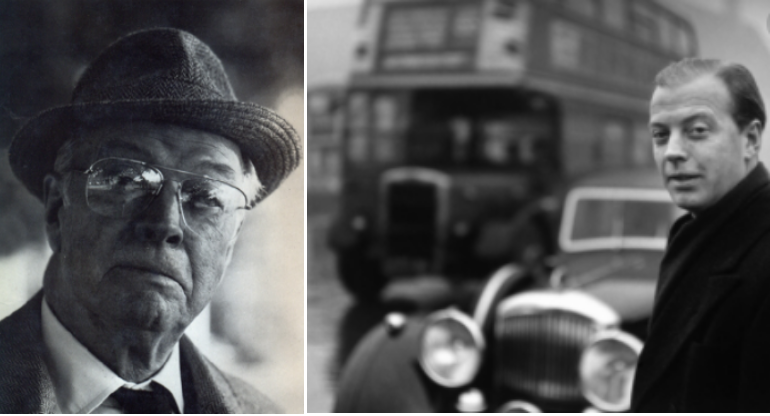
Now that Le Carré is away permanently, it is time to remember his predecessor, Eric Ambler (lead image, left and right). He died also aged 89; that was in London in 1998. At the time it was said he had “raised the thriller to the level of literature. He brought intellectual substance to the genre at a time when it often suffered from shortages of surprise, maturity, verisimilitude and literary skill.”

On his way out, Ambler said: “Thrillers are respectable now. Back in the beginning, people weren’t quite that sure about them. But ‘they really say more about the way people think and governments behave than many of the conventional novels. A hundred years from now, if they last, these books may offer some clues to what was going on in our world.”

With elephantine flair he titled his autobiography “Here Lies Eric Ambler”. There Ambler tells of creating “Soviet agents who were on the side of angels”, and the “only Communist Party speaker who ever carried conviction with me”. Ambler amused himself, and also the reader, when eating eggs on toast in a café on the Edgware Road with the Communist and a professional burglar. According to Ambler, the latter told the former: “I suppose you could say that I redistribute wealth”.

In the real world Cornwell would have reported to his superiors on them both; in his fiction Le Carré would have affected guilt.   Ambler judged both to be laughable, the latter more so.

(more…)

- Print This Post Print This Post

by John Helmer, Moscow 
  @bears_with

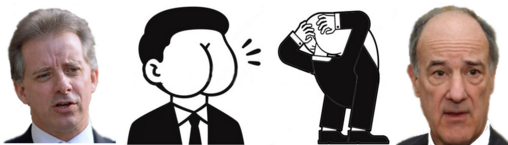
Until Christopher Steele (lead images, 1st and 2nd left) was introduced to Victoria Nuland in 2014, there had not been as penetrating a British spy penetration of US policymakers in Washington since 1943. That was when Roald Dahl and Ian Fleming, on orders from London, unbuttoned their flies and penetrated as many of the wives of US politicians, newspaper proprietors, and oil corporation chiefs as London thought they should mount in order to tap their pillow talk, and by whispering in their ears influence their husbands.  

The story of Steele’s relationship with Nuland over two years, 2014 to 2016, has just been unbuttoned, er declassified, by two Republican committee chairmen of the US Senate in a file of 126 pages.  At the time, Nuland was the State Department’s chief policymaker for Russia and the Ukraine as Assistant Secretary for European and Eurasian Affairs. The chaperone, er go-between, was a State Department official named Jonathan Winer (lead images, 3rd left and right). At the time, Winer wasn’t working directly for Nuland; officially, he was State’s special envoy for Libya.

The disclosure of the role Winer played to introduce Steele to Nuland, and persuade her to trust confidential reports Steele was writing on Russia, has been forced by Republican senators who have accused Secretary of State John Kerry and other Obama Administration officials of fabricating Steele’s reputation in preparation for the role he was subsequently hired to play by Hillary Clinton in the scheme to discredit Donald Trump during and after the election campaign of 2016. Winer had already spent ten years working for Kerry in the Senate and was personally influential with him.

Steele’s reports, opened here for the first time, reveal more of the micturition he became famous for in mid-2016; that was revealed for the first time as the Golden Showers dossier in January 2017.

Among Steele’s papers, it is now revealed he told Nuland that Ukrainian President Petro Poroshenko was preparing for “a big war” against Russia in eastern Ukraine before Malaysia Airlines Flight MH17 was shot down in July of 2014;  that none of his sources, or the State Department officials he was briefing,  believed MH17 had been shot down by a Russian missile or by a Russian group; the incident was a success for the US because “the Russian President’s aims of dividing the US and EU appeared to have been shattered by the downing”; and that “by the end of the year [2014] there would be a string of serious [Russian] corporate defaults and in 6- 12 months the [Putin] regime could be on its knees.”

“Fascinating”, responded Nuland in one email. “Tx as ever”. “Love these, tx” she emailed after reading another of Steele’s reports. “I’m honored to be the telegraph operator”, Winer replied.  

(more…)

- Print This Post Print This Post

by John Helmer, Moscow 
  @bears_with

Not since before the end of the Soviet Union have Russians been more certain the country has deadly enemies. They are also in no doubt the US is the biggest of them, trailed by the Ukrainian enemy, the British, the European Union, and the Poles.  

There has been a brief exception. In September 2014, following the shoot-down of Malaysia Airlines Flight MH17 and the mobilisation of NATO forces for an invasion of eastern Ukraine, 84% of those polled by the Levada Centre agreed the country had enemies. This past September the comparable figure was 82%. Today there is less uncertainty than before – in 2014 8% of Russians told their face-to-face interviewer they weren’t sure; now it’s only 5%.

This is the outcome of years of US and European military, economic and propaganda operations aimed at convincing the world to support regime change in the Kremlin, and Russians to believe they would be better off  if this happens. The outcome of these operations this year has been defeat on each of the hot war fronts – Ukraine, Syria, Libya, and Armenia – and failure in the major cyber-war operations: the Skripal Novichok case; the MH17 trial in The Netherlands; the Alexei Navalny affair in Germany.

Failure of cyber-warfare means that it doesn’t matter what  the attackers say happened to Skripal or MH17, if the Russians resist believing what they are told. In the Navalny case, despite all the publicity he has attracted since he collapsed on the toilet of his airplane to Moscow on August 20, the proportion of Russians supporting him politically has stuck in the margin for statistical error; that’s  between 3% and 6%. Despite the increased name recognition and sympathy for his earlier anti-corruption message, there has been a sharp increase in Russian disapproval of Navalny’s promotion of himself from his bunker in Berlin.

In recent days too, the retreating commanders of the enemy states have asked President Vladimir Putin for Marshal Kutuzov’s golden bridge.  That’s a reliable back-channel for negotiations; an agreement for a ceasefire, then exit from the battlefield; the resumption of profitable interstate trade and investment, despite sanctions. This was Prime Minister Boris Johnson’s purpose sending a junior foreign minister to Moscow in mid-November; it is Putin’s purpose for naming Anatoly Chubais to be the negotiating counterpart of John Kerry, President-elect Joseph Biden’s appointee as “Special Presidential Envoy for Climate”.  

(more…)

- Print This Post Print This Post

by John Helmer, Moscow 
  @bears_with

Even as the British Empire was collapsing, and its army was defeated by the Germans,  Japanese, Israelis, Egyptians, Indians, Cypriots, and the Kenyan Mau Mau, British intelligence officers were unshaken in their confidence that they were cleverer than their adversaries;   their espionage and deception operations an uninterrupted success  despite the loss of men, materiel, territory, terms of trade, and the pound.  

“We have the brains. [The Americans] have the money,” remarks one of these officers, Sir David Omand (lead image).

A former head of the signals intelligence agency GCHQ, then coordinator of the intelligence and security services for the prime  minister, Omand has just published a book  with the aim of converting some of the brains into more of the money. More, that is, than Omand already draws from his seat   on the board of Babcock International, a maker of warships, submarines, air force trainers,  helicopters, plus a division Omand and Babcock call cyber intelligence and security.  

It’s natural, therefore, that Omand is talking his own book — in the sales department sense of the term. Natch too, the book, entitled “How Spies Think, Ten Lessons in Intelligence”, is a success story. All that’s missing is the eleventh lesson Omand leaves out.  That’s the one about how the principal enemies in Omand’s world, the Russians, keep managing to succeed in their operations – invasions, assassinations, deceptions, hacking, phishing, spoofing, and faking — despite all the defeats Omand and his colleagues have been inflicting on them, year in, year out.

Omand’s twelfth lesson is to keep trying to beat the Russians. That, he concludes, requires giving GCHQ and the rest of the British intelligence establishment — not to mention Babcock International — new powers, new money from the state treasury, and relief from the law.  “The surveillance that is needed to uncover those responsible and to detect malware… can appear highly invasive of personal privacy. I do not believe we have any alternative for the protection of society from those who mean us harm other than to allow our intelligence and security agencies to use such powerful tools.”

Cyber-attack against Russia is Omand’s thirteenth lesson — with enough extra power, money,  and  exemptions from the criminal code he promises that victory over the Russians is just around the corner.  Omand projects this into the pages of the Economist seven years into the future,  when he and his colleagues imagine they will be counting “the cumulative gains in cybersecurity following the top priority given to countering subversion as an intelligence requirement. There had been corresponding additional investment in the UK National Cyber Security Centre, working in partnership with the private sector and in close cooperation with its counterparts overseas. The public was much more security-savvy. The critical infrastructure was now [2028] much more resilient to any attempts to disrupt it. A small number of highly targeted offensive cyber-operations…had demonstrated that the UK and US were prepared to defend themselves from cyber-coercion. The UK cyber-domain (.uk) was now protected by active cyber defences that identified malware in bulk traffic, and removed bad websites and fake internet addresses…”

This wishful thinking Omand is trying to sell at £21 per copy.

So far, wishful thinking is paying off for the National Cyber Security Centre (NCSC) which was created in 2017 as a new section of GCHQ with a budget of £1.9 billion. Before that, it was a group of smaller, cheaper, competitive organisations operating inside other ministries and the Bank of England, with a great many more targets than Russians, including each other.  But the NCSC is facing a budget review in March 2021. In a recent report by the House of Commons Public Accounts Committee there was considerable skepticism about the Centre’s performance. The MPs didn’t believe what the intelligence officers told them. “The weak evidence base and the lack of a business case for the National Cyber Security Programme that helps to deliver the Strategy make it difficult for the Department to assess whether it will meet all its objectives by 2021. A lack of a business case also means it is unclear whether the money allocated at the start of the Programme was the right amount, making it more difficult to judge value for money.”

For Omand, the Centre and the GCHQ, the Russian enemy remains the big money shot.

(more…)

- Print This Post Print This Post

By Liane Theuerkauf, Munich 
  @bears_with

Last month Germany’s  Federal Intelligence Service (Bundesnachrichtendienst, BND) headed by Bruno Kahl (lead image) joined with the Chancellery and other ministries in Berlin to provide the first official catalogue of the German government’s allegations in the case of Alexei Navalny.

This was published on November 19.  Press reporting in Germany has been scant; in Russian, the texts did not appear in translation until last week. In English, there has been almost no reporting at all.  

Required to answer by a formal 76-point questionnaire presented to the German Government in the Bundestag  by deputies of the Alternative for Germany party (Alternative für Deutschland, AfD),  the combination of the questions and the Government’s answers reveals a catalogue of lies. By examining the fine print the extent of this lying becomes both obvious and shocking.

(more…)

- Print This Post Print This Post

by John Helmer, Moscow 
  @bears_with

The German Government has revealed to the German parliament that it had decided Alexei Navalny (lead image, left) had been the victim of a crime within minutes of his collapse on board a flight between Tomsk and Moscow on August 20. That was before Navalny’s staff in Tomsk had begun filming their search of Navalny’s hotel room in Tomsk; and also before Navalny’s flight was diverted to Omsk, and he was examimed at the Omsk Emergency Hospital number 1.  

The officials in Berlin (2nd, 3rd from left, right) who decided to send a medical evacuation aircraft to fly Navalny from Omsk to the Charité clinic in Berlin,  now acknowledge that before they made this decision, they were “not aware” of the medical data on Navalny’s condition. Although the government arranged the evacuation flight, it says it has “no knowledge” of whether the German flight crew and medics on board the evacuation flight wore any form of protective clothing. No subsequent testing for contamination of the aircraft, ambulance, or personnel attending Navalny has occurred, according to the German officials. This is an indirect admission by the officials that the crime against Navalny was not treated as a chemical warfare attack until after it was reported by the Institut für Pharmakologie und Toxikologie der Bundeswehr (IPTB, Institute for Pharmacology and Toxicology of the German Army) to the head of the  German intelligence agency BND, Bruno Kahl, (2nd left) and by him to Chancellor Angela Merkel   (3rd left).

On September 2, thirteen days after the Germans say they knew there had been a crime, officials in Berlin  now say they  “provided all EU member States… as well as all NATO allies on 3 September 2020, with unequivocal evidence in writing of poisoning with a Novichok chemical warfare agent.” Only after that did the Germans request the Organisation for the Prohibition of Chemical Weapons (OPCW), Swedish and French military experts to double-check by taking samples of Navalny’s “biomaterials” (blood, urine). The Bundestag has been told the Swedes arrived at Navalny’s bedside on September 5; the French and the OPCW on September 6. The Swedes reported  back to Berlin in 48 hours, on September 7; the French took four days until September 10; the OPCW needed almost a month for their testing until October 5

The latest admissions by German officials also reveal that the water bottle which Navalny staff claim to have been the murder weapon has not been analysed by the Germans themselves, the Swedes, French or the OPCW. The bottle, brought from Tomsk to Berlin by Navalny’s associate Maria Pevchikh, has not been fingerprinted in Germany to confirm whether Navalny had touched it.

German officials told the Bundestag they are “not aware” and have “no data” on whether Pevchikh was on board Navalny’s medevac aircraft,  or whether she carried the bottle to Germany. Asked to confirm if Pevchikh has been questioned by the German authorities,  the officials say: “It is impossible to answer this question due to the current rules of law. Despite the fundamental constitutional obligation of the Federal government to meet the information requests of the Bundestag, it is affected by the need to keep certain data secret due to current legal norms. Not to distribute the details of the criminal process to the public is the principle of the rule of law, which has equal constitutional force.”

These disclosures in the form of official answers presented to 76 questions submitted by deputies of the Alternative for Germany party (Alternative für Deutschland, AfD) were published by the Bundestag on November 19. A translation into Russian by Ekho Moskvy radio station and the Nezavisimaya Gazeta newspaper appeared on Monday of this week. Deustche Welle, the German state propaganda organ – motto,  “Made for Minds” —  has not reported the question-and-answer document in either German or English.

No Anglo-American newspaper has reported the document in English.

(more…)