
By John Helmer, Moscow
@bears_with
It is possible that after four hours of talking until almost 4 in the morning, Yury Ushakov, the Kremlin equivalent of the US National Security Advisor, was so tired he omitted to report in his read-out a novel part of the negotiations.
Ushakov’s read-out runs for 730 words; it was posted on the Kremlin website at 04:15. The official English translators were still asleep, and for the time being, as this goes to print, there is no official English version.
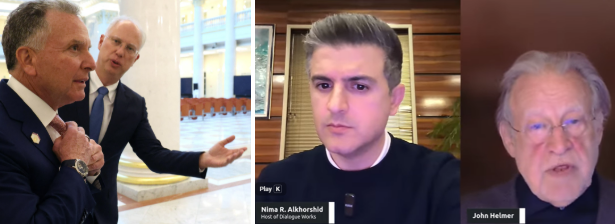
According to Ushakov, the US side comprised Steven Witkoff, Jared Kushner, and Joshua Gruenbaum. Ushakov omitted to list the Russian side, but the published photographs indicate they were President Vladimir Putin, Ushakov, and Kirill Dmitriev, the Russian business representative who had met the Americans in Paris earlier this week.
Ushakov identified Gruenbaum as the new participant. He described him as “a senior adviser to the White House, an expert on the economic dossier.” Ushakov, a veteran Russian ambassador in Washington, knows this is inaccurate.
Gruenbaum, 39, a law and business school graduate in New York, used to be a salesman for takeover and restructuring of distressed assets at two New York investment funds, Moelis and Kohlberg Kravis Roberts (KKR). His first job in the new Trump Administration a year ago was to take over and restructure the federal government’s contract procurement operations at the General Services Administration (GSA) along the lines Elon Musk followed in taking over and restructuring the government’s personnel policies.
The GSA is part-time for Gruenbaum. A GSA spokesman has claimed: “many officials serve in multiple roles. [GSA] Commissioner Gruenbaum is honored that the President has trusted him to support additional critical work that the administration is doing — a trust based on the commissioner’s track record of taking on challenging tasks and getting things done.”
Gruenbaum’s priority is with Witkoff and Kushner. He has been an active member of the New York Jewish negotiating team with Israel’s Prime Minister Benjamin Netanyahu for the post-military control of Gaza under Trump’s Board of Peace (BOP). In that role, Trump has just promoted Gruenbaum to become, with Aryeh Lightstone, “senior advisers to the Board of Peace, charged with leading day-to-day strategy and operations, and translating the board’s mandate and diplomatic priorities into disciplined execution.” The Jerusalem Post reports that Gruenbaum will play “a key role in helping BoP members with day-to-day operations.”
The connection between Gruenbaum’s role in the Gaza negotiations and his new place at the Ukraine talks is a swap — Russian sources believe — between the militarized reconstruction of Gaza which Trump is planning and the future of the four regions of Novorossiya which Putin is planning and the General Staff are fighting for. This swap, tabled overnight in the Kremlin, is Putin’s agreement to sit on the BOP board and accept the US-Israeli plan for Gaza in exchange for Trump’s agreement to the Russian territorial terms for a Ukrainian peace settlement.
The third element in the swap was signalled in Ushakov’s read-out, acknowledging “the situation in Greenland” was also “discussed.” But Putin had already signalled his concession the evening before, January 21, in a staged question-and-answer at the Security Council. “As for Greenland. What is happening around Greenland does not concern us in any way.”
(more…)