- Print This Post Print This Post

DwB_1651

By John Helmer, Moscow

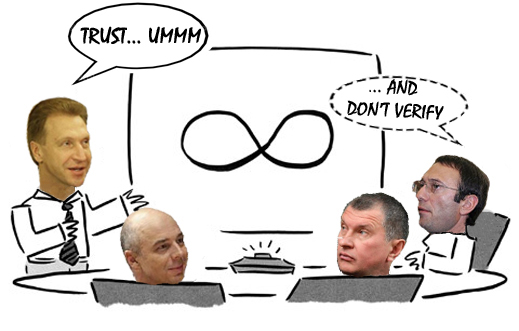
President Vladimir Putin has lost the war. Not the one with Washington for the future of Europe, eastern Ukraine, and the Kremlin itself. That war isn’t going so badly for Putin. The one he is losing is with the Russian oligarchs on whether they will repatriate their assets from their offshore havens, subject themselves to genuine auditors, and pay Russian tax.

Putin conceded defeat, a powerful international banker believes, when the president announced late last month that he accepts the establishment of Russian trusts to hold assets and income onshore and offshore without liability to pay domestic tax. According to Putin on March 25, “this is an innovation in our legislation, which before we didn’t have.”

“Russian capital,” the banker says, “has been saying from the beginning of the conflict in Ukraine that it wants Putin to abandon his deoffshorization plan. It’s going to succeed because the sanctions imposed since the conflict began have cut off the regular supply of capital to Russia. Capital isn’t patriotic, at least not in Russia. Putin is obliged to pretend he can persuade the oligarchs to act in the country’s interest. But he’s pretending. The proposed new law on trusts shows it.”
(more…)

- Print This Post Print This Post

DwB_1649

By John Helmer, Moscow

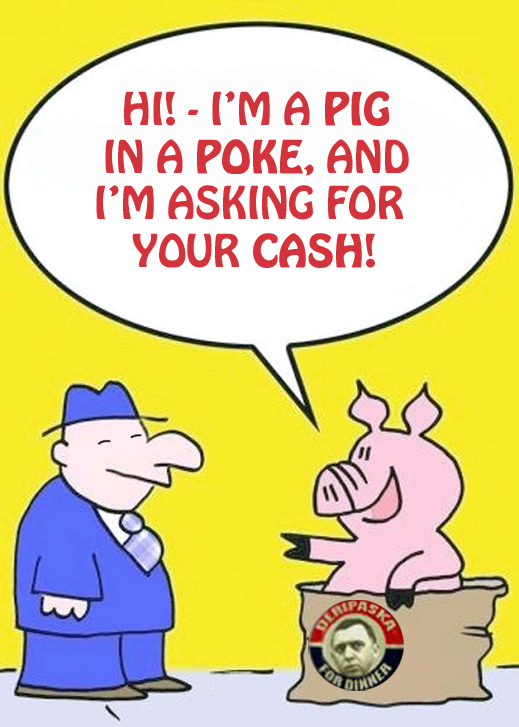
Insiders at the Russian aluminium monopoly Rusal say that chief executive and control shareholder Oleg Deripaska has been miscalculating the effect of share price surges Rusal has enjoyed on the Hong Kong Stock Exchange in recent weeks. That’s because the share price gains have been quickly reversed – and because Rusal’s most important lender, state owned Sberbank, is unpersuaded that the value of the company is gaining.

Sources on the Hong Kong exchange acknowledge a case officer has been assigned to monitor share trading of Rusal, and that he has been aware of abnormal trade volumes on several days in February and March, along with seesawing in the price of the share. But the Exchange chief executive, Charles Li, is reluctant to confirm what the exchange has done to uncover what happened and enforce exchange trading rules. The exchange is also afraid of being accused of covering up irregular trading practice and inside information. According to Li’s spokesman, Scott Sapp, “HKEx does not comment on individual companies or its regulatory actions.” Sapp then asked not to be named.
(more…)

- Print This Post Print This Post

DwB_1650

By John Helmer, Moscow

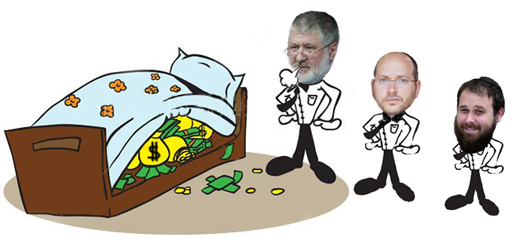
When Ukrainian warlords need a well-earned rest from fighting the civil war, there’s always Cleveland, under State Department protection, or Miami for the warm weather.

Igor Kolomoisky has accumulated more than a quarter of a billion dollars in US investments through a chain of front companies which stretch from several American states to Miami, Florida, to Cyprus, and to the Caribbean. He has also managed to keep his name out of the public record of the American transactions. But the money trail in some of his deals, and at least one of his partners, have come under scrutiny by US and state government agencies, and federal courts in several US states.

Kolomoisky himself, according to a Kiev source and a federal US court filing in December 2012, “has traveled to the United States over the past few years and should have no trouble obtaining a visa.” Kolomoisky has been in the US in recent days, reportedly on a restricted visa, in order to discuss his future and the future of his American assets with US Government officials. Public records reveal that the value of these assets has been falling sharply, and that some may be sold in debt default auctions unless Kolomoisky can persuade state and federal government agencies to provide subsidies, concessional utility rates, tax and other credits.

Sources in Cleveland, Ohio, where Kolomoisky has control over several downtown buildings and a hotel, report that his assets there have lost market value since he acquired them. “Out of state investors think they will make a ton of money,” one of the sources said. “they don’t. I don’t think [Kolomoisky] made any money [in Cleveland].”
(more…)

- Print This Post Print This Post

DwB_1648

By John Helmer, Moscow

The Canadian Government announced last week it is giving away another
C$200 million to Ukraine, topping the $200 million handed to Kiev last September.

A spokesman for Foreign Minister Rob Nicholson concedes the money is not being audited as the announced loan agreements require. Nicholson, according to Johanna Quinney in Ottawa, doesn’t know whether the first $200 million has been spent through the Ukrainian budget on military operations in the civil war in the east, or against Russia. In signing for the money to fund the war, Nicholson, who is running for election in six months’ time in the Niagara Falls constituency near the US frontier, may be violating Canadian law, Ottawa sources say.
(more…)

- Print This Post Print This Post

DwB_1646a_

By John Helmer, Moscow

The Cyprus Government’s unit for combating money-laundering will consider an investigation of Igor Kolomoisky if it is requested by the Ukrainian or US Governments, Eva Papakyriacou revealed on Tuesday. Papakyriacou is the head of the unit, whose acronym, following the Greek, is MOKAS.

She declined to say if there has been a request for investigation, either by a foreign government, or by the Cyprus government agencies responsible for Kolomoisky’s Cyprus passport, or the source of funds of his Privatbank group in Cyprus. “All the information possessed by MOKAS is confidential,” Papakyriakou said. “However, it is noted that the source of funds is checked by the Banks and the Supervisory Authority for Banks is the Central Bank.”
(more…)

- Print This Post Print This Post

DwB_1647

By John Helmer, Moscow

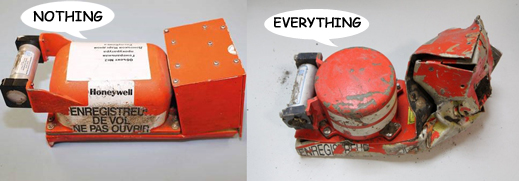
On July 17, 2014, at 1320 Universal Time Coordinated (UTC)* , Malaysian Airlines flight MH17 crashed in eastern Ukraine. The investigating authority, the Dutch Safety Board (DSB), reported within five days that the two black boxes, the cockpit voice recorder (CVR – lead image, left) and the flight data recorder (FDR), had been recovered. On September 9, eight weeks after the crash, the DSB issued what it called a preliminary report.

On March 24, 2015, at 1041 local time, Germanwings flight 4U9525 crashed in southeastern France. The first black box, the CVR (lead image, right), was recovered within the first 12 hours, and the contents reported to the media by investigators of the Bureau d’Enquêtes et d’Analyses pour la sécurité de l’aviation civile (BEA). The second black box, the FDR, was found on April 2. The BEA released a summary of what it contained one day later. According to French reporters, the time elapsing between the discovery of the CVR and public disclosure of its contents was less than 24 hours – “overnight we went from zero information to knowing everything”, Paris-Match has reported.

Comparing the two crash investigations, the Dutch and the French, the disclosures have been very much slower in release for the MH17 case – and almost totally unrevealing. Is this evidence about what really happened to the aircraft – or is it evidence about the forces to which the investigators have succumbed?
(more…)

- Print This Post Print This Post

DwB_1645

By John Helmer, Moscow

Forgery in the Russian art market is diminishing. “The situation is becoming much better. There are now very few fakes,” reports James Butterwick, a London-based dealer and specialist in Russian art. “This has nothing to do with the experts. The market is the expert now, and it’s become very difficult to buy a picture of dubious authenticity. Save us from the academics and the connoisseurs.”
(more…)

- Print This Post Print This Post

DwB_1644

By John Helmer, Moscow

Oleg Deripaska, control shareholder and chief executive of the Russian state aluminium monopoly Rusal, hasn’t exactly made a positive rate of return for Asian investors. In fact, share-buyers at the Hong Kong Stock Exchange are likely to conclude that he’s made a hash of every venture he’s tried to bring to that particular market.

Starting with Rusal, the first Russian corporate issue on the Hong Kong exchange, the share dropped 8% on its debut in January 2010, and the company has subsequently lost more than half its initial capitalization. Why then should Deripaska risk his reputation and asset value again with a fresh offer to Asian investors, particularly the Chinese? Answer: he has no reputation and little asset value left to lose.
(more…)

- Print This Post Print This Post

DwB_1641

By John Helmer, Moscow

War, devaluation, and recession aren’t usually something to drink champagne to. So it was inevitable that Abrau-Durso, Russia’s only champagne house listed on the stock exchange, would suffer.

When President Vladimir Putin told the leadership of the Federal Security Service (FSB) on Thursday that “the situation cannot remain like this forever. It will change, for the better I hope,” he wasn’t exactly raising a toast in bubbly. The situation, added Putin, “will not change for the better if we succumb and yield at every step. It will only change for the better if we become stronger.”

Abrau-Durso has an anti-crisis strategy. This is to expand its vineyards; substitute home-grown for imports of wine-making materials from South Africa, Chile, and southern Europe; reduce costs and the sale price of each bottle; sell more wine at a lower margin of profit; combat what Abrau-Durso executives regretfully call “contempt for Russian wine.”
(more…)

- Print This Post Print This Post

DwB_1640

By John Helmer, Moscow

The late Yegor Gaidar, when acting prime minister of Russia, thought up the idea of the Yeltsin Tax. The late Boris Nemtsov didn’t think it was such a bad one when he was first deputy prime minister. The one still surviving officeholder responsible for the idea is Anatoly Chubais, chief executive of the state technology corporation Rusnano; he is unelectable to anything and fortunate to be alive. Their idea was the 100-percent withholding tax which Russians name after President Boris Yeltsin and his reforms.

In practice, it was the outcome of deliberate delay in paying wages by state and public institutions, for lack of budget funds from the federal Finance Ministry; and refusal to pay wages by commercial organizations, shareholding corporations, and private companies.
(more…)