- Print This Post Print This Post

DwB_1716

By John Helmer, Moscow

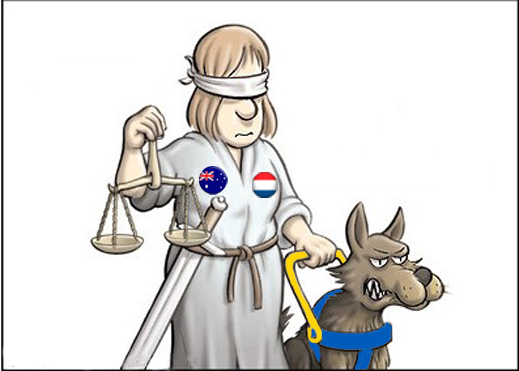
The Australian Government is sure the Dutch Safety Board (DSB) investigation of the downing of Malaysian Airlines MH17 will fail to identify the precise cause of the crash, and will be inconclusive on who and what were responsible. A report, termed final by the DSB, is scheduled for release on October 13.

So certain of the outcome are Australian officials that since May they have been negotiating with the Dutch Government to extend for another year until August 2016 a treaty agreement for Australian police, intelligence agents and Defence Ministry officers to operate in The Netherlands. Without Australian bodies left to identify or repatriate, and only the debris of the MH17 aircraft in partial reconstruction in a hangar at the Hilversum Army Barracks, Dutch and Malaysian sources are questioning what purpose is served by the treaty extension.

In July the Australian and the Netherlands governments signed a protocol for the extension of the Australian military operation on Dutch territory. The original pact of August 1, 2014, and its protocol also provide that while they in The Netherlands, even inside the Hilversum base, the Australians will carry arms, and employ other weapons, including explosives; the pact also protects them from Dutch law if they hurt locals while using their arms. “Are the Australians armed to guard the evidence in The Netherlands,” asks a Dutch source, “to prevent it from being disclosed publicly? Are the Australians arming themselves against the Dutch?”
(more…)
- Print This Post Print This Post

dwb_1717b

By John Helmer, Moscow

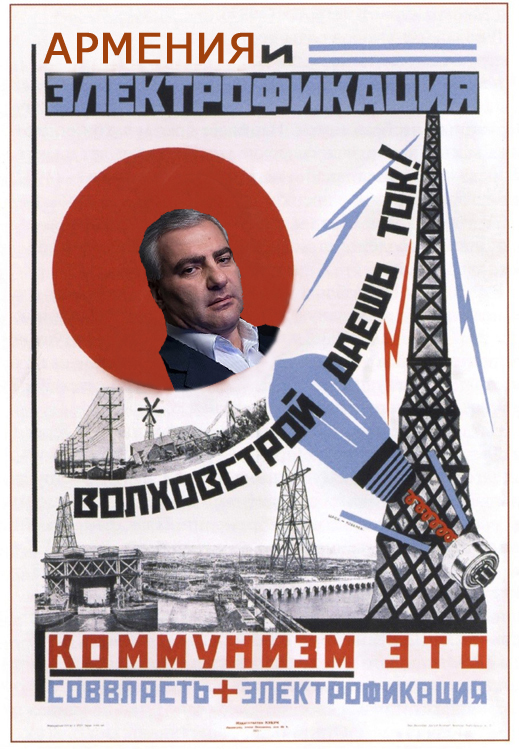
Samvel Karapetyan (lead image) had a fortune last week of $4.6 billion. This, according to profiles in Forbes Russia, he made all by himself from Russian property development. The dollar number puts Karapetyan at No. 26 on the ladder of fortunes in Russia, where he lives and works; number 1 in Armenia, Karapetyan’s motherland and the location of his family’s alliance with the President of Armenia, Serzh Sargsyan, and his ruling Republican Party.

Karapetyan’s importance and visibility have recently leaped because of a deal in which Inter RAO UES, the large Russian power utility, has sold its 100% stake in the Electricity Networks of Armenia (ENA). The sale and purchase are reported to have taken place at a fraction of ENA’s asset value which Inter RAO reported on December 31, 2014, following a year in which ENA’s earnings tripled. Karapetyan appears to be the buyer, but through a spokesman at his Tashir Group in Moscow, he is refusing to say so. Inter RAO – the fifth most transparent power company in Russia in 2009, according to the company website — is also not confirming the sale. “We are not commenting,” the company spokesman said this week, “on the Armenia subject.”

The deal is exceptionally sensitive in Armenia, because ENA’s attempt between June and August to raise its electricity tariffs triggered countrywide protests. These have obliged Sargsyan and his ministers to back down, announcing last week that the 16% hike is being abandoned. At the same time, Gazprom has agreed to lower its gas supply price for Armenia’s power plants. Other financial sweeteners following from the Kremlin have included a $200 million military loan. According to Armenian commentaries and those of US and European political analysts, the ENA transaction, the protests, and the Russian reaction are the latest moves in the geopolitical contest between Russia, which controls most of the country’s energy sources through Gazprom, and the US, which is encouraging Armenia to reduce its dependence on Moscow, and taking over the big Vorotan hydroelectric combine through the World Bank and a New York-based company called Contour Global. What then is Inter RAO selling, and what is Karapetyan buying, if neither of them will say?
(more…)

- Print This Post Print This Post

DwB_1714_2

By John Helmer, Moscow

Something funny happened to the clown in the laundry. When he went in, the pockets of his pants were empty. When he came out, they were overflowing with money. “What kind of washing detergent do you use here?” he asked.

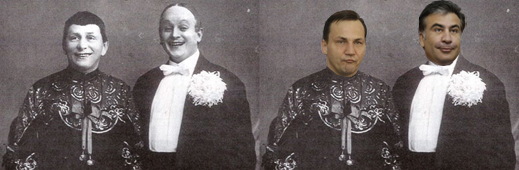
Not even under the circus big-top, with a troop of elephants trumpeting in the background, does this sound particularly funny. But if you know that the laundry the clown means is a political metaphor (the elephants, too), then the audience will fall out of their seats with laughter. That was what made Bim & Bom (lead, left) , the most famous clowns to perform in Russia between 1890 and 1940, too endearing for the authorities, even the Cheka and Stalin, to stop.

In today’s tale, the clowns are Sikkie and Sakkie (right) — Radoslaw Sikorski, sacked foreign minister of Poland, sacked Marshal of the Sejm (parliament Speaker); and Mikheil Saakashvili, indicted President of Georgia. The money laundries in their performances are better known as think-tanks — the Polish Institute of International Relations (PISM), the Center for European Policy Analysis (CEPA), the Saakashvili Presidential Library. In this show the bit parts and pratfalls are played by Marcin Zaborowski, Anne Applebaum, Edward Lucas, and several Greeks.
(more…)

- Print This Post Print This Post

Dwb_1713

By John Helmer, Moscow

Smelting aluminium is a dirty business, so it’s every smelterman’s dream to recuperate on a tropical island far from the Big Smoke. Denis Island, for example, three balmy degrees south of the Equator in the Indian Ocean. And so, once upon a recent time, Oleg Deripaska (lead image), control shareholder of the Russian aluminium monopoly Rusal, downed tools, shut the door on his potline, and flew off. To Denis Island, where he was accompanied by his own valets, cooks, servers, and maids.

Or is this the fantasy of Rusal employees, fearful of wage payment delays and job losses looming in the management’s new plan, according to an insider at Rusal headquarters in Moscow? “The crisis will not miss a single industry,” Deripaska predicted early in the year. “’The worst is yet to come.” For whom? Rusal insiders at Moscow headquarters ask.
(more…)

- Print This Post Print This Post

DwB_1715

By John Helmer, Moscow

Presidents Vladimir Putin and Barack Obama have on file three pieces of evidence showing both of them knew what had caused the crash of Malaysian Airlines MH17, and of the deaths of all 298 souls on board. They knew it little more than two hours after the crash had occurred in eastern Ukraine. They also knew each other knew it, because they discussed what had happened in a telephone call which took place before 19:45 Moscow time, 11:45 Washington time, on Thursday, July 17. MH17 was downed that day at 16:20 Ukraine time, 17:20 Moscow time, 09:20 Washington time.

The first piece of evidence is the agenda paper for the telephone call. This had been negotiated and formalized by the Russian Foreign Ministry, the Russian Embassy in Washington, the State Department and the White House before July 17. The second piece of evidence is the tape of the Putin-Obama conversation, as recorded by the Kremlin. The third piece of evidence is the tape of the Obama-Putin conversation, as recorded by the White House.

This evidence establishes that Putin believed, and Obama believed Putin would announce, not that a ground-to-air missile had brought MH17 down, but that other weapons had done so. The story that a Russian-made Buk missile had caused the disaster began after Obama had spoken to Ukrainian President Petro Poroshenko at about 19:00 Kiev time, 20:00 Moscow time, 12 noon Washington time.
Take away that story, because Obama knew it to be false when he had spoken earlier to Putin, and what do you have? A war crime by two governments. How to prove innocence and guilt? The tapes at the Kremlin and the White House.
(more…)

- Print This Post Print This Post

DwB_1712_2eyw

By John Helmer, Moscow

Political responsibility and legal liability, like fish rot, start at the head. President Barack Obama’s and President Vladimir Putin’s heads, to be exact.

For evidence of the destruction of Malaysian Airlines Flight MH17, and of the 298 people on board, what the two presidents knew from the start — before the start, in fact – was revealed in a telephone conversation the two of them held three hours after the crash. Today, fourteen months later, it is now certain what they didn’t know, and didn’t discuss, because it didn’t happen. One of those things was an explosion of a Buk ground-to-air missile on the port (left) side of the aircraft. Why that didn’t happen has now been revealed in the only direct physical evidence admissible so far in international courts of law. This is the post-mortem evidence of the 296 individuals, and 700 body parts recovered from the aircraft.

The coroners of the UK and Australia say they will not test this evidence for the foreseeable future; by a loophole in the coronial law they may refuse to consider it at all. In Germany and The Netherlands, lawyers say there is no independent coronial court for investigation of cause of death . German state police and the Dutch-led Joint Investigation Team (JIT) are not independent of their governments; nor of the Ukrainian Government’s right as a JIT member to veto what is investigated, what is disclosed, who to convict.

The only courts in which it will be possible to consider this evidence are the European Court of Human Rights (ECHR) in Strasbourg, and the International Criminal Court in The Hague. The first is now the venue of a case brought by the daughter of Wilhelm Theodore Grootscholten, 55, a Dutch victim of the MH17 crash. The second is to decide who is responsible for the death of Fatima Dyczynski, 25, also Dutch. The defendants charged with culpability in the loss of their lives are the Government of Ukraine; Dutch officials at the time of the crash, Minister of Security and Justice Ivo Opstelten and Fred Teeven, the State Secretary for Security and Justice; the International Civil Aviation Organization; and the European Organisation for the Safety of Air Navigation (Euro Control).
(more…)

- Print This Post Print This Post

DwB_1712_

By John Helmer, Moscow

The Dutch Government has decided to launch a missile attack on Moscow in October. By suppressing all evidence obtained from the bodies of victims of the crash of Malaysian Airlines MH17, officials of the Dutch Safety Board and associated Dutch military officers, police and prosecutors are preparing to release a report on the crash with a gaping hole in its veracity.

At the same time, and apparently unknown in The Netherlands, an Australian coroners’ report on the identification and forensic testing of the bodies carried out in The Netherlands reveals post-mortem evidence to show that in their public statements the Dutch government officials have been lying about metal evidence they claim to have found. This evidence has not only been buried with the passengers’ remains. It has been buried by the Dutch Government and by coroners in the UK and Australia, who are now legally required to investigate independently what caused the deaths of citizens in their jurisdiction. All are withholding the CT scans, X-rays, autopsy and other post-mortem results, including metallurgical assays, the documentation of which accompanied the coffins of the aircraft’s victims from The Netherlands to their homelands.
(more…)

- Print This Post Print This Post

DwB_1711

By John Helmer, Moscow

Vladimir Yakunin, the recently replaced boss of Russian Railways, says President Vladimir Putin saved his bacon when he was fired the first time in June 2013, and then a second time a year ago. But last month, Yakunin has been telling his friends, it was Putin who made a pig’s breakfast of himself. On August 18, the day after Yakunin disclosed what he claims was his resignation, Putin said the move had been Yakunin’s choice, adding: “I have yet to speak to him about it.”

For Yakunin to appear to have been driven out of Putin’s “inner circle” – the US Treasury uses that term; the White House prefers “cronies” – has triggered speculation in the Anglo-American media that the US campaign against the Kremlin has begun to produce the first signs of regime crack-up.

Yakunin is encouraging the speculation himself by telling his friends that his ouster is political, maybe ideological, but nothing to do with the state of Russian Railways (RZhD) or the capacity of the state budget to cover its rising costs and growing losses. Putin won’t listen to him any longer, Yakunin is confiding. The President is isolated more than ever before, he adds. For the usually loyal Yakunin to be saying this, even if quietly and to non-Russians, can only mean that reality is getting away from one of them. Some of Yakunin’s foreign friends like to think it’s Putin. The Russians think it’s Yakunin himself. “He’s lost his usefulness to the boss,” says one. “Age and the arrogance of power have overtaken his sense. He hasn’t been defeated by Putin’s enemies. He’s defeated himself.”
(more…)

- Print This Post Print This Post

DwB_1708b

By John Helmer, Moscow

Cyprus Government investigators have opened an inquiry into ex-Senator Leonid Lebedev (lead image) for transfers into a hidden Cyprus trust of $150 million in cash allegedly stolen from the regional Russian electricity company TGK-2 and a related company, TKS. Investigations by Russian prosecutors and the Ministry of Internal Affairs (MVD), reported to court hearings in Yaroslavl, have counted almost $240 million Lebedev has been accused of stealing through a chain of companies associated with his Sintez group, ending up in Cyprus. A Russian Government request for the Cypriot authorities to open Lebedev company registers and tax filings has been confirmed as triggering criminal checks on the island.

The Cyprus authorities are also checking how Lebedev managed to obtain a Cyprus passport in 2011; and the source of the funds he pledged to place in Cyprus to meet the €5 million requirement for buying citizenship. That was a year before Lebedev swore in the Limassol District Court that he was a Russian citizen, without assets in Cyprus, and “impossibil[ity] to travel to Cyprus”. His testimony was in response to a lawsuit by Commerzbank of Germany charging Lebedev with $240 million in loan fraud. At the time, Lebedev was a Politically Exposed Person (PEP), according to Cyprus and European Union regulations, and subject therefore to much tougher official checks.

Lebedev also hid his Cyprus nationality from the Federation Council, where he was the senator for the Chuvash Republic between 2002 and April of this year. For more on his dismissal, read this.
(more…)

- Print This Post Print This Post

DwB_1709

By John Helmer, Moscow

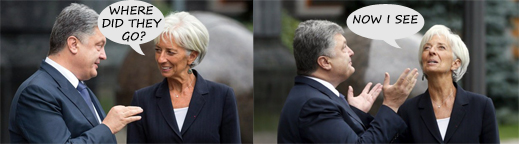
In Kiev on Sunday, Ukrainian President Petro Poroshenko complained that he isn’t getting cash from the International Monetary Fund (IMF) fast enough. Christine Lagarde, the IMF’s managing director, told him to stick to the Fund conditions, but she also promised to go soft on whether the IMF will stop the money if Ukraine decides not to repay the $3 billion bond owed for repayment to Russia in December.
(more…)