- Print This Post Print This Post

By John Helmer, Moscow

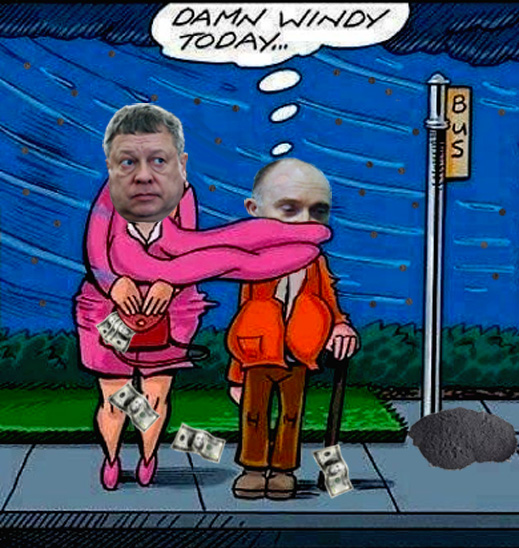
Sergei Ivanov had been in charge of protecting Russia’s environment for just ten weeks when he arrived in Chelyabinsk city last November 1. The former Kremlin chief of staff and principal advisor to President Vladimir Putin took with him a large delegation of federal officials, including a deputy prime minister, the minister of natural resources and environment, and the chief of the environmental control agency, Rosprirodnadzor,  to meet Boris Dubrovsky, the Chelyabinsk governor (lead image, right).  

Much was promised for cleaning up the air of the city and region. A month later, on December 5, President Vladimir Putin visited Chelyabinsk region, and flew by helicopter with Dubrovsky over several of the worst air pollution areas.  Dubrovsky announced  that he favoured a new set of air control standards for enforcement by federal and regional governments. Putin replied with the acknowledgement that air pollution was especially serious in Chelyabinsk.  He claimed: “we need to encourage entrepreneurs, and industry to apply the latest technology, the best technology available. This program starts to work, and I very much hope that it will have the desired effect in 2017.”

Then in mid-January the smog struck Chelyabinsk city. Ivanov, Dubrovsky and Putin had all failed to prevent the longest air pollution crisis in the city for years.  Mechel’s owner, Igor Zyuzin (lead image, left), had succeeded in keeping his plants operating with minimal interruption, a promise to do better, and no criminal charges.  A local environmental activist says:  “People in the west think Putin is so powerful he can change the outcome of elections in the US, UK, France and Germany. So how come he can’t put a stop to the говно in the Chelyabinsk air coming from one oligarch who owns the plants?” (more…)

- Print This Post Print This Post

By John Helmer, Moscow

As if it weren’t already certain, President Vladimir Putin intends to run again for president in 2018. He has made this visibly obvious (lead image), though it’s not yet officially so. The  signal  Putin has chosen – a unique one in the history of European and American leaders of state —  is one which kings display on their chests. That’s peaked lapels instead of notched lapels on their suit jackets. Until Putin,  the last president in Moscow to wear peaked lapels was Mikhail Gorbachev. By the time he did that in August 1991, he had just five months left in power.  

(more…)

- Print This Post Print This Post

By John Helmer, Moscow

In the US, UK, and Germany –  leaders of the worldwide campaign to attack Russia  and overthrow President Vladimir Putin – the taste for Russian vodka jumped in 2016 after falling sharply during 2014 and 2015. Russian vodka drinkers, too, started to recover their taste in September, October and November of last year. According to a report from one of the leading Russian vodka brand-name producers, the September-November time period was also when the volume of vodka sold domestically showed the first signs of growth since 2014. Overall, the volume of vodka sold in Russia grew by 6% in that interval; by 8%,  if the cheapest vodka brands are excluded.

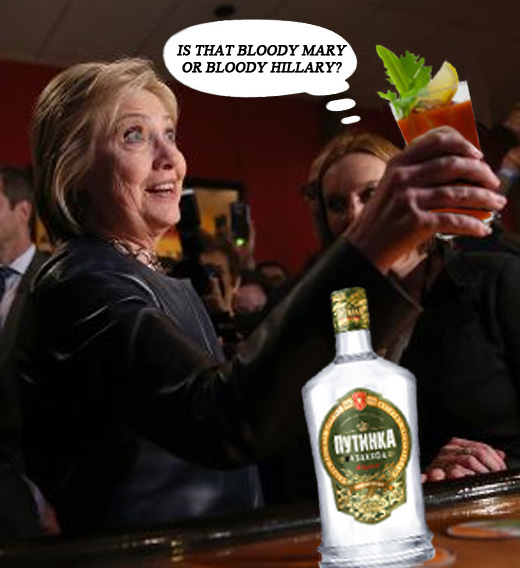
The Russian vodka taste test doesn’t mean, however, that those who have been losing their war against Russia are drowning their sorrows, as Hillary Clinton (lead image) did on election night in November, when Donald Trump defeated her for the US presidency, and Clinton became paralytically drunk.   For one thing, according to reporting from the Moscow Centre for Federal and Regional Alcohol Markets (TsIFRRA), the greater volume of vodka consumed abroad reflects a recovery from the fall in vodka exports which started in 2014, particularly in Ukraine. It is also a sign of demand from the larger numbers of affluent Russians who have fled the homeland, along with their cash, in the past two years.  

The reason for the increase in domestic shipments of vodka and consumer sales, according to TsIFFRA, is the shift in consumption from illegal vodka to legal vodka, as government control of vodka sales gets tighter. Russians aren’t drinking more vodka these days, TsIFFRA says — they are drinking better quality vodka, paying more, but are no happier, nor drunker,  than they were in 2013, before the war against life in Russia began in earnest.   (more…)

- Print This Post Print This Post

By John Helmer, Moscow

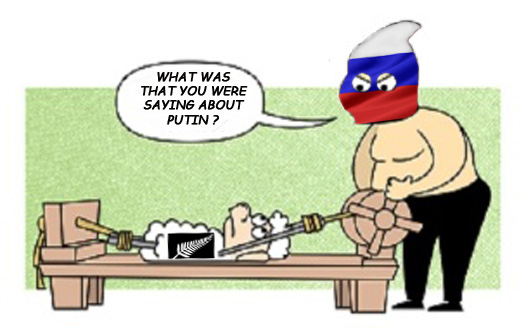
The Russian government this week fired a new shot across the bows of New Zealand, one of the Obama Administration’s staunchest allies in the Pacific and on the Ukraine and Syrian warfronts.

Starting on Monday next, February 6, imports of New Zealand beef will be banned by the Russian Service for Veterinary and Phytosanitary Surveillance (Rosselkhoznadzor, RSN). The results of testing by RSN confirmed   “numerous identifications of bacteria of the Listeria monocytogenes type.” In addition, traces of the prohibited hormone growth additive ractopamine had been detected in NZ beef offal.  Accordingly, RSN said, it was commencing “temporary restrictions on deliveries to Russia of beef and beef offal from New Zealand”; the offal is a common  ingredient in Russian sausage manufacture.  The announcement from RSN added: “Rosselkhoznadzor also considers the possibility of entering of temporary restrictions on import from New Zealand to Russia of fish products, in connection with numerous identifications in consignments of New Zealand fish of bacteria of  Listeria monocytogenes type,  and higher than admissible levels of mercury.”

NZ lamb and mutton exports to Russia have not been mentioned by RSN, and are not affected for the time being.

The threatened ban on NZ fish is not new. The threat was first announced last  October 5, days after the NZ prime minister at the time, John Key, issued a public insult to President Vladimir Putin, and attacked Russian policy in the Ukraine and Syria. Read the full story here

Weeks later, on December 4 Key announced his surprise retirement. NZ press reports claimed that Key’s wife had forced the move, not Putin. (more…)

- Print This Post Print This Post

By John Helmer, Moscow

When His Holiness Patriarch Kirill of Moscow and All Russia (lead image, left) made a speech to the State Duma last week, it was both more, and less,  than a case of preaching to the converted.

This is because investigations by the Central Bank, the Deposit Insurance Agency of Russia, a handful of Russian reporters and whistleblower churchmen have revealed evidence that the Church has been operating elaborate schemes for converting state funds into private profits, causing a string of Church-controlled banks to go into bankruptcy,  and then into state-funded bailouts.  Taxpayer and state budget funds, and cash belonging to state corporations, have been moved through deposits in these banks, supervised by the patriarch himself, into political donations to United Russia and other groups of parliamentary deputies; into construction contracting at church properties; and into related-party loans and investments which have disappeared offshore, never to be recovered or repaid. 

Of six Russian banks in which the Church has large shareholdings and control stakes since 1995, five have gone bust; been delicensed by the Central Bank; or been charged with criminal fraud, embezzlement and money-laundering offences. In three of the most recent Church bank insolvencies, Vneshprombank (VPB) in October 2016, Peresvet in December 2016, and Ergobank two weeks ago, the gap between assets and liabilities is already believed to be at least Rb 300 billion ($5.1 billion).  State auditors are expecting to count more money lost in the black hole. That is more money than Kirill is asking the State Duma to refinance for the Church from the 2016 budget, Central Bank reserves, and capital of the Deposit Insurance Agency (DIA).

The deputies of United Russia, the majority party in parliament, aren’t saying no; they aren’t inquiring either.  (more…)

- Print This Post Print This Post

By John Helmer, Moscow

A new campaign against the Russian devil has started in the US and UK media where the Hillary Clinton-for-President forces are strongest. The problem for them this time is that President Vladimir Putin is on the side of the angels. But he is unwilling to stop a power play by the Russian Orthodox Church.  Four out of five Russians, and an even higher number of Russian women, would back Putin if he did. (more…)

- Print This Post Print This Post

By John Helmer, Moscow

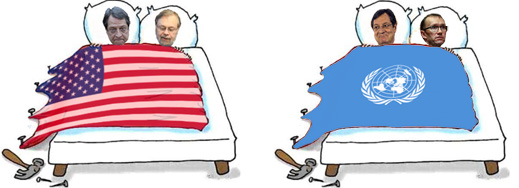
Cyprus President Nicos Anastasiades (lead images, left) has come under intense political and personal pressure to agree to terms of settlement for the future of Cyprus, swapping Turkish military occupation for European Union rights for all Turkish immigrants to the island — the former to be implemented over years; the latter to become effective immediately.  

The sensitivity of that deal, Cypriot, Greek and US sources said this week, is such a political bombshell  for Anastasiades seeking re-election in a year’s time that he wouldn’t be risking detonation, if not for a personal vulnerability he is facing at the same time.

Two New York Supreme Court releases this month reveal that  emails between Nicos Anastasiades’s family law firm and a wealthy Russian client, Leonid Lebedev (left lead, right side), were withheld when Anastasiades’s partner, Theofanis (Theophanis) Philippou, testified in a Cyprus court recently. Philippou has been one of Lebedev’s personal lawyers in Cyprus, and he has made official records of this. Anastasiades was also Lebedev’s adviser at the law firm and at the Imperium group of companies, which Philippou and Anastasiades operated to  manage their clients’ corporate business, personal trusts, and cashflow. Their relationships with Lebedev predate Anastasiades becoming president of Cyprus in February 2013.

It is that record which Philippou was ordered by the New York and Cyprus courts to produce. It is their sensitivity for the president now that has led to a cover-up.

(more…)

- Print This Post Print This Post

By John Helmer, Moscow

Mikhail Fridman (lead image, left) has enough problems not to want to make his position worse in the US, Europe and Russia – all at the same time.

There have been recent protests outside Fridman’s Alfa Bank branches in Moscow, St. Petersburg and Nizhny Novgorod, as well as inside the State Duma in Moscow, accusing Fridman of helping to finance the troops of the Kiev regime in combat on the Novorussian front.

Fridman’s Russian telecommunications company Vimpelcom – headquartered in Amsterdam, listed on the Nasdaq Stock Market in New York – has been under close supervision by US Government inspectors as part of an anti-corruption settlement of its activities in Uzbekistan a year ago. Then last week in Madrid, Fridman and Vimpelcom were reported to be under joint US-Spanish investigation for a fraudulent takeover attempt at the Spanish telecommunications and games provider, ZED+; and allegedly for paying bribes through ZED+ companies in Russia to associates of the current Russian Interior Minister, Vladimir Kolokoltsev.

The former chief executive of Vimpelcom Russia, Mikhail Slobodin, is in hiding, on the run from a  corruption indictment filed in the Russian courts last September. 

Fridman’s LetterOne holding has announced from London it will not be investing in Russia in future, and prefers the US instead. “It’s too risky,” Fridman told Bloomberg  last year. 

So why have the risk-averse Fridman and the fugitive Slobodin engaged the San Francisco-based, Russian-speaking Ukrainian Gregory Shenkman (lead image, right) when Shenkman is currently facing multiple court claims in Pennsylvania,  Delaware,  and California for millions of dollars in unpaid debts, alleged embezzlement, and sexual harassment?  Sources in California and also in Italy,  where Shenkman has been seen in recent days, claim Fridman needs the American “to hustle for the next generation of data applications technology — apps — to install on telephone devices and revive growth of revenues and profits. Shenkman is part of Fridman’s business shift out of Russia. But like ZED+, Shenkman is a big risk in the US.” (more…)

- Print This Post Print This Post

New broadcast by Chris Cook with John Helmer, Victoria, B.C., Canada

Click to listen   

Interview starts at Minute 37:15:

“Leave aside the ideology, leave aside the issues, leave aside the big policy politics: there’s one thing you don’t do when you make a foreign minister your country’s representative – you don’t put a liar in the job.”
(more…)

- Print This Post Print This Post

By John Helmer, Moscow

Chrystia Freeland (lead image), appointed last week to be the new Canadian Foreign Minister, claims that her maternal family were the Ukrainian victims of Russian persecution, who fled their home in 1939, after Adolf Hitler and Josef Stalin agreed on a non-aggression pact and the division of Poland between Germany and the Soviet Union. She claims her mother was born in a camp for refugees  before finding safe haven in Alberta, Canada. Freeland is lying.     

The records now being opened by the Polish government in Warsaw reveal that Freeland’s maternal grandfather Michael (Mikhailo)  Chomiak was a Nazi collaborator from the beginning to the end of the war. He was given a powerful post, money, home and car by the German Army in Cracow, then the capital of the German administration of the Galician region. His principal job was editor in chief and publisher of a newspaper the Nazis created. His printing plant and other assets had been stolen from a Jewish newspaper publisher, who was then sent to die in the Belzec concentration camp.  During the German Army’s winning phase of the war, Chomiak celebrated in print the Wehrmacht’s “success” at killing thousands of US Army troops. As the German Army was forced into retreat by the Soviet counter-offensive, Chomiak was taken by the Germans to Vienna, where he continued to publish his Nazi propaganda, at the same time informing for the Germans on other Ukrainians. They included fellow Galician Stepan Bandera, whose racism against Russians Freeland has celebrated in print, and whom the current regime in Kiev has turned into a national hero.

Just before Vienna fell to the Soviet forces in March 1945, Chomiak evacuated with the German Army into Germany, ending up near Munich at Bad Worishofen.  On September 2, 1946, when Freeland says her mother was born in a refugee camp, she was actually in a well-known spa resort for wealthy Bavarians.  The US Army then controlled that part of Germany; they operated an Army hospital at Bad Worishofen and accommodated Chomiak at a spa hotel.  US Army records have yet to reveal what the Americans learned about Chomiak’s war record, and how he was employed by US Army Intelligence, after he had switched from the Wehrmacht.  It took Chomiak another two years before the government in Ottawa allowed the family to enter Canada.

The reason the Polish Government is now investigating Freeland is that Chomiak’s wartime record not only victimized Galician Jews, but also the Polish citizens of Cracow.  In a salute to Freeland as a “great friend of Poland” by the Polish Embassy in Ottawa last week, Warsaw officials now believe a  mistake was made.   (more…)