- Print This Post Print This Post

By John Helmer, Moscow

Dmitry Pumpyansky’s (lead images) TMK, Russia’s largest steel pipemaking company, has announced that it is withdrawing its initial public offering (IPO) of shares in its US subsidiary, which had been planned for later this month on the New York Stock Exchange.  The announcement has appeared in the western media, but not yet on the TMK website. TMK planned to retain 62% of the US company after the IPO; Pumpyansky controls 65% of TMK through a Cyprus offshore entity called TMK Steel Holding Ltd.  

TMK’s Houston-based subsidiary known as IPSCO issued this release on Thursday, Texas time. “IPSCO Tubulars Inc. (“IPSCO”) today announced that it has decided to postpone its proposed initial public offering of its shares of common stock due to adverse market conditions. ‘While we received significant interest from potential investors, the continued market and economic volatility are not optimal conditions for an initial public offering,’ said Piotr Galitzine, Chairman of the Board of Directors and Chief Executive Officer of IPSCO. ‘As a company, we’ve consistently made decisions in the best interests of our stockholders, employees and customers, and we will continue to do so.’”

Pumpyansky had been attempting to double his money. The attempt to spin off his American steel and pipemaking operations to American investors for a price approximately equal to the TMK group’s  market capitalization was promoted by US banks seeking to recover loans they had extended; and by Anatoly Chubais, long one of the US Government’s candidates to rule Russia instead of the Kremlin incumbents since 1999. Chubais runs the state holding Rusnano, which bought a 5.5% stake in TMK in 2015. (more…)
- Print This Post Print This Post

By John Helmer, Moscow

‘All politics is local’ was something Tip O’Neill, the late Massachusetts congressman and Speaker of the US House of Representatives, used to say. ‘A week is a long time in politics’ was something Harold Wilson, the late British Prime Minister, said at about the same time. 

This week,  you have several illustrations of putting the two together on battlefields in Syria, Russia’s southern front,  and in the international financial  markets. There, officials of the Trump Administration in Washington have pulled off attacks on Russian targets  – some visible and direct, some indirect and camouflaged. These have caused serious casualties and costs on the Russian side, and produced military and financial gains on the American  side. Plus hand-rubbing among Russia’s adversaries;  denial talk in Washington and New York.

(more…)

- Print This Post Print This Post

By John Helmer, Moscow

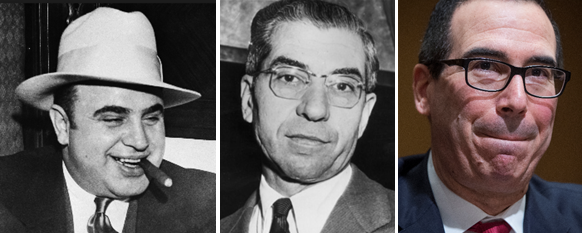
Steven (Steve) Mnuchin (lead image, right), a New York banker who has spent a year being Secretary of the US Treasury, is worse at dissembling his racket than his better-known American peers at racketeering,  Alphonse (Al) Capone of the Chicago Outfit (left) and Charles (Lucky) Luciano of the New York Commission (centre).  Mnuchin’s racket is billions of dollars bigger, but in legal principle and method, the fraud and extortion are much the same as the Outfit’s and the Commission’s. Mnuchin’s muscle is bigger too, though that requires warfare, which  the Outfit and the Commission were established to do without.  

Last week  Mnuchin  issued a Treasury report to Congress on the impact of US sanctions on Russian sovereign debt, which isn’t a report at all. It’s a leak to a news wire,  so sloppily arranged that one of the seven pages is a duplicate of the first, though the leaker didn’t notice he had slapped the same page on to the copier screen twice.  The US Treasury didn’t realize, Bloomberg, the newswire, didn’t check.  In the 228-year history of US Government reports to the US Congress, such a goof has never happened before.

The fraud in Mnuchin’s report is to claim in public that he is attacking Russian financial operations and the future of the Russian economy when he is doing something quite different in private, protecting advantages for the leading US investment banks in which Mnuchin has had a life-long family interest. The extortion is what Mnuchin’s agents abroad are privately saying to persuade  major foreign institutions competing with American ones not to buy or trade in Russian sovereign debt, when in public there is no legal authority for the US to do this.  

At the same time, Mnuchin is threatening  to do to Russian sovereign debt what the US has never done to a country with which it was in a Congressionally-declared war – not Spain, Germany, Austria-Hungary, Italy,  Japan. He also omits to identify what the consequences would be when China, the leading foreign holder of US sovereign debt, understands it will be next.  China (including Hong Kong) currently holds $1.37 trillion in US sovereign debt, and the figure has been relatively stable since 2010. Russia holds one-tenth of that amount — just $105.7 billion;  and it has been declining steadily over the same time. (more…)

- Print This Post Print This Post

By John Helmer, Moscow

Dmitry Pumpyansky (lead image, left), the 53-year old oligarch who dominates the Russian steel pipes business, knows how to pay for protection.

Last week the US Treasury listed him as an oligarch whose corruption record and closeness to the Kremlin may qualify him for sanctions, according to Section 241 of the Countering America’s Adversaries Through Sanctions Act (CAATSA). Pumpyansky is vulnerable to US asset freeze and credit cut-off because he owns steelmills, pipemills, bank accounts, and other assets in the US; about one-quarter of his sales revenues, profits and earnings are produced in the US. So why is he proposing to sell shares in his American business on the New York Stock Exchange in a few weeks’ time?

There are three answers. One is that Pumpyansky’s American business is the only loss-maker in his group, so he is selling the Americans a pup.  The second is that the American banks underwriting the initial public offering (IPO) of what is titled IPSCO Tubulars Inc. are also large lenders to the business;  so they are recovering their money, and reducing the risk that sanctions against Pumpyansky would hurt them in future. Finally, Pumpyansky is paying Anatoly Chubais (lead image, right) to influence US Government officials not to penalize Pumpyansky. Chubais, a board director of Pumpyansky’s parent company in Moscow, has been the American candidate for ruling Russia since he ran the state privatization programme from 1992; President Boris Yeltsin’s Kremlin; and then the breakup and selloff of the Russian electricity system. Chubais is the only powerful Russian state company official not to be named on last week’s US Treasury list. (more…)

- Print This Post Print This Post

By John Helmer, Moscow

As midnight tolled in Washington, DC, and January 29 slid into January 30, the deadline for the US Government to produce a report to the Congress listing Russian oligarchs close to President Vladimir Putin slipped by in the darkness. No dog barked.*

Required by the Countering America’s Adversaries Through Sanctions Act (CAATSA), enacted with President Donald Trump’s signature last August, the oligarch report was not produced on time. Nor were three other reports – one on sanctions for Russian sovereign debt issues, one on sanctions for business with the Russian defense sector, and one on the extent to which Russian state banks and state asset holdings have re-nationalized key sectors of the Russian economy, such as banking, insurance, real estate, and ports.     

There was no press release from the White House, the US Treasury, or the State Department. The  House Foreign Affairs Committee and the Senate Foreign Relations Committee, which are responsible for administering CAATSA, made no announcement of  what had happened, and  not happened. Despite a media blitz in advance of the deadline, anticipating the release of dozens of Russian oligarch names as potential targets for fresh US sanctions, not a single mainstream US newspaper or broadcaster reported the failure of the list to materialize.

(more…)

- Print This Post Print This Post

By John Helmer, Moscow

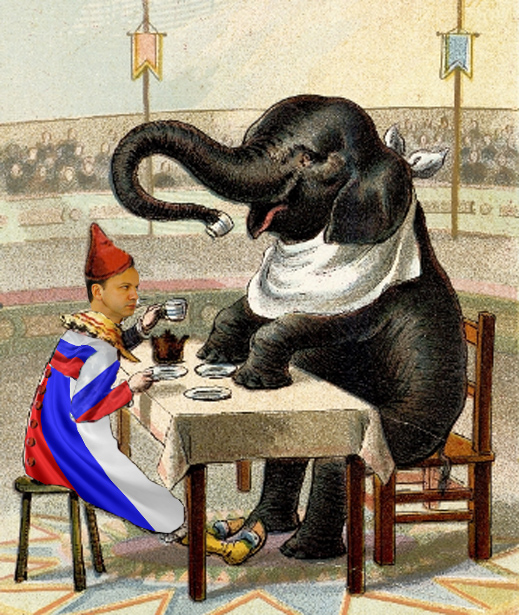
No matter how intelligent elephants are, they won’t learn not to defecate when performing at the circus. Generations of circus managers and animal trainers have wrestled with the problem, but the elephant sphincter has forced them to bow to the inevitable

The solution they have come up with is to employ clowns walking behind the elephants with scoops,  buckets, and brooms. Their job is to divert attention when the inevitable occurs, and make the audience laugh. Yury Nikulin, the greatest of Russian clowns and director of the Old Circus in Moscow, once told me that if the clowns he assigned to the elephant’s rear guard failed to get the crowd laughing, they wouldn’t get promoted until it did.  

Deputy Prime Minister Arkady Dvorkovich (lead image, left) is trying to preserve his job when President Vladimir Putin appoints the new Russian government after the election of March 18.  A US-educated chess adept and protégé of Prime Minister Dmitry Medvedev, Dvorkovich is thinking several moves ahead in his game. That game, Dvorkovich calculates, must survive the possible replacement  of Medvedev as prime minister. So when Dvorkovich said in Davos there are no oligarchs in Russia, only “good businessmen”, he wasn’t trying to make the Russian audience laugh. He was trying to save his job — with support from oligarchs who haven’t backed him before. (more…)

- Print This Post Print This Post

By John Helmer, Moscow

Andrei Kostin, 61, the head of the state-owned VTB Bank, has enjoyed a long career as a state official and state banker.  His reputation among his international banking peers does not highlight expertise in treasury operations  or investment ingenuity. Rather, Kostin is reputed for being the trusted executor of his shareholders’ instructions, deliberative, loyal, cheerful.

Since Kostin was head of Vnesheconombank (VEB) between 1996 and 2002, and head of Vneshtorgbank (VTB) since then, the instructions Kostin is trusted to follow come from the President, the Prime Minister and the senior state officials who rule the VEB and VTB boards, as well as from the security services with which Kostin was acquainted early in his government career. President Vladimir Putin made an exceptional public token of this trust by honouring Kostin’s 61st birthday last month with the gift of a Chimes wristwatch. 

When Kostin makes public statements in western media, it is understood he aims to reflect what the Kremlin has decided; he is not lobbying a personal or factional policy line before the decisions are made. So what were Kostin’s instructions when in Davos this week he declared, in reply to a question about the threat of US Government sanctions against Russian oligarchs: “I don’t think that everyone will now start to run away like cockroaches that disappear through the floorboards. The business community is generally calm”?

International bank sources in London and New York say they regard the remark as uncharacteristically vivid for Kostin. “In the first place, Kostin doesn’t think of the oligarchs as cockroaches,” commented a source who has known Kostin professionally for years.  “In the second, he knows they have already run away with their money, leaving Kostin and other state bankers holding their debts. In the third place, everyone knows they are anything but calm right now.” (more…)

- Print This Post Print This Post

By John Helmer, Moscow

Next to the certainty that President Vladimir Putin will win re-election on March 18, there is a doubt which no Russian pollster, political sociologist or official of the Central Election Commission dares to discuss on the record. That is the evidence from polling surveys of how many voters will cast ballots on the day – the turnout percentage.

The Kremlin and the president’s campaign boosters have announced a target of 70/70; that is 70% turnout, 70% vote for Putin.

The available evidence indicates that intention to vote, the projected turnout, has been sinking into the 50th  percentile. This level is so low, the Central Election Commission (CEC) has been ordered to do everything possible to raise turnout. Everything possible may include the method of President Boris Yeltsin’s administration; that’s the inclusion of voters who are dead but whose names remain on the registers. Named after the Nikolai Gogol story,   the Dead Soul vote is estimated by experts, who don’t wish to be named,  at between 3% and 7%; up to 10% in some regions.   (more…)

- Print This Post Print This Post

By John Helmer, Moscow

In criminal trials the rule for prosecuting and defending lawyers is the same. Never ask a witness a question unless you already know the answer. The corollary rule for defending lawyers is – if the answer to your question will incriminate your client, don’t ask it, and hope the prosecutor fails to do his job.

Glenn Simpson, a former employee of the Wall Street Journal in New York, is currently on trial in the US for having fabricated a dossier of allegations of Russian misconduct (bribes, sex, blackmail, hacking) involving President Donald Trump and circulating them to the press; the objective was to damage Trump’s candidacy before the election of November 8, 2016. Simpson was called to testify before the Senate Judiciary Committee on August 22, 2017; then the House Permanent Select Committee on Intelligence on November 8 and again on November 14, 2017. So far, Simpson’s veracity and business conduct face nothing more than the court of public opinion. He has not yet been charged with criminal or civil offences. That will happen if the evidence materializes that Simpson has been lying.

Simpson’s collaborator in the dossier and his business partner, Christopher Steele, is facing trial in the London High Court, charged with libels he and Simpson published in their dossier.  Together, they are material witnesses in two federal US court trials for defamation, one in Miami and one in New York.  If they perjure themselves giving evidence in those cases, they are likely to face criminal indictments. If they tell the truth, they are likely to face fresh defamation proceedings;  perhaps a civil racketeering suit for fraud;  maybe a false statement prosecution under the US criminal code.

One question for them is as obvious as its answer. Who do an American ex-journalist on US national security and an ex-British intelligence agent go to for sources on Russian undercover operations outside Russia in general, the US in particular?  Answer — first, their friends and contacts from the Central Intelligence Agency (CIA); second, their friends and contacts from the Secret Intelligence Service or MI6, as the UK counterpart is known.

Why then did the twenty-two  congressmen, the members of the House Intelligence Committee who subpoenaed Simpson for interview, fail to pursue what information he and Steele received either directly from the CIA or indirectly through British intelligence?    

The answer noone in the US wants to say aloud is the possibility that it was the CIA which provided Simpson and Steele with names and source materials for their dossier, creating the evidence of a Russian plot against the US election, and generating evidence of Russian operations. If that is what happened, then Simpson and Steele were participants in a false-flag CIA operation in US politics.

This isn’t idle speculation. It has been under investigation at the Federal Bureau of Investigation (FBI)  since Simpson and Steele decided in mid-2016 to go to the FBI to request an investigation, and then told American press to get  the FBI to confirm it was investigating. At the fresh request this month from the Chairman of the Senate Judiciary Committee, the FBI is still investigating.   (more…)

- Print This Post Print This Post

By John Helmer, Moscow

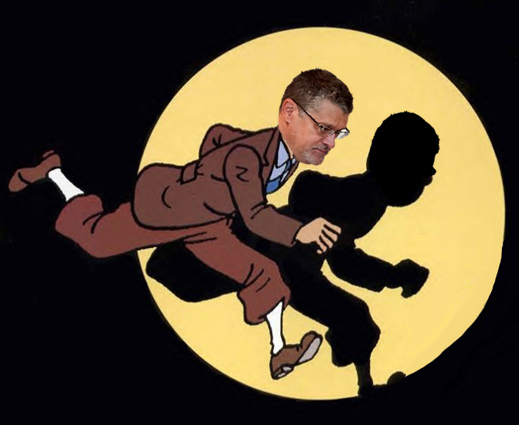
American reporters are so mesmerized by Russia-related investigations of the Trump family, Trump businesses, his election campaign and the presidential transition, they can no longer see the obvious. The recently released Senate Judiciary Committee interrogation and testimony of Glenn Simpson (lead image) proves — if it proves anything at all – that Glenn Simpson and Christopher Steele, authors of the Golden Showers Dossier, are liars who fabricated claims about Russians which they then promoted to reporters and the Federal Bureau of Investigation (FBI) without double-checking or independent verification.

Simpson appeared before the Senate Judiciary Committee on August 22, 2017. His interrogation by senators and their staff lasted almost eight hours, beginning at 9:34 in the morning, and ending at 7:04  in the evening. Lunch took forty minutes. There were nine toilet breaks, one every hour, averaging just 6.9 minutes. Long enough to empty bladders;  too short for golden showers. (more…)