- Print This Post Print This Post

By John Helmer, Moscow

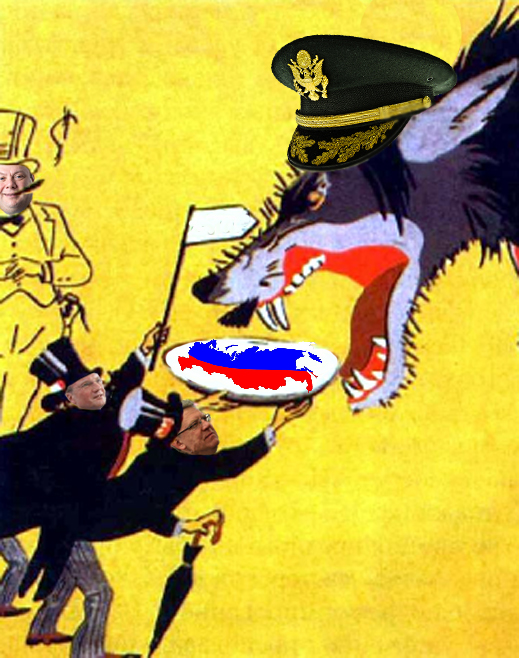
The longer the delay in the official announcement of who is to be the new Russian Defence Minister, the plainer it is that Prime Minister Dmitry Medvedev wants to oust Sergei Shoigu from the job because he is a rival presidential succession candidate; and because President Vladimir Putin is afraid of the Stavka, the combined forces of the Defence Ministry, General Staff, the intelligence services, and the military-industrial complex, if by dismissing Shoigu Putin is seen to be capitulating to the enemy on each of Russia’s war fronts. (more…)

- Print This Post Print This Post

By John Helmer, Moscow

Tom Wolfe (lead image, centre, right), the American investigative writer, died on Monday in New York aged 88. The New York Times, as deaf still to the meaning of words as Wolfe was once acute, reports  the cause was an “infection”. When I knew him in 1970 I was a commissioning editor at Esquire on Madison Avenue.  Wolfe was surprising to be with — which I contrived to happen more than once because he liked to eat beef steaks,  and we were both amused to sit at a table in an Argentinian restaurant under a huge stuffed bull.  The Wolfe surprise was that he was so shy and so handsome in his show-off costumes. He was also unexpectedly deferential to fellows with British accents who knew a thing or two (more than he did) about London tailoring. In the Esquire stable then, Wolfe wasn’t wise and quippy, like Gore Vidal. He wasn’t as dull-witted as Norman Mailer, nor as fly-blown as Truman Capote.  Save for Vidal, all of them are now well past their use-by date. Wolfe can still be taught in graduate journalism classes though he dates less well than Hunter Thompson. In 2012 this was my obituary for the passing of Wolfe’s talent – the moment after he displayed his loss of understanding of what his eyes and ears were telling him. (more…)

- Print This Post Print This Post

By John Helmer, Moscow

Once again, Alexei Kudrin (lead image), candidate for the second most powerful post in the Russian government after President Vladimir Putin, has had his ambition circumcised. The state news agency Tass reported Kudrin as confirming yesterday that he has accepted nomination as the new head of the Accounting Chamber, Russia’s state auditor and budget watchdog. Kudrin replaces a junior and protégée when he was finance minister, Tatiana Golikova; she has been promoted by Prime Minister Dmitry Medvedev to become his deputy prime minister for social welfare policy.

In the week since Putin’s inauguration,  Medvedev has banished two men capable of rivalling him for the succession to Putin’s presidency – Dmitry Rogozin, representing the military-industrial and state sector of the economy, and Kudrin, representing the oligarch sector and the United States campaign for regime change.    

(more…)

- Print This Post Print This Post

By John Helmer, Moscow

Victor Vekselberg and his Renova group were put out of business by the US Treasury in the April 6 sanctions list. The reasons announced  were that Renova is owned by Vekselberg,  and Vekselberg “is being designated for operating in the energy sector of the Russian Federation economy;” and also because there is a two-year old Russian prosecution “of  the company’s chief managing director and another top executive, for bribing officials connected to a power generation project in Russia.” For more on the criminalization of Russian electricity rates and the Kremlin policy of selective prosecution, read this.

One of the Renova group companies targeted by the US produces mineral water from Lake Baikal, the world’s largest, deepest freshwater lake and one of the purest of water sources in the country; Renova’s Baikal Holding also has plans to turn the water into lemonade and other soft-drinks.  Because these too are an American target, the far from well-known Baikal brand of bottled water has become the likely recipient of millions of dollars in Russian federal budget assistance.  

This is how the US economic war against Russia works. The target escapes; the sanctions achieve none of the declared US Government objectives.  The collateral damage, on the other hand, is concentrated on Russian taxpayers and consumers.  They pay to preserve the oligarch’s business intact.  (more…)

- Print This Post Print This Post

By John Helmer, Moscow

Since the Middle Ages, so for almost a thousand years, the hat which symbolized European learning was the mortar board. It originally meant the wearer had graduated with a university degree. It also symbolized that he had more degrees and more learning still to earn.  It was a symbol of the superiority of the wearer’s education compared to the unlettered — and of his mediocrity among the learned.

When the Chairman of the Russian Constitutional Court, 75-year old Valery Zorkin, presided at Tuesday’s investiture of President Vladimir Putin for his fourth term, Zorkin was wearing a  mortar board —  a hat not  known before in Russian court tradition.  The other court judges in the audience also wore them.  

The Defence Minister Sergei Shoigu and General Valery Gerasimov, Chief of the General Staff, were in their ceremonial uniforms, but hatless. The Prime Minister, Dmitry Medvedev, wore a double-breasted suit with double vents. Unprecedented for him, but hatless. The only other hatted official at the ceremony was Patriarch Kirill. Without mortar boards, if they think they have more to learn about governing Russia, they are keeping it to themselves. (more…)

- Print This Post Print This Post

By John Helmer, Moscow

President Vladimir Putin is considering whether to appoint a vice president for negotiating an end to sanctions with the US and the European Union (EU), and an about-turn in Russia’s foreign and defence policy.  

In the scheme proposed by former finance minister Alexei Kudrin (lead image, centre), the job would hold more power than the prime minister, allowing Dmitry Medvedev to remain in his place, but subordinate him to the new man.  Kudrin’s idea is that he would become this de facto vice president; the dominant policymaker of the government after Putin; and his likely successor.

Vice president is the term being used among Kremlin officials and advisors. Not since the constitutional crisis of 1993, when Vice President Alexander Rutskoi led the Russian parliament in rebellion against President Boris Yelstin, has the position of vice president existed in Russia, with the power to succeed or replace the incumbent president. It is an arrangement for which Kudrin claims to have the backing of the US and the EU.  Kudrin would also draw on the support of the Russian oligarchs, inside and outside the country.

The Kudrin scheme is being opposed as capitulation by the leadership of Russia’s defence, military and security forces. The Defence Minister, Sergei Shoigu, the chief of the General Staff, General Valery Gerasimov, the deputy prime minister in charge of the military-industrial complex, Dmitry Rogozin, and other senior officials have been trying to persuade Putin to appoint a new prime minister to fight the military, economic and information war which they believe the US intends to wage against Russia until the Kremlin accepts  the West’s terms. For the story of their Stavka, read this.  

These officials are fiercely opposed to Kudrin, and to his attempt to make an alliance with Medvedev to claim the legal succession to Putin, should Putin agree to relinquish the powers and policies against which the NATO powers have planned regime change.    

Igor Sechin, the chief executive of Rosneft and a presidential succession contender himself, is not in the running for the so-called vice presidency. Sources close to him say he is opposed to the ambitions of Kudrin and Medvedev but he is biding his time. As deputy chief of the Kremlin staff when Putin was president between 2000 and 2008, Sechin was the de facto vice president for domestic policy, and dwarfed Medvedev. (more…)

- Print This Post Print This Post

By John Helmer, Moscow

At the start of April President Vladimir Putin believed he could postpone Russia’s strategic and battlefield responses to the state of war which the US is escalating.  He was to be disappointed.

On April 6, the US Treasury announced  it is putting the state aluminium monopoly United Company Rusal out of business, not only in the US but worldwide.  Not since July 26, 1941,  when President Franklin Roosevelt froze Japanese assets in the US and prohibited all US trade with Japan, especially metals and oil, as well as all US dollar transactions,   has the American state attempted such a thing against a rival Great Power. Roosevelt calculated it was one deterrent step short of US war with Japan. Everybody understands now that miscalculation led to Japan’s decision to make its preemptive strike against the US Navy at Pearl Harbor, five months later.

There is another, earlier precedent for the US Treasury’s act of war against Russia. That was on  November 21, 1806, when Napoleon issued his  Berlin Decree. That forbade the export of British goods to Europe or other states controlled by the French military, or the imports of goods on which Britain depended from its empire. Too weak to defeat the British Navy or invade the British islands, Napoleon opted for economic sanctions, retaliating for the trade blockade imposed by the British Navy around the French coastline, starting in May of that year.  “It being right,” Napoleon had declared as the justification  for his blockade, “to oppose to an enemy the same arms she makes use of, to combat as she does, when all ideas of justice and every liberal sentiment (the result of civilization among men) are discarded.”  The British had extended war beyond military operations, Napoleon added in his decree: “it cannot be extended to any private property whatever, nor to persons who are not military, and until the right of blockade be restrained to fortified places, actually invested by competent forces.” The Continental Blockade, thus launched, lasted until Napoleon’s first abdication in April 1814.

On the fourteenth of this month the US launched its assault on Syria, agreeing in advance with the Russian General Staff to avoid Russian forces and Russian-defended targets. That attack was a military failure. But  with continuing Israeli operations from the air against Syrian, Iranian and Russian targets, Putin has been requested by the General Staff and Defence Minister Sergei Shoigu to authorize the deployment of Russian S-300 missile defences to deter and destroy fresh attacks. Putin has been delaying this decision.

Then on April 25 US forces broke into the Russian consulate at Seattle. This was the second such attack by the US on Russian diplomatic territory in the US; the earlier one was on September 2, 2017, when the Russian consulate in San Francisco and  simultaneously,  Russian trade mission offices in Washington and New York.

The Russian Foreign Ministry called the US actions “illegal invasion”, and violations of the Vienna Convention,  but not acts of war.

In the past four weeks Putin has called his Security Council into session just twice. The first was on April 6, to discuss, according to the Kremlin communique, border control plans.   The second Council meeting took place on April 19, which the Kremlin reported as discussing “the recent Western airstrikes…[and]  measures to prevent floods and wildfires.”

Putin took several important decisions besides, but he did it out of sight at the Novo-Ogaryovo dacha, and for his own reasons kept them secret. (more…)

- Print This Post Print This Post

By John Helmer, Moscow

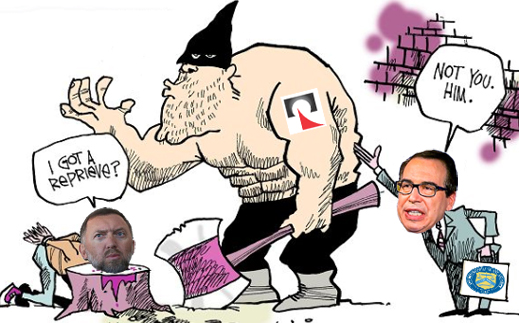
There are two reasons why  the aluminium metal markets are not making long-term bets on the price of the metal, the alumina required to make it, and the share prices of the metal producers, including Russia’s aluminium monopoly United Company Rusal. The first reason is that the US Treasury Secretary Stephen Mnuchin (lead image, right) has decided to eliminate Rusal’s controlling shareholder, Oleg Deripaska (left), but leave Rusal to carry on its business without him.  The second reason is that President Vladimir Putin cannot make up his mind on whether to sacrifice Deripaska for the good of the company and Russia’s metal industry.  If Putin refuses Mnuchin’s deal, the US sanctions to put the company out of business, announced on April 6, will be enforced in full.  Pricing the consequences now of then is next to impossible.

According to Mnuchin’s statement on Monday, “RUSAL has felt the impact of U.S. sanctions because of its entanglement with Oleg Deripaska, but the U.S. government is not targeting the hardworking people who depend on RUSAL and its subsidiaries. RUSAL has approached us to petition for delisting.  Given the impact on our partners and allies, we are issuing a general license extending the maintenance and wind-down period while we consider RUSAL’s petition.”

On Tuesday Putin responded  through his spokesman  Dmitry Peskov. “so far it is difficult to say how consistent our American counterparts are in their approach. We still consider these sanctions to be illegal. We believe that in relation to a single company such actions are akin to asset grabbing.” 

That is Deripaska himself doing the talking. The only man in Russia who thinks that state recovery of a heavily indebted asset from an oligarch is an asset grab is Deripaska. Putin has yet to disagree. Mnuchin has given Putin six months until October 23 to make up his mind. (more…)

- Print This Post Print This Post

By John Helmer, Moscow

A politician becomes a psychopath when he or she acts without calculating the consequences for approval rating and voter support. The same thing goes for ministers and their advisers who urge military operations abroad which make voters feel unsafe at home. Fear and insecurity aren’t good for incumbents.

President Donald Trump and Prime Minister Theresa May both made this miscalculation when they launched their April 14 attack on Syria. In the latest political polls they are now worse off than they were before the attack. The military operation, according to US and UK poll compilations, has reversed the positive trend in their standing with voters since the start of this year. (more…)

- Print This Post Print This Post

By John Helmer, Moscow

US President Donald Trump didn’t mean to start a revolution. President Vladimir Putin tried persuading him not to. But on April 14 the revolution was launched by American warplanes, surface ships and a submarine.

The outcome is that the US can no longer count on air superiority anywhere in the world where Russian air defences operate, backed by Russian command-and-control systems. Without air superiority, the US has no force multiple on the ground of the magnitude required for the Pentagon to attack; that is, the ratio of American men and firepower the Pentagon calculates for making sure their enemies on their ground can be defeated.  

This is revolutionary, and has spread instantly to every war front — the Russian lines with NATO; the Korea-Japan front; the Taiwan Straits and South China Sea for China; and the Indian Ocean for India and Pakistan.  

The treaties which promise US allies that an attack on them will draw US military support for their collective defence – Article 5 of the North Atlantic Treaty (NATO), Article 4 of the Australia New Zealand US Treaty (ANZUS), Article 3 of the Inter-American Treaty of Reciprocal Assistance (Rio), and the Japan, Philippines, South Korea, Taiwan, Pakistan and Israel defence treaties – are dead letters.

So long, shock and awe – that was the American warfighting doctrine against people who lack Russian-standard defences. 

(more…)