- Print This Post Print This Post

By John Helmer, Moscow

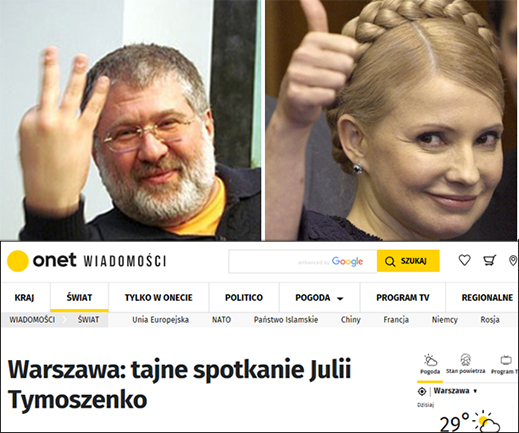
In the Polish capital of Warsaw a fortnight ago, Igor Kolomoisky met secretly with Yulia Tymoshenko. The reason for the secrecy is the terms of exchange which they discussed. These include Tymoshenko’s agreement that if she is elected president in Kiev in eight months’ time with Kolomoisky’s support, he will get relief from Ukrainian state pursuit of billions of his dollars currently frozen on British court orders. (more…)

- Print This Post Print This Post

By John Helmer, Moscow

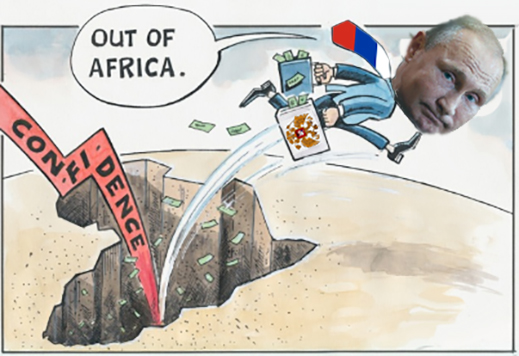
When it comes to support for President Vladimir Putin’s international positions, the South African (SA) Government has been among the most consistent and enthusiastic of any in the world. However, Russian policy in South Africa has been damaged by the behaviour of Russian oligarchs and state businesses implicated in the corrupt schemes of former SA president Jacob Zuma; he is now facing multiple indictments for seeking and taking bribes for himself and his family.  Putin’s landing in Johannesburg on Thursday ought to have been the signal for a fresh start. (more…)

- Print This Post Print This Post

By John Helmer, Moscow

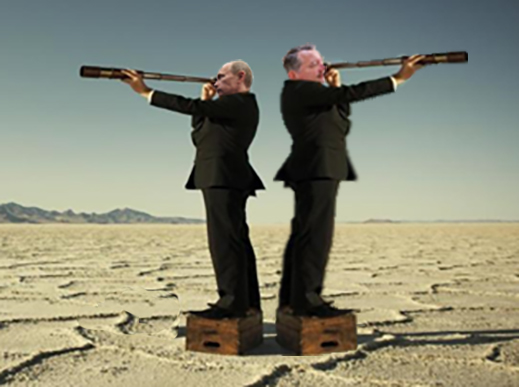
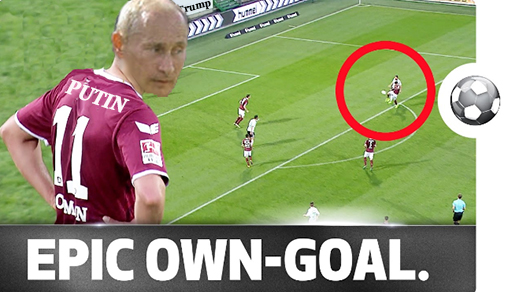
President Vladimir Putin (lead image, left) has announced a new policy of withdrawal from eastern Ukraine under cover of a referendum to confirm the sovereignty of Kiev.

No, hold it. Putin has announced an old policy in a new way in the English-language press.  

No, no – an old policy, already rejected in private by the US Government and the Kiev regime, was announced by Putin to President Donald Trump in Helsinki on July 16. That was in case Trump  hadn’t been told or hadn’t thought of it. It was also for Putin and the Russian military command, the Stavka, to demonstrate to each other that the US will agree to no Russian withdrawal agreement until Crimea is recovered. 

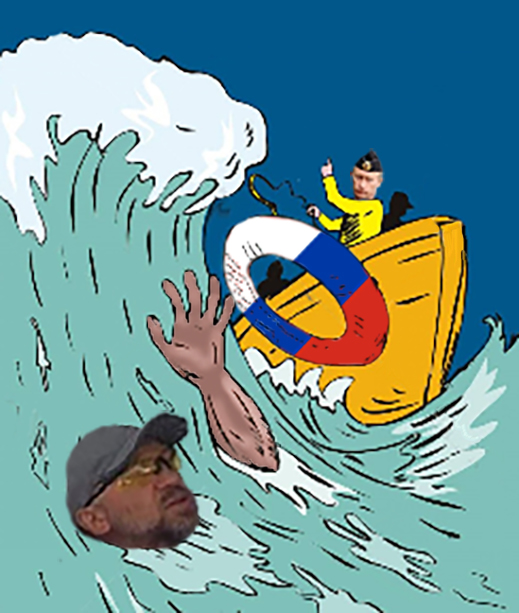
In the Russian language media, there is only one Russian explaining this means war without end. That’s Igor Strelkov (right), the former leader of the Donbass uprising in 2014. He says Putin’s  formula for the Ukraine settlement  is “chewing gum” he wants to spit out when noone is looking. “But there are some political signals that up to the present moment the capitulation of DNR  [Donetsk People’s Republic] and LNR [Lugansk People’s Republic] is not planned.  If it was so, Russia wouldn’t have eased the migration rules for Donbass citizens. So this idea is temporarily closed. Another idea — will the Ukrainian armed forces be defeated? A ceasefire isn’t possible without it.”  That’s what Russians military sources call the Syrian solution. (more…)

- Print This Post Print This Post

By John Helmer, Moscow

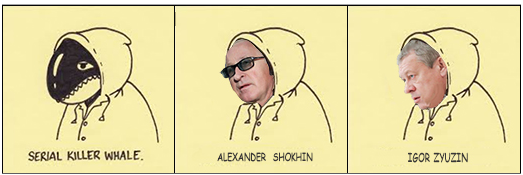
Mother Nature, Greenpeace  and the National Geographic Magazine believe that killer whales  (lead image, left) are predators of the sea who have been misnamed. They are dolphins who kill whales (also seals, sea lions, sharks, and occasionally, when they get upset, a zoo-keeper). 

In Chelyabinsk, environment investigators  and city residents  believe  that the Mechel steel, coke and coal company is a predator which kills people with air and waterborne pollution. The control shareholder of Mechel, Igor Zyuzin (lead image, right) employs people. He employs Alexander Shokhin (centre) to use his influence with the Kremlin and officials of the federal and regional governments to guard Mechel and make sure it isn’t stopped doing what it does.

Mechel ought to say what that is, according to the rules of the United States Securities and Exchange Commission (SEC) as a public shareholding company listed on the New York Stock Exchange (NYSE). Except that as a Russian company, Rule 405, Rule 3b-4,  and Rule 12g3-2(b) exempt “foreign private issuers” from the same standards of disclosure as apply to US resident companies.   This doesn’t mean the SEC allows Mechel to get away with, er murder; it is obliged to comply with Russian laws against that. But if it is operating illegally on Russian territory, its reports to the SEC and NYSE don’t have to say so.

Accordingly, when Shokhin is telephoned and emailed at his office in Moscow,  he knows the American rules don’t oblige him to answer any question about his job at Mechel, including how much the company pays him as Zyuzin’s deputy on the board of directors. Shokhin is diving deep under the surface where he can’t be seen -– and the American rules make it legal for him to do it. The cure for Mechel’s poisoning of Chelyabinsk which Shokhin has persuaded his friends in government to allow is simple – Mechel pays the government a small amount of money for its poisons, tax deductible. (more…)

- Print This Post Print This Post

By John Helmer, Moscow

In the armchair warrior’s version of game theory played with and without nuclear weapons, there’s a special place for the calculation of strategic deterrence that’s called tit for tat. President Vladimir Putin and President Donald Trump agreed between themselves that in the tit-for-tat game between the Kremlin and the White House, anticipating, reciprocating and deterring are best achieved by cooperating.

That word was used nineteen times in the presidents’ news conference. It appeared nine times in Putin’s opening statement; four times in Trump’s opening statement; and six times in Putin’s answers to questions.

Because the two sides had agreed in advance not to issue an official communiqué revealing (to Trump’s adversaries at home) what they had agreed, these remarks were staged in front of the cameras instead. Cooperation was the obvious point of agreement. However, since they left Helsinki, lower-level American officials and their media – Russian officials and their media,  too — have replaced tit for tat for shit for shat. That’s information warfare jargon for opening the mouth and talking drivel. (more…)

- Print This Post Print This Post

By Eric van de Beek and Max van der Werff, Amsterdam*

Max, a year ago we looked back extensively on three years of MH17. Which are for you the most important events and developments over the past year?

Without any doubt the liability of the Russian Federation claimed by the Netherlands and Australia and then the first real firm denial by President Vladimir Putin. The positions on what really happened can no longer be reconciled and both parties cannot go back any more. (more…)

- Print This Post Print This Post

By John Helmer, Moscow

President Vladimir Putin’s side of the brunch table at the Helsinki summit almost matched President Donald Trump’s side. Seven sets of knives, forks and spoons;  six officials, one interpreter, matching lieutenant-generals. The odd man out — that’s to say in — was Dmitry Peskov, the Kremlin spokesman. Peskov’s White House counterpart, Sarah Huckabee Sanders, was excluded.  Peskov wrote notes during the delegation meeting; his contribution became public during the press conference of the two presidents which followed. (more…)

- Print This Post Print This Post

By John Helmer, Moscow

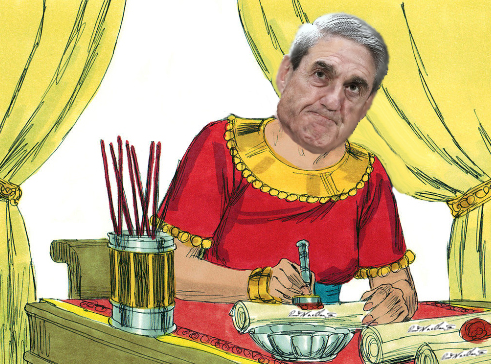
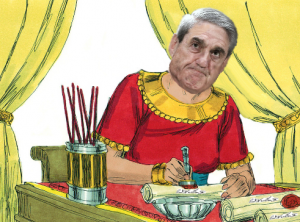
Robert Mueller (lead image), the special US prosecutor of crimes of espionage between Moscow and Washington, picked July 13 to issue his indictment of twelve alleged Russian military intelligence officers for doing their jobs on evidence collected by US intelligence officers doing their jobs.

The Russian crime alleged by Mueller in Paragraph 1 of the indictment  was  “large-scale cyber operations to interfere with the 2016 U.S. presidential election.” The US crime, revealed by Mueller but unindicted so far by the Russian General Prosecutor, was large-scale cyber operations to interfere with Russian state security.

Mueller could not have picked a more auspicious date if he weren’t an ignoramus on the history of autocracy and democracy, European and American. For it is one day later, on July 14, when every year France celebrates the start of the French Revolution. The reason for the celebration is the end of abuse of power by kings and pretenders to state authority, and their replacement by the democratic rule of law. That revolution, like the annual celebration, isn’t quite over.

What Mueller did this year was to issue what was called, before July 14, 1789, a lettre de cachet – a letter with the royal signet or seal.  In the French practice, this was a combination of indictment, conviction, and order for arrest, confiscation of property,  and punishment of an individual, who had no right in law to know the charge against him; prove the evidence;  appeal the sentence.

The Mueller indictment of twelve officers of the Russian military intelligence agency, GRU (Main Intelligence Directorate of the General Staff) is a fresh US-Government style lettre de cachet. It names the men accused, their crimes,  and the punishment.  The penalties include “upon conviction [the twelve] shall forfeit to the United States any property, real or personal, which constitutes or is derived from proceeds obtained directly or indirectly as a result of such violation, and any personal property that was used or intended to be used to commit or to facilitate the commission of such offense.”

Mueller has neither the power nor the intention of trying the accused, or the particulars of his lettre,  in an American court of law. This is why on July 13 he intended to violate the Fifth Amendment of the US Constitution, first introduced in Philadelphia on June 8, 1789, just a month before the lettre de cachet lost its power in Paris.  The Fifth Amendment says noone shall be “deprived of life, liberty or property without due process of law.” (more…)

- Print This Post Print This Post

By John Helmer, Moscow

In a ruling issued on June 28 and now publicly available, the Chief Magistrate of England, Emma Arbuthnot, has dismissed an application by Russian prosecutors for extradition of Andrei Votinov. He is charged in Russia with fraud against the Rosneft subsidiary, the Tuapse Oil Refinery. The 33-page judgement is a rare test in an international court of the reputation of Igor Sechin, chief executive of Rosneft.   

Arbuthnot rejected allegations by Votinov that Sechin was persecuting him or that Sechin had played an improper role in Rosneft’s audit and subsequent complaint of fraud.  She dismissed Votinov’s claim that he was being targeted by Sechin because he had “stood against Rosneft’s political support for the regime.”

The judge also rejected the claims by a British academic, Richard Sakwa, who testified on Votinov’s behalf to the court  that the case had been fabricated against him,  motivated by personal vindictiveness on Sechin’s part and by Votinov’s political views.

Nonetheless, Arbuthnot dismissed the extradition request by the Russian prosecutors and released Votinov. Because of “the prominent role of the complainant [Rosneft] in this case and the false statement given by a senior investigator [Murat Tkhakakhov] ,” Arbuthnot wrote in her judgement, “I find the facts in this case lead me to the conclusion that this is one of those exceptional cases where the defendant [Votinov] has shown there is a real risk that he will suffer a flagrant denial of justice if he were to be extradited to the Russian Federation.” (more…)

- Print This Post Print This Post

By John Helmer, Moscow

Until the moment in April, when the US Government attacked Oleg Deripaska and his companies, including Rusal, the state aluminium monopoly,  his revenues, earnings and profits were looking up, and not only because the aluminium price had been rising. The electricity sale revenues of EN+ were also climbing, even though production of electricity was flat. Profits, most of which flow as dividends to Deripaska and his associates, might have been even greater,  EN+  reported last month to the London Stock Exchange, if not for the reduction of water flow down the Angara River and into Lake Baikal.  Less water through the sluices to the turbines means less electricity and aluminium; that means less profit in Deripaska’s pocket.

EN+ blames the water problem on the weather. Rivers Without Boundaries (RWB), a leading non-governmental organization devoted to protecting Lake Baikal and the river systems which feed it, announced last week that EN+ is to blame for water flow policies which threaten the lake with a combination of flooding in the wet season and reduced waterflows in the dry.  “[The] long-lasting negative social and environmental impacts which go unmitigated for decades,” says Evgeny Simonov of RWB, “are a far greater threat posed by En+ Group to the global security and well-being of the population of Russia than the alleged political implications of its owner’s activity.”

RWB is also charging that last December Deripaska was behind a federal government decree which puts a stop to 16-year old standards for the water volumes entering Lake Baikal from the Angara River.  This decree, signed by Prime Minister Dmitry Medvedev on December 27, permits a much wider fluctuation in the lake’s minimum and maximum water levels than the Russian government and its experts judged  environmentally safe in 2001.   Medvedev’s decree allows Deripaska to divert more river water into his turbines in the dry season, and release more water in the flood season.

And there’s the rub. Until Deripaska’s profit prospects and share value collided with the US Treasury’s Office of Foreign Assets Control (OFAC),  the biggest threat to his profit line was the declining water levels of the river system passing through the Angara River cascade and hydropower complex, and thence to the falling water level of Lake Baikal. For remedy, Deripaska had persuaded the Kremlin to save his profit last December by allowing him to continue generating more hydropower and delivering less water than is good for Lake Baikal. (more…)