- Print This Post Print This Post

By John Helmer, Moscow
  @bears_with

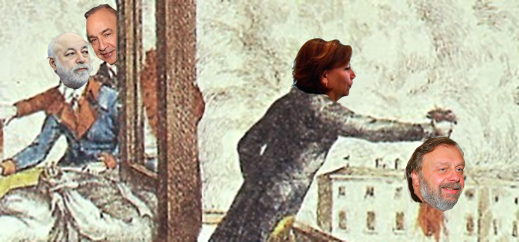
The New York State Supreme Court has ruled to dismiss Leonid Lebedev’s (lead image, right) five-year case against Victor Vekselberg (first left) and Len Blavatnik (second left) for a 15% share of their £13.8 billion sale of the TNK-BP oil company to Rosneft in 2013.    Lebedev has been suing for an award of $2.7 billion. In London he has been trying to bank on winning the payoff.  

In a 19-page ruling, issued on Tuesday at noon, Judge Saliann Scarpulla (second from right) dismissed all Lebedev’s claims for money from the 2013 Rosneft transaction. She also ordered Lebedev to pay  “costs and disbursements to defendants as taxed by the Clerk  upon the submission of an appropriate bill of costs.”  The cost of the litigation for Vekselberg and Blavatnik, which has also extended to courts in London, Ireland, Cyprus and Switzerland, is almost $20 million; Lebedev’s costs are about the same.

Lebedev fled Russia in April 2015, abandoning his Federation Council seat. At the time he feared expulsion from the Senate for lying about his foreign citizenship and assets. He was also facing a criminal investigation of embezzlement of about $240 million from a regional electricity utility, TGK-2. This he had acquired with the patronage of Anatoly Chubais, once the head of the state’s electricity holding, UES.

Lebedev found safe haven in the US and Cyprus; the former by arrangement with the US State Department; the latter from President Nikos Anastasiades and his law firm in Limassol. They arranged a Cyprus passport for Lebedev which they kept secret from the Cyprus courts just as Lebedev kept it secret from the Russian Senate.

Lebedev started his New York court case in February 2014, choosing the Manhattan branch of the state court because Vekselberg and Blavatnik had lived and conducted business in New York, and because Lebedev claimed they had negotiated their deal in a walk through Central Park in Manhattan. Lebedev alleged Vekselberg and Blavatnik had violated the terms of their original deal in 2001, and cheated him over the ensuing years. Vekselberg and Blavatnik countered that Lebedev  had been paid everything which had earlier been agreed between them; concealed his money through an Irish front company and in bank accounts in Switzerland, Cyprus, Ireland,  and New York; and then lied in the US court papers.

In Scarpulla’s ruling this week, she said Vekselberg and Blavatnik “have shown that the 2001 Investment Agreement lacks contemporaneous consideration and, consistent with Korff, Lebedev has failed to raise an issue of fact on this issue.” That’s judicial language dismissing Lebedev’s lawsuit for faking terms of the agreement which had not been agreed; and failing to prove evidence of his right to benefits. By ordering Lebedev to pay his own costs, plus Vekselberg’s and Blavatnik’s costs, Scarpulla has ruled that Lebedev never had a case to argue and fabricated his evidence from the start. (more…)

- Print This Post Print This Post

By John Helmer, Moscow
  @bears_with

Five years of civil war have convinced most Ukrainian voters to vote for peace by negotiation and compromise with the regional governments of Donetsk and Lugansk, and with Moscow. Support for continuing the war until the eastern regions capitulate has now shrunk to the western region of Ukraine around Lviv, and among those in Kiev living off the flow of cash from the US, Canada, and the International Monetary Fund (IMF).

Even among them, the war party is a small minority – 28% in favour in the west; 16% in the centre; compared to 13% in the east and 8% in the south. Altogether, only one in six Ukrainians (17%) now wants to fight on. Peace at any price is favoured by one in five (20%); peace on compromise terms by 49%.

 These are the new findings of countrywide surveys of Ukraine voters in June, commissioned and paid for by the Dutch Government. They confirm the results of a voter poll carried out in May for the US State Department.  

So far no Canadian, British or American newspaper or think-tank has reported on the shift in Ukrainian voter sentiment, although the country will hold its Verkhovna Rada (parliament) election on July 21. Nor have the Russian media noticed. (more…)

- Print This Post Print This Post

By John Helmer, Moscow
  @bears_with

The US State Department, the Republican Party Institute and Igor Kolomoisky can’t all be wrong about what the overwhelming majority of Ukrainian voters is thinking – that there is a civil war in the Ukraine which cannot be won by US arms,  money, and putsches in Kiev.

The question to be decided on polling day, July 21, for the new Verkhovna Rada (parliament) is:   which side in the war, the eastern Ukraine including Odessa, or the Galicians around Lviv in the west,  will win power?

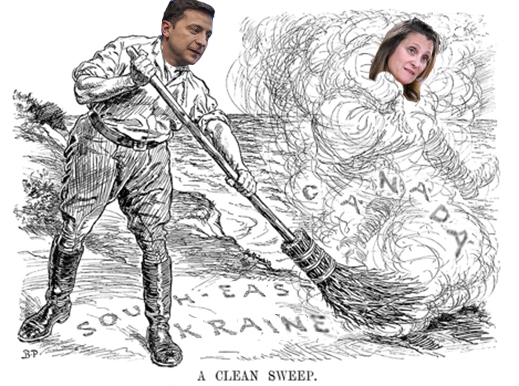
The answer already appeared in a May poll by the US Agency for International Development (USAID), and in the most recent June and July voter surveys by the local Ukrainian pollster Rating. A coalition of parties whose support is strongest in eastern Ukraine will control parliament and will back the new President, Volodymyr Zelensky (lead image, left), to negotiate terms with the breakaway governments of Donetsk and Lugansk (collectively, the Donbass), and with Moscow. On these polls, the Galician parties of western Ukraine will have no national party representation in parliament, no ministers nor high-ranking officials, and just a handful of constituency seats in Lviv, Brody and Ternopil.  

Last week, the Galicians held their election rally in Toronto, where their faction is headed  by Chrystia Freeland (lead image, right), Canada’s foreign minister, with financing from the State Department through USAID, and from Victor Pinchuk, a Ukrainian steel oligarch, supported by the Ukrainian Canadian Congress, a lobby group representing west Ukrainian refugees from the German Army’s defeat in 1945. Freeland, a Galician by origin, and Kurt Volker, a German by origin and the State Department’s Special Representative for Ukraine, gave the proceedings, entitled the Ukraine Reform Conference, an official government appearance.  So did appearances and speeches by President Zelensky and a handful of Baltic state politicians. 

But Toronto votes don’t count. If the domestic Ukrainian vote follows the current Ukrainian and US  polls, then Freeland’s Galicians will be forced to retreat,  just as her grandfather Michael Chomiak fled with the German Army as it was driven out of Ukraine and Poland by the Red Army. Chomiak ended up in Alberta, Canada. Freeland too.   After July 21, the last retreat for the Galicians is Canada. (more…)

- Print This Post Print This Post

By John Helmer, Moscow
  @bears_with

Classical music has been one of the features of Russian national identity and patriotic sentiment since the 1917 Revolution, especially among the self-professing intelligentsia of Moscow and St. Petersburg.  That meant Tchaikovsky alongside Pushkin; Shostakovich and Prokofiev beside Gorky and Sholokhov.

Even during the past twenty years, the classical music audience on Russian radio has continued to grow, while in the rest of Europe similar audiences have been dwindling. But now, after five years of war against Russia and contracting state budgets and incomes, are listeners still tuned in? Or is the audience for Russian classical music doomed because the ears are aging, then dying off; or because young ears use digital streaming instead of traditional radio?

Radio Orfei — heir to the Fourth Programme of the Soviet All-Union Radio and since 1991 the state-funded classical music broadcaster – insists its music audience is defying the trend that is eating away at BBC Radio 3, KulturRadio of Germany, and France Musique. But the commercial radio audience measurements for Moscow suggest otherwise, at least right now. They show that Radio Orfei can no longer be counted in the Top-40 of Moscow radio stations. Worse, its audience reach has slipped below one percent of the total radio audience.  By contrast, BBC 3’s audience reach is currently at four percent.

On the other hand, a new report by a London-based consultancy says digital streaming isn’t the death knell. “Despite classical music’s timeline beginning somewhere in medieval times, it feels like its time is about to arrive again,” reports Keith Jopling of Midia Research.    “While the classical music genre accounts for just five percent of the global recorded music market…classicial music is opening up, with ‘mood-based’ playlists on streaming services reaching many millions mor, often younger listeners drawn in by the music’s ability to evoke mood, emotion, or offer something truly different to the more popular genres of the day.” (more…)

- Print This Post Print This Post

By John Helmer, Moscow
  @bears_with

When Igor Kolomoisky (lead image, centre) financed anti-Russian units operating with the Ukrainian Army in the Ukrainian civil war, he was a staunch ally of Petro Poroshenko’s government in Kiev and the Obama Administration’s chief Ukraine policymakers, Secretary of State Hillary Clinton (left) and her Assistant Secretary for European Affairs, Victoria Nuland (right).

They in turn dominated the voting on the board of directors of the International Monetary Fund (IMF), led by managing director Christine Lagarde. Following the US regime change which installed Poroshenko’s regime in the spring of 2014, the IMF voted massive loans for the Ukraine to replace the Russian financing on which the regime of Victor Yanukovich had  depended.  More than a third of the fresh IMF money was paid out by the National Bank of Ukraine (NBU), the state’s central bank, into PrivatBank controlled by Kolomoisky and his partner, Gennady Bogolyubov.

At the time, investigations of Kolomoisky’s business and banking practices, and the special relationship he cultivated with the NBU, reported he was stealing the money through a pyramid of front companies lending each other the IMF cash which was not intended to be repaid. Clinton, Nuland, Lagarde and the IMF staff and board of directors ignored the evidence, as they continued to top up Kolomoisky’s pyramid. Criminal investigations by the US Department of Justice and the Federal Bureau of Investigation (FBI) were also reported at the time; they were neutralized by their superiors.  

A new Delaware state court filing a month ago, triggering new US media reports, appears to signal a shift in US Government policy towards Kolomoisky. Or else, as some Ukrainian policy experts believe, it is a move by US officials to put pressure on the new Ukrainian President, Volodymyr Zelensky, whom Kolomoisky supported in his successful election campaign to replace Poroshenko.

In the new court papers, front company names and the count and value of US transactions between them,  which PrivatBank has dug out of its own bank records,  is published for the first time. But the scheme itself is not new. It was fully exposed in 2014-2015 in this archive.  Nor is it news, as subsequent US media reports  claim, that the FBI is investigating Kolomoisky and his US associates for criminal racketeering. The FBI investigation was first reported here

What is missing is an explanation of why it has taken so long for the PrivatBank case against Kolomoisky to surface in the US courts and in the US press. Also missing is a list of the accomplices and co-conspirators in the scheme. These include officials of the IMF,  the US and Canadian Governments who knowingly directed billions of dollars into the NBU,  from which, as they knew full well at the time, the money went out to Kolomoisky’s Privat Bank, the largest single Ukrainian recipient of the international cash. At the top of the list of accomplices, immediately subordinate to Clinton, Nuland and Lagarde, are David Lipton, the US deputy managing director  at the IMF, and the head of the IMF in Ukraine until 2017, Jerome Vacher. (more…)

- Print This Post Print This Post

By John Helmer, Moscow
  @bears_with

To introduce himself to the international financial markets, ahead of his arrival in Osaka for the G20 summit meetings, President Vladimir Putin has given an interview to the Financial Times, a Japan-owned, England-based newspaper. The publication has headlined its report: “Vladimir Putin has trumpeted the growth of national populist movements in Europe and America, crowing that liberalism is spent as an ideological force.” Putin’s remarks, according to the newspaper, are fresh evidence of Russian interference in the elections of the US and Europe… As the de facto ruler of Russia for almost two decades, Mr Putin, 66, has been regularly accused of covertly supporting populist movements through financial aid and social media, notably in the 2016 US presidential election, the Brexit referendum and the recent European Parliament elections.”

The full transcript, published overnight by the Kremlin,   is a more accurate reflection of Putin’s views. Read the excerpts which the FT hasn’t found fit to quote. (more…)

- Print This Post Print This Post

By John Helmer, Moscow
  @bears_with

This week a group of US senators has proposed to leave Turkey in control of the northern part of Cyprus, and force the Greek Cypriots to choose between the US and Russia for the economic and political future  of the south of the island.

The Senate Foreign Relations Committee agreed by a large bipartisan majority on June 25 to put into law a new Eastern Mediterranean strategy. If the bill is enacted, Cyprus will be required to decide that in exchange for American protection from Turkish military threats, including Russian-made S-400 missiles to be based in southwestern Turkey,  the Cyprus  Government must not allow Russian naval vessels to dock at Cypriot ports,  and should block all Russian money and investments on the island.  At the same time, Greece has been told the US military intends to expand its occupation of Crete around the Souda Bay base; at Larissa Air Force Base, midway between Athens and Thessaloniki; and at other Greek locations.

The proposed new law is the most comprehensive plan for American military occupation of Cyprus and Greece since the Greek civil war of the 1950s.  The US plan also establishes State Department censorship of the Greek-language media in Cyprus and Greece, and threatens US sanctions against the Orthodox Church bishops of the two countries. (more…)

- Print This Post Print This Post

By John Helmer, Moscow
  @bears_with

The Russian General Staff has reinforced the air defences for Russians at the Iranian nuclear reactor complex at Bushehr, on the Persian Gulf, according to sources in Moscow. At the same time, Iran has allowed filming of the movement of several of its mobile S-300 air-defence missile batteries to the south, covering the Iranian coastline of the Persian Gulf and the Gulf of Oman. More secretly, elements of Russian military intelligence, electronic warfare, and command and control advisers for Iran’s air defence systems have been mobilized to support Iran against US and allied attacks.

The range of the new surveillance extends well beyond the S-300 strike distance of 200 kilometres, and covers US drone and aircraft bases on the Arabian peninsula, as well as US warships in (and under) the Persian Gulf and off the Gulf of Oman. Early warning of US air and naval-launched attacks has now been cut below the old 4 to 6-minute Iranian threshold. Counter-firing by the Iranian armed forces has been automated from attack warning and target location.

This means that if the US is detected launching a swarm of missiles aimed at Iran’s air-defence sites, uranium mines, reactors, and military operations bunkers, Iran will launch its own swarm of missiles at the US firing platforms, as well as at Saudi and other oil production sites, refineries, and pipelines, as well tankers in ports and under way in the Gulf. (more…)

- Print This Post Print This Post

By John Helmer, Moscow
  @bears_with

The Russian literary intelligentsia doesn’t have a long history – just 200 years of the Russian language in poetry, for example. So it’s to be expected that the writers, including the poets, haven’t had time to overcome the resentment and envy of each other which is still the Russian intelligentsia’s most distinguishing feature, and consuming vice.  London and New York writers have been longer at scribbling for a living;  their vice is still unbridled.

Anna Akhmatova, one of the greatest of Russian poets by the consensus of the poets themselves, suffered throughout her life from every form of resentment causing her no end of hardship. The resentment and betrayals of her multiple husbands and lovers (male and female); of her housekeepers, nurses, and acolytes; of her son Lev Gumilev (Gumilyov); of her fellow poets and members of the Soviet Writers’ Union:  Akhmatova’s fortitude in suffering this  is now part of the history of her character which is as celebrated as her poetry. This is because her poetry may be considered a variable, a matter of aesthetic taste and fashion, which change with the times.

Her endurance, on the other hand, is a constant – her achievement as a Russian who endured the civil war, Stalin’s terror, the German war, the siege of Leningrad, the Communist Party’s punishment. Also, her achievement as a woman whose lyrics of love, abandonment, loneliness and death are a testament to the survival of the spirit against the material odds.  (more…)

- Print This Post Print This Post

By John Helmer, Moscow
  @bears_with

Dutch prosecutors have announced international arrest warrants and criminal charges against three Russians and a Ukrainian whom they accuse of being part of a chain of Russian military and political command leading to the downing of Malaysia Airlines Flight MH17 over eastern Ukraine on July 17, 2014.

The four are accused of acting in the Ukrainian civil war “to gain ground at the expense of the Ukrainian State and its armed forces”; of cooperating together in actions “which ultimately led to the shooting down of the MH17… Although they did not press the button themselves, it is alleged they worked closely together to get the BUK TELAR [anti-aircraft missile] to the firing location with the aim of shooting down an aircraft. They are therefore suspected to be held jointly responsible for shooting down flight MH17.”

In the anonymous voiceover of a video clip, presented during the June 19 press conference in The Netherlands, the allegation is reported that there was a Russian chain of command for the deployment of a Buk Telar anti-aircraft missile battery of the Russian Army. “It was through this chain that the suspects were able to get heavy military equipment from Russia to the battlefield in eastern Ukraine. And in this way the BUK-Telar of the 53rd brigade could be transported to the agricultural field in Pervomaiskiy and its missile could be fired with terrible consequences.”

Could isn’t the same as did.

The Australian police official at the presentation expressed “faith in the Dutch legal system”. He made no commitment to the Dutch allegations or to the specific claims against the named suspects. He added:  “we will also continue the investigation. The step we have taken today gives us the energy to continue. We will not let go. To progress, we are again appealing for witnesses today.”

The Malaysian government representative refused to endorse the allegations which were announced by the Dutch. (more…)