 [1]
[1]
By John Helmer, Moscow
@bears_with [2]
President Vladimir Putin has an STD problem, according to sources in a position to know.
That’s Succession Testing Day – September 20, when Russian voters will go to the polls to elect a new State Duma. Between then and now, Kremlin political strategists believe they must stop the downward decline they are seeing in their polling measurements of approval for Putin’s performance, and of deeper declines which voters are registering in their approval of the prime minister, the government, the regional governors, and worst of all, the State Duma.
Through January, the independent pollster Levada is reporting declines of three to seven percentage points for these national voter targets [3]. The Kremlin polls are more frequent, more precise – but secret.
Reading these polls, Putin and his advisors agree that for him to arrange a consensus successor, an orderly succession, and a secure retirement for himself, his closest associates and supporters between now and the start of the presidential campaign in 2029, there should be no rise in voter opposition, no appearance of an uncontrolled presidential candidate, no requirement for increased repression.
The politics and economics of these requirements is no recession this year or next [4]; no increase in war casualties; no troop mobilization; no lasting drone and missile damage to the trains and planes running on time and to the supply and price of petrol at car pumps for the summer driving season; no spread of urban terrorism.
“In general, how would you assess the political situation in Russia?” In the Levada poll index of positive and negative answers to this question across the country, the index reached its maximum positive level of 143 just before the economic crash of 2008. In 2022 the index halved, dropping from 82 before the Special Military Operation began to 46 at mid-year. Confidence recovered by 2024 but it has been volatile since then. Over the past three months it has lost more than 10 points on the Levada scale [5].

In the Kremlin polling, confidence in the political situation correlates closely with confidence in Putin and confidence in the Army. Putin’s campaign strategy accordingly requires acceleration of victory on the Ukrainian battlefield.
Moscow sources in a position to know say they are not confident that, even with the escalation of the General Staff’s ground advance in the east of the Ukrainian battlefield and the electric war campaign in the west, the Zelensky regime will capitulate soon.
“ ‘By spring?’ ‘No.’
“ ‘How much more time?’ ‘Let’s see.’”
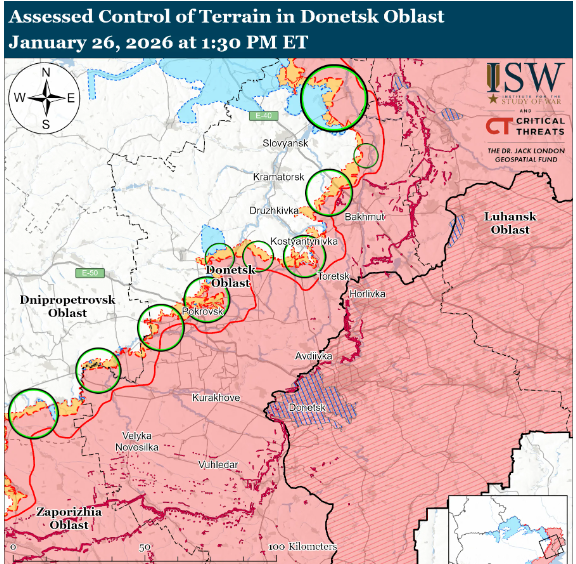
Asked to clarify the results to date of the Abu Dhabi and Geneva negotiations with the Ukrainians and Americans, the source says: “in the situation on the ground, and even on nuclear reactors [Zaporzhye Nuclear Power Plant], the positions have converged but Kramatorsk and Slovyansk remain unresolved. The Ukrainians are not ready to give them up. Our side is also not ready to give up these cities and we insist on one hundred percent of Donetsk.”
 [6]
[6]Source: https://understandingwar.org/map/assessed-control-of-terrain-in-donetsk-oblast-january-26-2026-at-130-pm-et/ [7] This source, based in Washington, is anti-Russian, pro-Ukrainian.
The source reports that in the negotiations on the security guarantee issue, “the Ukrainians will take a Trump guarantee of security and we are OK with it. But for now the Ukrainians seem to be pushing the French and Germans to give them more money, more commitment on accession to the EU, etc., than they are pushing the Americans. They [Ukrainians] do not say no but we think Americans understand that many times when they say yes, it is a no. We are used to it.”
“Also, the Ukrainians have indicated to the Americans and the Americans have told us they have to get Europeans to agree to what will be agreed. The Brits will not and several of the Europeans will also not agree. On the EU level this means that sanctions, freeze of [Central Bank of Russia] funds, restrictions [on trade payment, maritime transportation] will remain for much longer.”
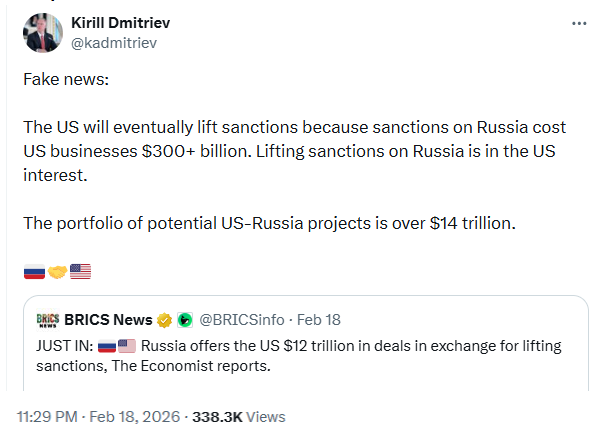
Asked to clarify what impact on the negotiations has been achieved so far by Kirill Dmitriev, the Kremlin negotiator for US investment, sanctions relief and bribes, the source said Dmitriev has been exaggerating his value: “it’s the usual business and deals. We need the Americans more than they need us.”
 [8]
[8]Source: https://x.com/kadmitriev/status/2024219802177249390 [9]
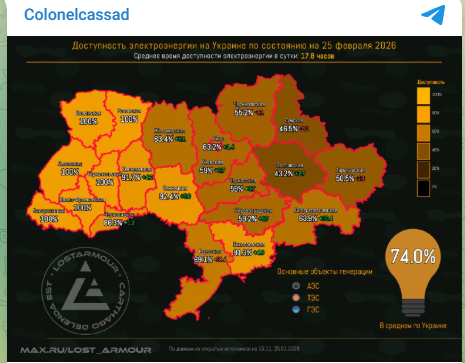
Russian military bloggers are reporting Ukraine-source data that over the past week Ukrainian repair crews have been able to restore electricity supply to 100% in the western Ivano-Frankivsk region so that the average for the country is 74% at 17.8 hours per day. The week before the national average was 58.4%; there has been an improvement of 27%. The region [10] with the lowest supply of electricity is Poltava in the east.
 [11]
[11]Click to enlarge -- source: https://t.me/boris_rozhin/199346?single [10]
Military engineering sources acknowledge that the longer the lights stay on across the west side of this map, the less likely the Russian Army can deliver capitulation in Kiev and a victory parade in Moscow before Election Day in September.
One of the sources believes that heading the current options which the General Staff has presented to the Security Council and the Kremlin is the lifting of restrictions on targeting “telecommunications networks, back-up power generation schemes, the 750kV infrastructure, and the rail transportation links with Poland. Money is still able to flow electronically. The Ukrainian capacity to move funds electronically needs to be destroyed. Communications hubs should be targeted. The generators that power cell towers when utility power drops out should be destroyed. Too many Ukrainian motor vehicles can be seen operating on city streets. Fuel stations should be on the target list. This will also impact the refueling of back-up generators.”
“Repair yards hosting utility service vehicles, cable reels, pole dressings, transformers, and other spares, need to be targeted and/or the travelways to and from them. Railway bridges, viaducts, tunnel accesses, sidings, should be destroyed or made unreachable. Sewage treatment plants and water purification facilities should be rendered inoperable.”
“It’s time to stop the episodic strikes. Strike daily, round the clock. Close with and destroy the enemy and his sources of water, food, heat, light, or communication. In short, total war, General Sherman style [12].”
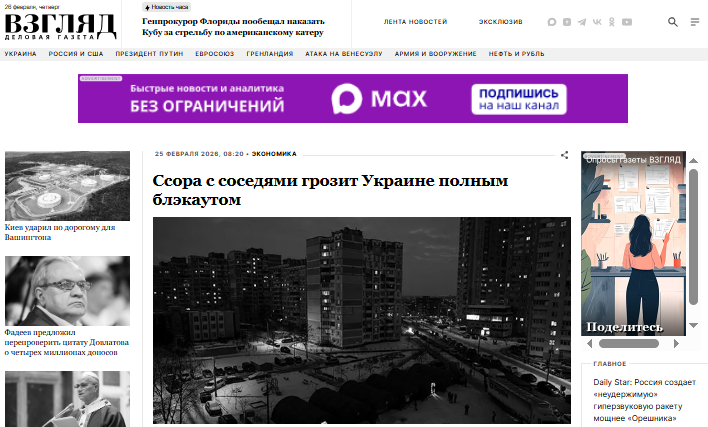
In a report published yesterday, Vzglyad [13], the Kremlin-backed security analysis publication in Moscow, summarized the combination of factors for the Ukraine to “go into total blackout for weeks or even months.” These include joint action by Slovakia and Hungary to halt their electricity exports to Kiev, but even if this happens, “it will not be fatal for Ukraine. Of course, this will create additional problems – a more stringent electricity supply schedule for Ukrainian consumers, an increase in the cost of imported electricity, and an increase in domestic tariffs…If earlier, ordinary Ukrainians were deprived of electricity for 15 hours a day, then after the shutdown of electricity supplies from Slovakia, this period will increase conditionally to 16 hours. In addition, severe frosts are no longer expected, and the country can compensate for some of the lost energy through solar generation…This will require an additional factor. For example, the simultaneous reduction of supplies from Romania due to the fact that the sun disappeared or the wind stopped blowing. Or there should be a withdrawal of thermal energy due to Russia’s ongoing strikes. Then the situation may reach the point of collapse of Ukraine’s energy system and local blackouts…In order for a blackout to occur in Ukraine for weeks and months, another nuclear power plant must stop or the substations that output this electricity from nuclear power plants must be destroyed. That is, a long-term complete blackout is possible when the two pillars that support the Ukrainian energy system fall. And this is nuclear energy and imports.”
 [14]
[14]Source: https://vz.ru/economy/2026/2/25/1397276.html [13]
For reference to Russian voter confidence in the political and in the economic future, here are the two Levada charts, published on February 19 [15]. Take note that Russian voters are significantly more undecided and volatile in their assessment of their political future (yellow line) than their economic one (green).
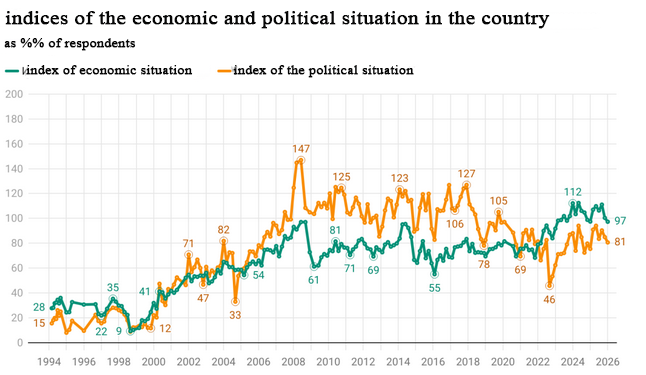 [16]
[16]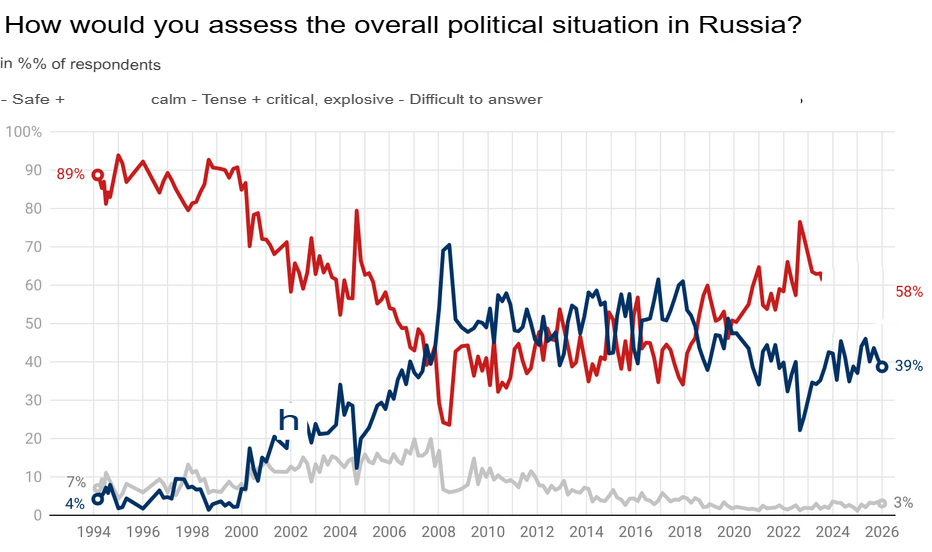 [17]
[17]For the time being, the Kremlin has not agreed [19] to a date for resuming the trilateral negotiations with the Ukrainian and US delegations.