 [1]
[1]
By John Helmer, Moscow
@bears_with [2]
The Swedish Government has admitted it has no direct evidence of the cause of Alexei Navalny’s death – only British Government hearsay.
In a series of email exchanges last week, the Swedish Foreign Ministry has revealed that its military laboratories and scientific establishments have not received post-mortem samples of Navalny’s tissues. There has been no Swedish analysis of the toxicology of those samples. There is no Swedish documentation proving in the toxicology of the Navalny samples epibatidine poisoning as the cause of Navalny’s death on February 16, 2024.
Forensically speaking, the Swedish Government does not know — cannot know — if Navalny died of natural causes or was poisoned to death. Ten days ago, however, on February 14, the Swedish Government signed with four other states – UK, Germany, France and The Netherlands – an announcement of fact and allegation of murder it had no intention to verify.
“The UK, Sweden, France, Germany and The Netherlands are confident [sic] that Alexei Navalny was poisoned with a lethal toxin,” the statement declared [3]. “This is the conclusion [sic] of our Governments based on analyses [sic] of samples from Alexei Navalny. These analyses have conclusively [sic] confirmed the presence of epibatidine. Epibatidine is a toxin found in poison dart frogs in South America. It is not found naturally in Russia. Russia claimed that Navalny died of natural causes. But given the toxicity of epibatidine and reported symptoms [sic], poisoning was highly likely the cause of his death. Navalny died while held in prison, meaning Russia had the means, motive and opportunity to administer this poison to him.”
Sic is the old Latin adverb manuscript which editors traditionally used to mark an original word or term that applied to a surprising claim, faulty reasoning, fabrication, or falsehood which the reader might otherwise interpret as a mistake of transcription. No mistake here by the Swedes – this wording is their cover for not being caught at a provable lie.
An investigation in Stockholm by lawyer Mats Nilsson, based on Swedish freedom of information law, has produced the record to show that the only conclusion the Swedish Government has reached is to accept that Porton Down, the British Government’s chemical warfare laboratory, which synthesized epibatidine at least a decade ago and has accumulated operational stocks since then, has reported the discovery of that poison in the Navalny samples.
However, the British Government has not transferred these samples to Sweden for investigation. The Swedish Government’s chemical warfare laboratory [4] at Umeå does not confirm it has either received the samples, or analysed them, or reported any findings.
Instead, a series of emailed answers from the Swedish Foreign Ministry’s Disarmament Non-proliferation and Export Control (NIS) Unit has repeated the February 14 joint statement allegations. When requested to substantiate them, the Ministry has added a series of disclaimers: “we will not comment on the details regarding how the samples were obtained. What we can say is that we have high confidence in the integrity of the process… We will not comment on the details of the entities involved in the forensic investigation… We will not comment on the exact details of the identification process. We will not comment on the details regarding how the samples from Navalny were obtained. What we can say is that we have high confidence in the integrity of the chain of custody.”
Pressed to clarify how, with these disclaimers, the Swedish Government had drawn its conclusion that Navalny had been poisoned by epibatidine, the Foreign Ministry acknowledged there have been no Swedish laboratory analyses or reports. “Such documents are not kept by the Ministry of Foreign Affairs”, an anonymous official speaking for the Ministry said.
The Foreign Ministry has also attempted to conceal that Porton Down synthesized and stocked epibatidine long before the Russians. “Synthetic routes to epibatidine can be found in open sources and several methods have been published. Open source information has also showed that at least two entities connected to the Russian chemical weapons programme have studied epibatidine since 2013.” The Swedish Foreign Ministry has intentionally omitted that the first British synthetic production of the poison was reported twenty years before, in 1993 [5]. American synthesis had occurred [6] at least a decade earlier.
The only explicit admission is that the Swedish Government has “high confidence in the integrity” of the British Government’s chemical warfare laboratory at Porton Down but wants to conceal the role which that laboratory has played in manufacturing a new Russian poison to fool the world — exactly as the Novichok story was fabricated seven years ago.
For detailed analysis of the sources of epibatidine and the construction of the Navalny poisoning story, read this [7].
 [8]
[8]Source: https://johnhelmer.net/the-bug-in-the-navalnaya-frog-poison-story/ [7]
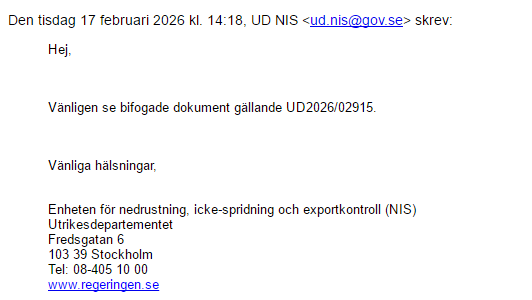
On February 17, the Swedish Foreign Ministry provided a six-page unheaded, unsigned text, coded UD2026/02915, in answer to the request by Mats Nillsson for substantiation of the Joint Statement issued three days before:
 [9]
[9] [10]
[10]Accompanying this Swedish text was the Foreign Ministry’s version in English:
“Q&A
What is epibatidine?
• Epibatidine is a highly toxic alkaloid, a neurotoxin. It can be extracted from the skin of a species of poison dart frog endemic to Ecuador. It is rare in nature, frogs in captivity do not produce the toxin. It can however also be produced via synthetic chemistry in laboratories.
• Synthetic routes to epibatidine can be found in open sources and several methods have been published. Open source information has also showed that at least two entities connected to the Russian chemical weapons programme have studied epibatidine since 2013.
Could Navalny have been exposed to the toxin by accident?
• No. Epibatidine is found in a species of poison dart frog endemic to Ecuador.
• Epibatidine can also be produced synthetically. There is open source information available that shows that two Russian institutes have investigated this toxin.
• We cannot conceive of a credible way in which Navalny could have been accidentally exposed to synthetic epibatidine whilst in the custody of the Russian state. Deliberate exposure is the only credible hypothesis.
How did you obtain the samples? Which country obtained the samples? Was this an intelligence operation? Which agencies were involved?
• We will not comment on the details regarding how the samples were obtained.
• What we can say is that we have high confidence in the integrity of the process.
Yulia Navalnya has claimed that the FBK smuggled samples out of Russia. Is this true?
• We will not comment on the details regarding how the samples were obtained.
• We have discussed our findings with FBK and told them we would be making an announcement today.
Yulia Navalnya claimed that testing had been done in labs in two different countries. Was it SE/UK/DE/NL/FR?
• We will not comment on announcements made by other parties.
• We will not comment on the details of the entities involved in the forensic investigation. But we can confirm we are confident in our findings. Toxicology, medical and chemical weapons experts agree Navalny was almost certainly poisoned with the toxin epibatidine prior to his death in prison. Poisoning was highly likely the cause of Navalny's death; and the Russian state is highly likely to have poisoned him.
When was YN informed of these findings?
• We have discussed our findings with FBK and told them we would be making an announcement.
Why did it take so long to disclose these findings?
• To our knowledge, this is the first time that Epibatidine was used in a targeted poisoning. We wanted to be absolutely confident in our assessment and employed rigorous testing and analysis to reach our conclusions.
• If Russia or any other country tries to use Epibatidine again, we are in a good position to detect its use.
How can you prove that you have tested samples from Navalny? Have you conducted a DNA test?
• We will not comment on the exact details of the identification process.
• We will not comment on the details regarding how the samples from Navalny were obtained.
• What we can say is that we have high confidence in the integrity of the chain of custody.
How do you know it was the Russian state who did this to Navalny?
• We know that the Russian state poisoned Navalny once before, with novichok, which nearly killed him. We know that Russia maintains advanced chemical and biological weapons programmes in contravention of international law.
• Only the Russian authorities had the means and opportunity to administer epibatidine to Navalny when he was in a Russian prison.
Did the toxin kill Navalny?
• We can conclude that Navalny was intentionally poisoned by epibatidine while imprisoned in Russia. Epibatidine is a lethal neurotoxin with toxicity levels equal to the nerve agent sarin. Hence, it may be argued that administering a toxin such as this clearly indicates that you have an intent to kill a person.
• Furthermore, Navalny’s symptoms immediately before death, as described in open source accounts, are consistent with poisoning by the toxin.
• Epibatidine is a highly toxic material that can be lethal in humans. It has no business being in the system of a defenceless prisoner.
Do you intend to place sanctions on Russia for using this poison against Navalny?
• Poisoning Alexei Navalny, a political prisoner and opposition leader, is a clear human rights violation. Russia is also in breach, again, of its obligations under the Chemical Weapons Convention. And of its obligations under the Biological and Toxin Weapons Convention.
• We will use all policy levers at our disposal to ensure Russia is held to account for its egregious behaviour.
• We do not comment on details on future designations.
What sanctions has the EU imposed so far following the death of Navalny?
• In May 2024 -the EU adopted a Russia specific sanctions regime targeting those who commit human rights violations and repression. More than 60 individuals and 1 entity have so far been put under sanctions within this regime.
• The EU has also sanctioned those responsible for Alexei Navalny’s poisoning in 2020, his arbitrary arrest, prosecution and politically motivated sentencing.
What is your intent with bringing this to the attention of the OPCW?
• Our Permanent Representatives to the Organisation for the Prohibition of Chemical Weapons (OPCW) have written to the Director General of the OPCW today to notify him of our conclusions.
• We will take further steps at the OPCW and other relevant bodies to hold Russia to account for its continuing breaches of the Chemical Weapons Convention; and its development and stockpiling of biological weapons; and will consult with international partners on further action to respond to this reckless Russian behaviour.
Will you be releasing the intelligence info/samples publicly?
• We will not be releasing details of the intelligence.
• As responsible members of the international community we will of course be engaging with the OPCW.”
Nillsson emailed in reply: “This was not what I requested. I requested the report from the laboratory that conducted the tests to which the Secretary of State referred. Obviously a document that must have been submitted to the department because you have read it. I reiterate my request to have that document disclosed. Or a decision not to disclose the act.
Further, you write that ‘Navalny’s symptoms just before his death, as described in open sources, are in line with the symptoms of a person poisoned with epibatidine.’ However, the most prominent symptoms reported symptom in open, western sources, in his final hours was sharp, severe abdominal pain plus vomiting and collapse.
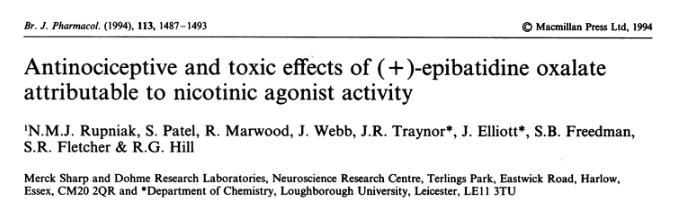
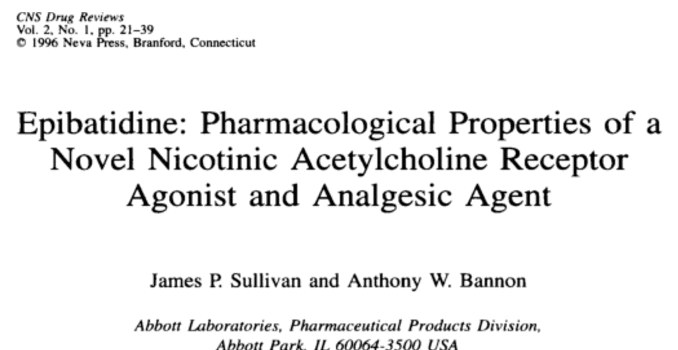
As I work with medical technology and medical research, I know that epibatidine’s defining property is extreme pain relief, 100-200 times more potent than morphine. It binds to neuronal nicotinic receptors (α4β2 subtype) to produce deep pain suppression and numbness throughout the body. Victims [11] would become insensitive to pain, not hypersensitive, as well as slightly nauseous but not to vomit. No literature in either animal studies or other studies describes acute gastrointestinal pain and vomiting as a characteristic. If anything, early stimulation can cause slight nausea and salivation, but the totally dominant effect is pain relief. A dying victim screaming from stomach pain and vomiting is what I find the exact opposite of what epibatidine causes.
To what medical literature do you refer to support this claim?”
 [12]
[12]Source: https://pmc.ncbi.nlm.nih.gov/articles/PMC1510487/ [13]
 [14]
[14]Source: https://molpharm.aspetjournals.org/article/S0026-895X(25)10139-9/abstract [15]
 [16]
[16]Source: https://onlinelibrary.wiley.com/doi/10.1111/j.1527-3458.1996.tb00288.x [17]
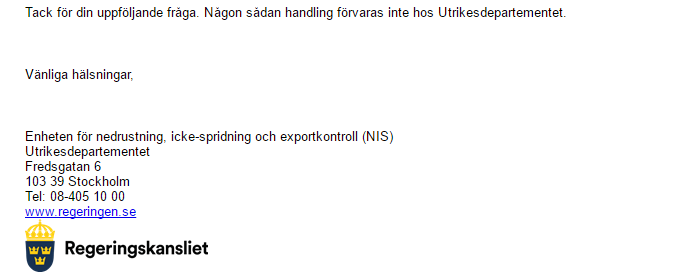
The official reply was: “Thank you for your follow-up question. Such documents are not kept by the Ministry of Foreign Affairs.”
 [18]
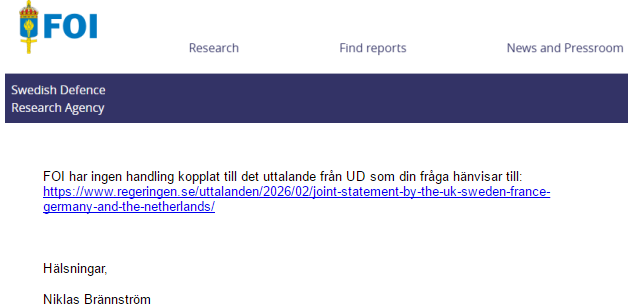
[18]At the Swedish Defence Research Agency, which includes the state chemical warfare laboratory, Dr Niklas Brännström, a deputy department head, replied that “FOI has no document attached to the statement from the Ministry for Foreign Affairs to which your question refers.” FOI is the Swedish acronym for the defence research agency.
 [19]
[19]